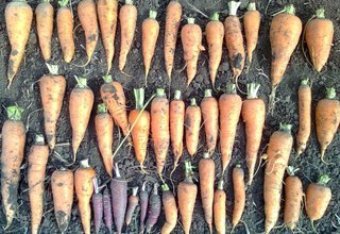
I consider it my duty as a farmer to maintain healthy and thriving landrace populations for the crops that are most desired by the people whom I feed. My protocol for doing so is:
- Add small amounts of new genetics to the gene pool from time to time.
- Include small amounts of older seed in each year’s planting.
- Be liberal during selection of seed parents.
- Swap seeds with the neighbors to enhance local adaptability.
- Grow a sufficiently large population to maintain genetic diversity
I add a small amount of new varieties to my landrace vegetables from time to time. I call them foreign varieties because they are not from this area. There might be something in the new material that is just what my garden needs. If they do well, I may save seeds from them. If they do poorly they may contribute pollen. I figure that I can plant up to about 10 percent non-locally adapted seed each year and not worry about it dramatically affecting my landraces.
Each year I include seeds from several previous years in my plantings. I do this to avoid having the genetic balance of the population thrown seriously out of kilter by a single odd growing season. That helps me to retain plants that do well in hotter or cooler growing seasons, and in wetter or drier seasons. This seed contributes about 10 to 30 percent of my crop.
I am liberal during selection, for example, by saving carrot roots of different sizes, shapes, colors, textures,
flavors and maturity dates. I save lots of seed from great-growing plants, and less seed from plants that struggle in my garden. I save more seed from plants that produce great-tasting food than from plants that are less flavorful, but as long as the food is edible it’s a candidate for seed saving. This allows the population to become localized to my garden while preserving lots of genetic diversity so that the seed may adapt to the changing climate, bugs, soil and practices of the farmer.
I frequently swap seeds with the neighbors. This lets me take advantage of the localization that they have done to our valley. I am more familiar with the practices of some neighbors than others. Some neighbors have been long-term collaborators and I trust their seed completely and plant it in large quantity. Other neighbors are almost unknown to me so I treat their seed as if it was foreign seed and plant it in limited quantities.
These practices are designed to maintain a large genetic base for my landraces and avoid inbreeding depression. The effective population of my landraces includes the plants grown in my garden for the past two to five years and in the gardens of my close collaborators during that same time, and in the gardens of those who provided foreign seed. This protocol allows me to preserve and enhance my existing landraces while allowing them to continuously adapt to local conditions. This is part of the reason why I believe that landrace gardening is a path towards food security through common sense and traditional methods.
Next week I will write about fertilization of landraces.
Joseph Lofthouse grows vegetables in a cold mountain valley where he practices the art of landrace gardening in order to feed his community more effectively.