

In earlier issues of MOTHER, I described in detail a few of the many
advantages hydroponic greenhouse gardening has over more
conventional methods of raising fruits and vegetables . . .
and in response, a reader wrote to MOTHER expressing the
following concern:
James DeKorne’s information on hydroponics is quite
interesting, but one aspect of the method sticks in my
craw: The process seems so dead. It’d be fascinating to
discover if plants grown hydroponically differ in manifest
energy –on some level apart from “nutrients” alone–as
compared to those grown in soil . . . .
I’ve found that this is a common reaction to hydroponic
gardening, even though anyone who has had any experience
with the concept will tell you immediately that there’s
nothing at all “dead” about it. On the contrary: The plants
I grow in my hydroponic greenhouse seem more alive
than their peers out in the garden mostly because of their
more rapid growth and prolific production of fruit.
Laboratory tests have shown that there are no nutritional
differences between normal vegetables grown hydroponically
and those grown in gardens (organic or otherwise). Neither
are there any differences in flavor: Last summer my wife
took two tomatoes –one from our garden and one from a
hydroponic tank in the greenhouse –and arranged them in
slices on two separate plates. Only she knew which was
which. After every member of the family tasted pieces from
each plate, it turned out that no one could detect any
differences in flavor . . . none of us could tell which
tomato was “organic” and which “hydroponic”.
Even so, it is true that the hydroponically grown tomatoes
you buy in the supermarket often taste bland and pulpy. One
explanation for this –aside from the fact that supermarket
produce is of dubious freshness –is that tomatoes produced
in commercial hydroponic greenhouses are special hybrids
which have been bred for color, uniformity of size, and
ability to ripen all at the same time. And these, of
course, are qualities which have nothing to do with flavor,
but everything to do with the convenience and profit of the
agribusinessman who raises the fruit.
No special hybrids for me, though . . . the tomatoes we
raise in our tanks are the same varieties we grow in the
garden (Burpee Big Boy being our particular favorite).
Nevertheless, not to evade the issue, the reader’s letter
that I’ve quoted calls into question something (namely,
“manifest energy”) for which I have no ready answer . . .
if indeed there is one. When we begin to talk about energy
levels beyond those that we have instruments to detect, we
begin to run up against a semantic impasse. Many organic
gardeners, I’ve noticed, tend to be very mystical about
their subject (and for all I know, they may be onto
something). I can only say that nothing in my experience
confirms, or denies, their esoteric beliefs. If there are
differences in the “vibes” given off by hydroponic tomatoes
versus those of soil-grown fruit, I cannot detect
them.
In previous articles I’ve given what I consider to be sound
ecological reasons for why I am an organic gardener. (The
fundamental consideration being that the natural approach
offers the only way I know to maintain continuous sod
fertility without disastrous side effects.) In my
greenhouse gravel tanks, however, I have no reservations
about using hydroponic chemicals . . . for one thing,
because I’ve proven to my own satisfaction that there are
no nutritional differences whatsoever in vegetables grown
by either sod or soilless methods.
The only criticism of hydroponic gardening that I accept as
valid is the complaint that hydroponics relies (for the
most part) on the use of chemicals which are derived from
fossil fuels, or which use vast amounts of these fuels in
their manufacture. For that reason, I’ve recently been
working with various organic hydroponic solutions,
and have been both surprised and delighted with the results
of my very first efforts.
The hydroponic method of growing produce was originally
developed as a scientific tool to determine the mineral
requirements of plants. Consequently, in its commercial
applications, hydroponics has always relied upon pure
chemical salts for nutrient solutions. Very little
research, however, seems to have been done with organically
derived plant food formulas.
Perhaps the most notable work that has been undertaken
along these lines was carried out in India. James Sholto
Douglas, in his book Hydroponics: The Bengal
System describes something known as
the “Sharder process” which was developed at the
Hydroponics and Fish Investigation Unit in Bengal:
Normal beds of aggregate are employed for raising plants,
but to supply essential nourishment to crops, manure shells
or pots are placed at appropriate intervals along the
trough. These consist of earthenware vessels, lined with
some kind of sieve or screen, and pierced by a number of
tiny holes at the bottoms. The pots are filled with a
nutrient sludge or semi-liquid manure, a typical formula
for which would be:
Fresh or dried dung, one handful.
Matured oil cakes, four teaspoonfuls.
Alternatively, such materials as hoof-and-bone meal, shoddy
(wool waste), and similar plant foodstuffs can be utilized,
the exact quantities depending upon their analyses. Dried
wood ashes are also fairly good for the purpose.
When the manure shells are placed in the hydroponic
troughs, and sunk down a few inches into the aggregate,
with only the upper portions remaining exposed, they slowly
release their nutrient contents into the growing medium.
These then become available to the plant’s roots as food.
Covers should be placed over the vessels, and from time to
time they may be refilled with nutrient sludge or topped
up. Every three months the beds should be flushed through
with plain water to cleanse them . . . .
Another experiment with an organic nutrient solution is
briefly described on page 135 of the Portola Institute’s
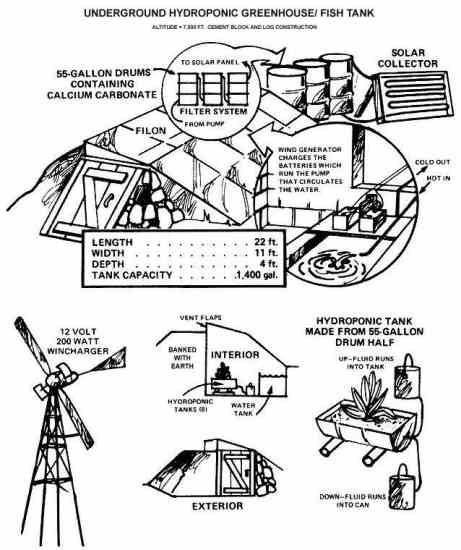
Energy Primer. Here, the water from aquaculture tanks is used as
a, growth medium:
Finally, associated with each main [fish tank is a
hydroponic growing compartment where the culture water from
the main tanks (a “soup ” of excellent fertilizer) is
flushed through gravel beds planted with vegetable crops.
My initial feeling when I read this was that the fish tank
effluent probably would not supply an adequate variety of
nutrients for the plants’ optimum growth. Consequently, to
test this assumption I started growing some pinto beans
hydroponically, using only the water from my own
aquaculture tank as a culture medium.
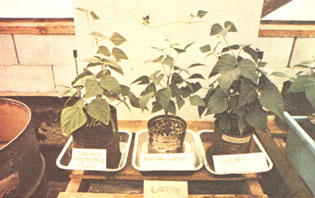
At first, the bean plants put on amazing growth, rising
several inches above some “control” seedlings (which were
growing in a commercial nutrient solution). After a couple
of weeks, though, the “commercial” beans began to catch up
with those receiving only fish tank water . . . and by the
end of the month, the fish tank beans which had become pale
and sickly in appearance had all but stopped growing, while
the other beans were normal in all respects.
These results seem to parallel those obtained by workers at
the U.S. Fish & Wildlife Service’s fish farming
experiment station in Stuttgart, Arkansas. In the May/June
1975 issue of Aquaculture and the Fish Farmer,
investigators Sneed, Allen, and Ellis report on an
experiment in which the effluent from a raceway complex
containing 10,000 pounds of channel catfish was flushed
into hydroponic troughs containing 17 varieties of
vegetables. Their results, like mine, were disappointing:
The yield of edible tissue varied widely among different
vegetable varieties. Although [all] varieties produced some
edible tissue, eleven were of very poor quality and
quantity. Three varieties produced average yields and three
produced yields considered to be above average for home
gardens. The best yields were produced by green peas and
cucumbers.
It would seem, then, that people who wish to combine
aquaculture with hydroponics should consider using fish
tank water as a “starter” –an excellent basic solution in
which to germinate seeds or with which to mix other organic
materials –but not as a complete plant food by itself.
Lawrence D. Weiss, in the May 14, 1973 issue of The
Tribal Messenger, gives us a clue as to how to mix a
more complete organic hydroponic solution:
Homemade mixtures of such things as well-rotted compost and
animal manure are cheap and ecological. The home farmer can
experiment with different such nutrients and strengths in
the water base. In this way he or she will find the
combination most suitable for his or her plants and
installation.
Using both fish tank water and well water, I prepared
several different strengths, mixes, and types of organic
solutions . in effect, making what is familiar to most
organic gardeners as “manure teas”. I used these various
liquids to grow tomatoes, radishes, lettuce, runner beans,
and pinto beans. (Most of the initial experiments were with
beans.) At the same time, identical plants received a
commercial hydroponic solution (Hyponex, 7-6-19).
At first, I was very “scientific” about everything: For
example, I would accurately weigh out 20 grams of rabbit
manure per liter of water. I soon realized, however, that
such careful measurements weren’t really necessary . . .
and that moreover, most Americans would not bother to
duplicate precise efforts of that nature anyway. (It’s hard
enough to persuade people to try a new gardening technique
without throwing the metric system at them!) So I ended up
with the following standard formula:
One small-size Quaker Oats box full of a mixture containing
equal parts rabbit manure, chicken manure, earthworm
castings (manure), and wood ashes.
One 20-gallon can of well water or fish tank effluent
filled to within an inch of the top.
(Note: I can’t honestly say I noticed any difference
between the results I obtained with well water and those I
obtained with fish tank water, although it stands to reason
that the latter fluid would contain more nutrients. I
purposely avoided rainwater, however, since it’s likely to
be deficient in the micro-nutrients manganese, boron,
etc., which are almost always present in ground water.)
The organic ingredients were vigorously stirred into the 20
gallons of liquid and then allowed to steep for several
days (by which time all the solid particles would settle to
the bottom). The resulting liquid, which was the color of a
weak cup of tea, was next poured carefully into cans,
while fresh water was added to the original container to
make a new batch.
We found that we could get several cans of hydroponic fluid
from each batch of organic material. From time to time I
would add fresh measures of the organic mix to the liquid .
. . relying mostly, I must admit, on when it felt
right to do so (that is, when the “vibes” were right!).
At first, I very religiously tested the pH of the solutions
(pH being a measure of how acid or alkaline anything is).
All of the hydroponics books really stress the importance
of this, since plants will only thrive within certain
narrow pH ranges. Experience has shown us, however, that
the pH of our solutions both organic and commercial, is
nearly always right about where it should be: between 6.0
and 7.0. So we hardly ever even test the pH of our liquid
plant foods anymore. You probably will want to
analyze yours (at least in the beginning) if you try
hydroponics, however, so a short discussion of the subject
is, perhaps, in order.
As anyone who’s ever had an aquarium knows, a pH test can
be performed with a special “indicator” called Nitrazine
paper , available from most any drugstore. When
you dip a strip of this paper in the fluid being tested,
the strip changes color (the final color depending on the
exact pH: yellow for strongly acid, blue for strongly
alkaline, or several intermediate hues for readings in
between). To find the approximate pH of whatever you’re
testing, you then simply match the color of the paper
against a color chart on the side of the container it came
in. (If you’re unfamiliar with this very simple procedure,
don’t be alarmed . . . it isn’t any big deal.)
Now, if the solution you’ve tested turns out to be too
alkaline, an acid must be added to “balance out” the pH.
Likewise, an alkali must be added if the liquid is too
acid. Commercial greenhouses, of course, use pure
hydrochloric acid or sodium hydroxide to adjust the pH of
their nutrient solutions.
Since both of the above chemicals are extremely dangerous,
as well as expensive, we’ve relied –successfully, I might
add–on plain old white vinegar (acid) and baking soda
(alkali) to alter the pH of our solutions. (All this
chemical talk may sound horribly complex, but I assure you
there’s nothing to worry about. As I mentioned before, we
very seldom have to tinker with the pH of our solutions.)
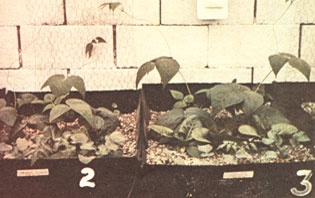
The results of my experiments indicate that almost any
organically derived solution will support plant growth. For
example, bean plants raised in a solution containing
chicken manure alone grew just as well as the same plants
raised in the complete complement of manures.
I must also be honest and state that two “control”
plants–raised in pure worm castings, with no water at
all, grew just as well as any of the hydroponic plants,
including those which received the commercial solution.
(This may provide an alternative for those who object to
the hydroponic concept.)
In general, vegetables raised in the commercial solution
grew slightly faster than the organic solution plants, but
not significantly so. Actually, the most striking
difference between the two was that the organic solution
plants did not wilt during the hottest part of the
day, while plants raised with the commercial solution
almost always wilted! (We observed this phenomenon
on a daily basis, so it isn’t a figment of our
imaginations.) Bear in mind that all the plants were being
raised in a greenhouse, and that during the time of the
experiment summer of 1975, the inside temperatures often
went over 100° F, conditions which would make any
self-respecting plant wilt! Within five minutes of being
fed the organic nutrient solution, however, all wilt
symptoms disappeared (the same as when you water wilting
plants in the garden or in pots).
It isn’t possible, of course, to explore exhaustively the
subject of organic hydroponic techniques in these pages. A
complete treatment of this matter will appear in our
forthcoming ecosystem book. What I’ve outlined here,
though, should be enough to get you started. There are
many, many experiments yet to be made and different
nutrient solutions yet to be tried. We feel we’ve only just
begun.
Lawrence Weiss, in The Tribal Messenger, pretty
well sums up the way it is with this fascinating field:
“Remember that there is no ‘correct way’ to do anything in
hydroponic farming. Experiments and experience will always
be your best guides. One reason hydroponic farming is so
much fun is [that] everyone does it differently.
Fish Tank Water and Plants
The marriage of aquaculture with hydroponics is a “natural”
. . . or so it would seem. As James DeKorne points out,
however, plants raised hydroponically in fish tank effluent
seldom grow very well.
Why? Author DeKorne hints at one possible answer when he
suggests in his article that aquaculture runoff be used as
a starter fluid “not as a complete plant food by
itself”. The implication, of course, being that fish tank
water alone won’t support plant growth because it doesn’t
contain all the nutrients that plants need.
Maybe that’s true. Maybe not. In any case, we shouldn’t
overlook another (equally plausible) explanation: namely,
that vegetables do not thrive in aquaculture effluent
because the liquid contains growth inhibitors. It
is well known, for instance, that fish closely confined in
tanks frequently will not grow beyond a certain size-no
matter how much they’re fed, because of growth inhibitors
which they themselves secrete. Perhaps some of these
inhibitors can also affect the growth and development of
plants. The idea, we feel, should at least be researched.






