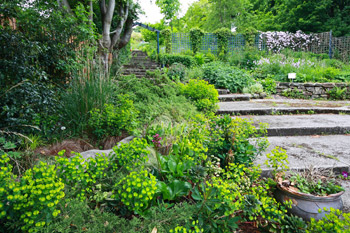
We have a saying around our house: When the pest control truck is at the neighbor’s house, all the spiders come over to our place because they know it is safe. Biodiversity is a top priority in my Northern California rural/suburban garden, and I work hard to have many plants, animals, insects, and, yes, arachnids represented.
I have seen a resident toad or two crawling around at night. I’ve spotted gopher snakes (of course we have gophers too), quail, hawks, owls, hummingbirds, bees, bugs, spiders, opossum, cats, feral turkeys, and even a beautiful pheasant stopped by. This does not even count my flock of thirty chickens, or the occasional human visitor we get. But it took a while to get to all this diversity.
The garden wasn’t always so welcoming to a variety of creatures. When we moved in, the backyard wasalmost entirely covered in English ivy, and the front yard was a perfect lawn.
In the backyard I removed small sections of ivy and started adding other plants. I planted a few apple tree guilds using Toby Hemmenway’s book Gaia’s Garden: A Guide to Home-Scale Permaculture as my blueprint, with heirloom apple trees, dynamic mineral accumulators (like daikon radish), and herbs (both culinary and medicinal). I put in some, rhubarb, bell beans, corn, okra, lettuce, and plenty of squash for good measure. I felt like I had to just get one of everything growing.
Each fall, I’d expand my shrub and fruit tree plantings after laboriously removing the ivy by hand and shovel (I use no gas-powered tools in my garden). I put in currants, pomegranates, figs, apricots, olives, and peach trees. I planted what I considered unusual shrubs, like edible honeysuckle and pineapple guavas, just to have something different around the neighborhood.
In the front yard, patches of lawn became plantings of rosemary, lavender, salvias, elderberries, pineapple guavas, olive trees, grapes, almonds, citrus, and peaches.
My criteria were that the plant must serve some purpose, be it edible or not, to find a place in my garden. Flowers attract pollinators. That makes them useful in creating biodiversity in my garden. The bee or hummingbird might come for the showy flowers, but they’ll stay and visit all the other flowers, which will turn into food for friends, my family, and me.
After three years of removing ivy in the backyard, and lawn in the front yard, and planting many other things, a sort of magical thing happened: A hummingbird built a nest right outside our window. The string lights on our covered patio were apparently the perfect spot for this hummingbird’s nest. We watched her start with spider webs and mulberry catkins, and go on to adding the beautiful lichen camouflage. The irony is not lost on me that she chose electric light strands (we did unplug them during her stay).

She would leave the nest and feed at our blooming abutilon, salvia, and lavender flowers. She had five fledglings, from three different hatches, that year, before moving on. Since then, three other hummingbird nests have been constructed on our patio string lights, and each time it is a beautiful and amazing process to watch.
It took a few years for the toad to show up. I was thrilled to learn that toads eat slugs. And it took another few years for the gopher snake to show itself. Each time a wild creature takes up residence in my garden, or just passes through, I feel proud of all the hard work I’ve done to make a place for them. I also appreciate the great web of nature expanding in my backyard. It is a web that I’ll work to encourage, by removing more ivy and adding more plant diversity. Who knows who could show up next?