

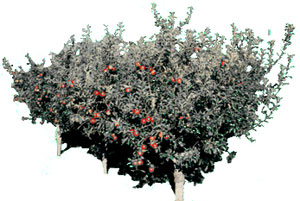
The Seasons of the Garden column shares seasonal gardening information and tips with MOTHER EARTH NEWS readers on choosing between popular dwarf apple rootstocks shares some of their advantages and disadvantages.
Seasonal Gardening: A Short Guide to Dwarfing Rootstocks
Midsummer’s merciless sun scorches down from the cloudless
skies, and parched plants slowly lower their leaves as the
earth bakes beneath them. When dusk descends and the first
tentative fireflies flicker against the darkening horizon,
water the soil to slake its thirst . . . and resolve that
next year you’ll make (and use!) much more moisture-holding
mulch.
The rootstocks commonly used to create dwarf apple trees
were developed, over a number of years, in England . . .
first at the East Malling Research Station and later at the
Merton Station (which explains why the prefixes M–or
EM –and MM are used to designate the different
varieties). These rootstocks can all reduce the tree size
(but not the fruit size!) of a variety that’s grafted or
budded onto them . . . and they do so by simply limiting
the amount of food that the tree gets. This same factor
induces early bearing (often three or four years sooner
than that of full-sized trees) by reducing the amount of
vegetative growth. It seems that while there’s leaf and
limb growing to be done, the apple tree postpones setting
fruit.
Depending on what rootstock you select and what apple
variety you’re budding, the eventual height of the tree can
range from 6 to 25 feet. You should consider several
factors in choosing one of the five rootstocks generally
available: [1] the amount of land you can devote to apples
and the number of trees you hope to have, [2] the nature
and fertility of your soil, [3] the types of insects and
diseases present, and [4] the vigor of the apple variety
(or varieties) you want to grow. Here’s a
listing–arranged in order of dwarfing effect, from
most to least–of a variety of popular rootstocks . .
. and some of their advantages and disadvantages.
M-27 is really sort of a ringer: Although
it’s been under development for several years, it isn’t yet
available commercially. This super-dwarfing rootstock
produces container-sized apple trees that stand a minuscule
4 feet tall. Work is now being done on propagating the
rootstock by tissue culture. When that’s a reality,
supplies should increase rapidly.
M-9 has the greatest dwarfing effect of
any widely available rootstock. Trees grafted or budded
onto it will usually grow to about 30% of their normal
size, which means that the M-9 dwarf trees are between 6
and 10 feet tall at maturity. Apples will usually begin to
bear in two or three years, and yield about 60 pounds of
fruit when they’re fully grown. You can cram these dwarfs
pretty close, too . . . they’re commonly grown on 10- or
12-foot centers. The rootstocks do have some drawbacks,
though. For one thing, they tend to have a weak root system
and to be somewhat brittle, so it’s necessary to stake the
trees to keep them from blowing over and perhaps snapping
where they’re grafted. (Many professionals bud these trees
high–about 12 inches from the rootstock’s original
ground level–so they can be planted deeply for better
anchoring.)
Apples budded to M-9 are susceptible to attack by
nematodes, woolly aphids, and fireblight, so think twice
about choosing this rootstock if any of these nasties are
about. On the other hand, M-9 trees are resistant to collar
rot, which means that they’ll usually do reasonably well in
wet or clayey soil. (Be sure to clear an area at least 2
feet in diameter when you plant one of these little fellers
. . . mulch to keep weeds and grass from stealing all the
food in the soil . . . and be prepared to irrigate M-9
trees during dry spells.)
M-26 is second to M-9 in dwarfing
capacity. Trees on this rootstock usually grow about 40% of
the standard height, producing dwarfs that range from 8 to
12 feet tall. The M-26 root system is stronger than that of
M-9 (though staking is still necessary). The tree is
hardier, too, and growth is more vigorous . . . especially
in soils with poor fertility. M-26 is susceptible to collar
rot, though (so don’t plant it in wet or clayey soil), and
fireblight and woolly aphids are also problems. It’s best
to place buds high, and to set out these dwarfs on a 10 feet by
18 feet grid.
M-7A (the letter “A” indicates that this
is a virus-free sibling of the original M-7) is a
semi-dwarfing rootstock . . . producing sturdy,
winter-hardy trees that are about 50% of standard size.
These productive, early-bearing, 12- to 15-foot beauties
should each produce over 100 pounds of fruit a year at
maturity. Apples on M7A do well in most soils, even in
clay. The rootstock is susceptible to suckering, but that
tendency can be defeated if you bud high and plant deep.
M-7A’s aren’t very drought-resistant and are susceptible to
woolly aphids. They should be planted on a 12 feet by 20 feet grid.
MM-106 produces trees that are about 60%
of normal size (usually 12 to 18 feet tall). This
early-bearing, drought-tolerant rootstock is excellent for
the naturally smaller, slow-growing spur apple varieties.
M-106 trees are productive, root better than M-7A trees,
and do not sucker. They are vulnerable to collar rot,
though . . . so–once again–keep them away from
wet or clayey soils. And if you’re cursed with early autumn
frosts, keep in mind that M-106 trees harden off late and
are thus susceptible to freeze damage. Space these
semidwarfs on a 14 feet by 22 feet grid.
M-111 produces the largest apple trees of
our group of rootstocks: They attain about 70% of standard,
or 15 to 22 feet. The roots anchor well, are very
drought-tolerant, and do not often sucker. M-111 resists
woolly aphids and collar rot, too, and is good in all types
of soil. Spur-type trees do especially well when grafted to
M-111, but–as is the case with all varieties grafted
to it–will fruit more slowly than they would on any
of the rootstocks above. Allow the big dwarfs an 18 feet by 24 feet
spacing.
CHOOSE WISELY
When you’re selecting a rootstock/scion combination,
remember that the strongest varieties should be matched to
the most radically dwarfing rootstocks . . . and that the
better your soil is, the more you need to use a highly
dwarfing root. Among the stronger-growing apples are (in
order of decreasing vigor) Northern Spy, Mutsu, Summer
Rambo, nonspur McIntosh, Empire, Stayman, Red Delicious,
Red York, Greening, Winesap, Beacon, Cortland, and Lodi.
Weak growers (in order of decreasing strength) are Yellow
Delicious, Jonathan, Rome, Macoun, Ida Red, and the spur
varieties.
If you’re planning to bud-graft onto either an apple branch
or an already growing seedling or dwarfing rootstock, you
can do so right away. But if you’re ordering one of the
Malling or Malling-Merton rootstocks now, you might have to
plant the youngsters in a nurse bed in the garden for a
year’s growing. The dwarfers should, you see, be at
least a quarter-inch in diameter at the point of
the graft. If your delivered pieces are a bit too thin,
simply plant the rootstocks in a protected bed, spacing
them about a foot apart. Then, come next July, you’ll have
a supply of vigorous candidates for bud grafting.
THEY’RE ROOTING FOR YOU
Dwarfing and semidwarfing rootstocks are available from
several sources. Mellingers (Dept. TMEN, North Lima, Ohio, catalog free) offers M-7 at
five for $7.15, MM-106 at five for $7.75, and M-26 at five
for $9.75. Lee-Land Nursery (Dept. TMEN, North
Kingsville, Ohio, catalog free) has M-9 and M-26 for
$1.75 each, while M-7A, MM-106, and MM-111 sell for $1.50
each. Lee-Land also has interstem dwarfing rootstocks,
which unite the strong dwarfing qualities of M-9 with the
sturdy root systems of MM-111 or MM-106. These cost $4.00
each. Southmeadow Fruit Gardens (Dept. TMEN, Lakeside, Michigan, price and variety list free, encyclopedic
catalog of fruit varieties $8.00 . . . and worth it as a
permanent reference) offers the following in packages of
ten at $15 per package: M-2, M7, M-9, M-26, MM-104, MM106,
and MM-111. Both Mellingers and Lee-Land can supply you
with grafting equipment, including knives and rubber
budding bands.
EDITOR’S NOTE: Orchardists interested in grafting an
antique apple scion onto a dwarfing rootstock might want to
read the article on page 130 of MOTHER EARTH NEWS NO. 63. And we think
you’ll find the treeplanting center spread in issue 65 to
be a valuable guide. See page 104 to order back
issues.
Have a Bud
The summer months–from mid-July through
August–are the best times to expand your apple
orchard, using a technique known as bud grafting (or
budding). You’ll need a rootstock (see the preceding
guide), or an apple branch of about pencil thickness, on
which to make the bud graft . . . and scions, or budsticks
(that is, young branches of the desired variety, cut from
this year’s growth and kept constantly moist until used).
You’ll also need a razor-sharp blade (an X-acto-brand knife
works well) and a supply of commercially produced rubber
budding bands or budding tape.
This particular grafting technique involves inserting a
vegetative bud cut from the apple variety you want to
propagate into a T-shaped flap that’s been scored in the
rootstock or branch. The cambium layers of the bud and the
rootstock will grow together, and the apple variety can
begin life on a new understructure.
Here’s how to do it: First, select a vigorously growing
branch of the apple type you’d like to produce. (If you
want an unusual variety, don’t despair . . . you can order
any of 79 different scions sold by the Worcester County
Horticultural Society for only $1.25 each. For a list of
those available, send a self-addressed, stamped envelope to
Mrs. Mason, WCHS, Dept. TMEN, Worcester,
Massachusetts.) Cut the branch and remove the leaves
from this budstick, leaving about a quarter-inch of each
leaf stem attached to the stick (they’ll make useful
handles). Next, make a T-shaped cut into the bark (but not
into the wood) of the rootstock or branch you’ll be
grafting onto. If you’re working with rootstock, make the
cut at a point 8 to 12 inches above ground level, so you’ll
be able to transplant the grafted tree deep while still
keeping the bud graft 2 inches above the soil (that will
prevent the grafted variety from rooting, which would
short-circuit the rootstock’s dwarfing action). The
crossbar of the T-cut should be about 1/2 inch and the
descender about 1 inch long.
Now, carefully peel back the bark that’s been loosened by
the T-shaped cut, turn to the budstick, and select a large,
healthy bud (they’re in the leaf axils) from the center of
the stick. Using your knife, slice off the bud and a
surrounding 3/4-inch shield of bark. Trim the top of the
bud shield flat, grasp it by the leaf stem, and insert it
into the cut in the rootstock or branch. Make sure that the
trimmed top of the shield butts firmly against the crossbar
of the “T”. Then fold the two bark flaps over the shield,
and wrap the graft–above and below the bud–with
budding tape or a rubber budding band, to protect the union
from moving or drying out.
If you’re lucky, the bud should “take” within two or three
weeks, at which time the tape or band can be removed.
You’ll know that you’ve succeeded if the stem portion
sloughs off while the bud remains fat and healthy. However,
should both stem and bud become puckered and sullen, you’ll
have to try again. (It’s imperative, though, to keep the
budstick cool and moist between attempts in case you do
need to make another graft.)
Don’t expect any growth from a new graft during its first
year . . . usually the bud remains dormant until the
following spring. When growth does commence, trim back the
rootstock to 3 or 4 inches above the graft. Later in the
season, when there’s been significant growth from the
grafted bud, you can trim the rootstock close to its new
leader.
There are two solid advantages to “making” your own apple
trees, using this technique. First, it’s inexpensive: You
can graft dwarfed trees for under $4.00 each, even if you
buy both rootstock and scionwood . . . and that’s a 50%
saving over the price of most commercial trees. Second, you
can custom-tailor the fruitbearer to your particular needs
. . . that is, you can select the proper rootstock for your
soil conditions and the vigor of the variety you’re
growing, and you can determine the approximate height of
the finished tree. You could even make your own 5-in-1
variety, bearing a quintet of antique apples!






