Thousands of years ago, some slouched cave dwellers groveled in the dirt and discovered that seeds grew better near the areas where they piled useless cave refuse. I doubt they shouted “Eureka!” but they must have passed the word along, because the idea of putting human, animal, vegetable, and mineral waste into the soil spread to all corners of the world.
A Guide to Speedy Decomposition
Composting can be a fascinating diversion — most of the time. If you’re like me, you may find it almost impossible not to visit your compost pile each day, push some of the top material aside, and have a look at what’s going on inside. It’s sort of an addiction, I guess, but a healthy one as far as the natural order of things is concerned.
The other day a self-sufficient neighbor of mine (who grows almost all of his own food to feed a family of five) was telling me about his father, a well-known figure in New York publishing circles. He is totally unlike his son in that he’s completely dependent on the supermarket for food and other necessities. “I don’t think Dad has ever grown a vegetable in his life. He doesn’t have the time or the space, really. But he has always been interested in gardening. He’s been giving me books about it since I was six. And you know, for as long as I can remember he has always had a compost pile in his little backyard!” I wondered what he did with all his compost once it was finished. My friend thinks he gives it to a neighbor who grows championship roses. My dad was a purist-one of the most dedicated composters I’ve ever heard about.
Obviously, composting has its rewards — spiritual, as in the case of this very literate man, and earthly, in the form of that rich, black humus, which does our gardens so much good. Neither of these benefits, unfortunately, comes without a certain amount of effort. To properly build, water, and turn a pile takes a little work. If your primary goal in composting is to reduce the volume of your leaves, brush, prunings, food scraps, etc., you may be content to pile up the materials and let nature take over the work. If you’re after the final product to improve your soil, you’ll probably be willing to invest more energy in the process. And once you understand why some of these laborious tasks are necessary, they may seem a little more like fun and a little less like drudgery.
Aerating Compost
Good aeration is essential to the process of decomposition in your compost pile. You can create enough air passages if you give it some thought before you build. Once your pile is four feet high, however, it’s a little late. Even if you don’t raise the pile off the ground, you can create air channels on the bottom by making the first layer with coarse material such as light brush or hedge trimmings. Adding two to four inches of sunflower stalks also works like a charm because they have soft centers that rot out quickly, providing air channels. You can also build your pile around ventilating stacks made of perforated drainage pipe, which is wire mesh twisted into cylinders, or cornstalks. Once your pile is built, you can try poking a piece of metal pipe down into the pile to open up a tunnel for oxygen, or try one of the tools on the market specifically designed to aerate your pile by lifting and fluffing the material. Be warned: If your pile contains lots of tough, fibrous material, it can seem impenetrable; experiment to see if tools will work for you.
Watering Compost
The amount of water in your compost pile is critical, but you have plenty of leeway in which to work. If the moisture content is much greater than 60%, you run the risk of having an anaerobic pile; if it’s much less than 40%, organic matter won’t decompose rapidly enough because the bacteria are deprived of the moisture they need to carry on their metabolism. Of course, you can’t monitor the percentages, so just try to make sure the materials in your pile are as moist as a well-wrung sponge.
Your biggest problem, as I see it, will be getting enough moisture to all parts of the pile. I’ve heard it said that the moisture content must be about right if the surface particles in the pile “glisten” with wetness. This is more than a little misleading. Soaking a pile with a garden hose until water runs off it does not necessarily mean that water is sinking through to all of the lower layers. In fact, squirting water on the surface may do no more than moisten the top one inch of material. If water gets only to the outer layers, a pile may actually dry out faster. The outer surfaces can cake — preventing both water and air penetration. If this happens in your pile, try poking some holes for water percolation as well as aeration. Even if you do, when it comes time to turn the pile, you may be disappointed to discover small pockets of dry material where little decay has been going on. In the long run, you may have to dismantle the pile somewhat and add water here and there if you have a serious drought problem.
Moisten As You Build
The best solution is to moisten the pile as you build it. If it is properly moistened to begin with, it’s likely to stay that way. Fresh green materials — particularly those that have been chopped or shredded — should need to have little or no moisture added. Dry hay, sawdust, straw, peat moss, or ground corncobs should be thoroughly moistened before they go into the pile. If you have the right kind of nozzle on your garden hose, dampen each new layer with a gentle spray. A real blast of water is not effective and may disrupt the structure of the pile below. If you see water running out of the bottom of the pile, you are over watering, which leaches out the valuable nutrients you are trying so hard to collect.
Rainwater is the best kind to put on compost. It picks up lots of oxygen, minerals, and microorganisms as it falls through the air, giving your compost an added boost. Don’t forget that you can “dish” the top of your pile to collect rain-water. Unpolluted pond water is good, too. Some people throw dishwater on their heaps. This may contain some good organic matter, but it also has detergents and grease, which may coat some of the vegetable matter, preventing aeration and inhibiting decomposition. Dishwater, no. Cooking water, yes. If you build your compost pile out in the open, you can use a tarp or build a cover to regulate the amount of rainwater your pile receives. Make sure whatever cover you fashion is not resting directly on top of the pile or it will cut off the air flow. Support the cover several inches above the pile. The easiest way — if you want your pile to be in the shade — is to stretch some hardware cloth between several trees and staple it securely in place.
When all else fails, use common sense. Reach part way into the pile in various spots and feel what is going on. If it’s warm there and feels more or less like a squeezed out sponge, everything is in great shape.
Turning Your Compost Pile
Turning your pile is the real chore in compost making. A cubic yard of finished compost weighs about 800 to 1,100 pounds; compost-in-the-making slightly less. If you don’t turn your compost at all, nature will take its course just as it always has. But turning is worth the sweat: it decreases decomposition time.
As far as using earthworms, you simply cannot rely on them to do all the work for you. Yes, they are great workers — and so are ants, mites, and other insects. But because worms are weak “pushers,” they must literally eat their way through the materials in the pile. They do a lot of good, but cannot bring the outside of the heap to the inside and the top to the bottom, the way you can with a five- or six-tined pitchfork. In comparison with earthworms, ants are the real muscle men. They can move materials around like mad. But a well-watered pile is unlikely to have many ants. So plan on having worms and bugs do limited amounts of mixing and reorganizing, ~ mostly in the outer perimeters of the heap.
How often you turn your pile depends largely on how ambitious you are. In general, the more you turn, the faster the rotting. But this is true only to a certain point. As you turn, you are mixing well-rotted materials with fresh, green material, and wet stuff with dry stuff. All of this speeds decay. If a pile is turned too often, microorganisms will not have a chance to get much done. Each time you disturb the pile, you’re killing a few microorganisms and work is temporarily slowed down.
The temperature in your pile can help you decide how often you should turn it. If a pile has a good carbon to nitrogen ratio and is composed of ground or chopped material, it can reach a temperature peak of 150°F as often as every three or four days. Normally, though, the cycle is longer. If you intend to keep track of the temperature to keep your pile at maximum heating capacity, turn the pile whenever your thermometer drops below about 100 F. But using temperature as your sole guide for turning means a lot of careful monitoring. Most casual composters are content to achieve peak temperatures that last for only a few days. This is usually enough time for a satisfactory thermal kill. Later, they allow the pile to cool off as the mesophiles (organisms that grow at a moderate temperature) take over and perform their good work. When this happens, pathogenic spores (those that are capable of causing disease) and weed seeds may survive for a while-at least until the pile is turned again and more heat is generated. Many home compost piles can be turned as infrequently as every six weeks to three months, unless the compost suddenly seems to be giving off a lot of odor.
Improve Oxygen Flow in Your Compost Pile
Aside from affecting the rate of decomposition, turning can also remedy certain problems in your pile. A lack of oxygen can cause anaerobic conditions inside the pile, which can result in a foul odor. Also, an excess of nitrogenous materials can cause an ammonia smell. Turning your pile brings in oxygen and lets the ammonia escape. Turn it — every day if you can — until the odor dissipates.
Another symptom of an anaerobic pile is layers of bluish-gray mold. Turning and fluffing the organic matter will help to get rid of it. The most efficient way to turn your heap is to cut down the sides of the pile in vertical slices. An ordinary spade works best if the pile’s ingredients aren’t too stringy. If they are, use a pitchfork.
The easiest kind of pile to turn is one inside a removable compost container. You can dis-mantle it, set it up again right next to the old pile, and move old material to the new location. Lots of composters who have permanent multi-container systems try to schedule things so that the compost from one full container can be turned into an empty one right next to it You may find that trying to turn a pile within a single container becomes a frustrating process. You can never be quite sure about what you have turned and what you haven’t. But don’t worry — as long you mixing the materials, you’re doing fine.
Grinding, Chopping and Chipping
Some organic matter will break down very slowly unless it’s chopped up. Brush, sticks, heavy stems of cabbage and broccoli, tomato and pumpkin vines, cornstalks, and wet matted leaves should all be ground up, shredded, chopped, or chipped into smaller pieces. This increases the surface area that the microorganisms have to work on and speeds decomposition. Chopping also reduces the bulk of the organic matter. A pile of wood chips is far more compact than a pile of brush. You can put up to four times as many chopped leaves into a compact container as you could whole ones in the same space. Chopping also bruises, cuts, tears, or punctures the tough outer skin of some types of vegetable matter and allows bacteria to get at the inner tissue. A fresh apple in a compost heap will soon become rotten apple, turning brown and soft; however, unless its outer skin is cut or dented, it will take a long time to rot completely. Grinding or shredding will break down the cell walls of plant tissue, too. Cellulose (the stuff that cell walls are made of) is hard to break down, so grinding helps here.
Moisture will ooze from the microscopic plant cells that are broken, making the material moist. This, of course, can have an effect on the moisture content of the compost pile. Ideally, you should have some control over the fineness or coarseness of the stuff that your chopping device produces. In the same way that green materials chopped too fine will make nothing but a green, pulpy mess, dry materials ground too fine will blend together when mixed with water to form a paste. This can dry and form a barrier impervious to water and air. This could happen, for example, with the small particles of sawdust produced by a belt sander. Be sure this sawdust isn’t concentrated in one section of the pile.
Composting Equipment
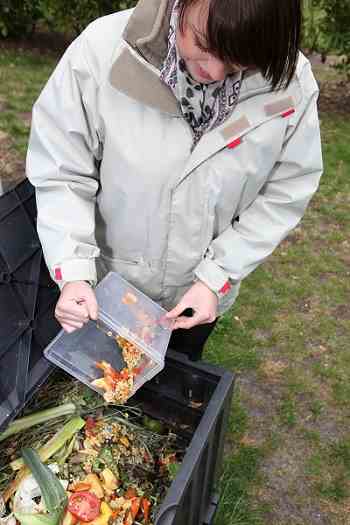
An ordinary kitchen blender is a handy tool for preparing kitchen waste and garbage for composting. Keep some sort of closed container (a large coffee can with a plastic lid works fine) on a back corner of the countertop, and throw all your compostable garbage into it When you’ve accumulated a full container, blend it with a little water and pour onto your pile, spreading it around so it doesn’t all wind up in the same spot Think of all the organic goodies that people feed to their garbage disposals instead of their soil. At least one avid home composter has fashioned a food-grinding apparatus using a garbage disposal unit. I don’t have explicit directions, but if you’re handy, try mounting the unit in a box instead of under the sink, add your food scraps (cutting up fibrous materials before adding them) and a little water, and collect the ground-up food in a bucket.
The cheapest and simplest chop-per/chipper is a machete (available at army surplus stores); an old stump or plank makes a fine chopping block. But you know the old saying: Chopping your own wood warms you twice—once by the exertion and once by burning the fruits of your labor. Using a machete to chop up a lot of debris may heat you a lot more than necessary. A rotary lawn mower can serve as a pretty good shredder. Lay whatever it is you want to chop on the ground and run the machine back and forth over it several times. You can even chop up sticks this way. Be sure that you aim the open end or chute toward some sort of backstop, such as a wall or a piece of plywood propped against a cart. Otherwise you’ll have trouble gathering up the shredded material.
Should you buy chippers and shredders from the market, choose one compatible with the size of your property, your com-posting ambitions, and your garden’s needs. Also, pick a machine that’s ruggedly built — choppers are subject to tremendous vibrations. Find out if and how well you can regulate the size of the particles in the aggregate you will be making. Most good machines have a series of removable rods, screens, or grates that help you regulate the texture of the material coming out. If the price tag of the machine is scaring you off, consider sharing one with your neighbors.
Compost Recipes and Methods
Note: I don’t suggest you use anyone method as a definitive model. A smart composter, like a good cook or experienced carpenter, adapts recipes or blueprints to fit his or her needs and materials; compromise by taking something from each.
The University of California Method
If you are just starting a garden and feel you need compost “right now;’ I’d say the University of California method is more than worth the effort. You can make usable compost in 14 days, and there only three necessities for success:
1) Chopping or shredding is important because it will increase the surface area of the organic materials.
2) There must be an intimate blending of microorganisms, a nitrogenous activator like manure, and carbonious materials such as leaves and grass clippings. This is easy enough to accomplish if you mix your raw materials together as they are fed into the shredder. Blending this way will assure a considerably more effective attack on the part of the microbes.
3) Frequent turning is vital, and should be done every three days at least.
One Saturday morning last October I started a new compost pile by following, more or less, the principles of the University of California method. The pile was to consist of leaves of all kinds, already-rotting sticks from the woods surrounding my house, and seedy first-cut hay, which I brought home in bales. Everything was chopped before it went into the heap and was pretty thoroughly mixed. First, I fed a big handful of hay into the shredder, then a handful of leaves, a handful of dead sticks, and so on. The pile measured about 5′ by 4′. Whenever it built up 3″ or 4″, I gave it a generous sprinkling of alfalfa meal and dampened it heavily with water from the garden hose. Every 18″ or so a thick layer of coarse, unchopped hay was added, just to provide clear air channels into the pile. By mid afternoon the pile was about 5′ high. I closed off the open side of the wire-fence compost enclosure by stacking several extra bales of hay there. Then I broke one or two more bales so that I could put a thick layer of tightly packed “books” or “flakes” of hay on top of the pile for insulation. I wet down the whole pile one more time for good measure.
By Sunday, the compost pile was warm. In less than a day, the bacteria in the compost material had decided among themselves who was going to take over and do most of the initial work. They had become so enthusiastic about their project that they produced a lot of heat. By Sunday night, the pile exuded steamy vapors. On Monday morning there was a heavy frost, but the pile was built; it was clear that the heap had already shrunk. The temperature was too high for me to comfortably put my hand beneath the top layers of hay.
Tuesday evening I turned the pile for the first time, and I turned it again every three days after that. On the third Saturday, exactly two weeks after it was made, the pile had cooled down. I tore it apart, loaded it into the garden cart, hauled it away to the garden in several trips, and spread it. It was certainly a far cry from the dark crumbling compost, but it had obviously been through partial sterilization as a result of the heat. It was riddled with actinomycetes, the weed seeds had apparently been killed (at least few of them germinated in the spring), and in spite of its stringiness caused by the unchopped hay, the pile smelled rich, earthy, and fertile.
By late spring its final decomposition in the garden was complete. The soil revealed no evidence of any of the particles of or¬ganic matter in the compost, including the wood chips from the old sticks-even though the garden had been through a cold winter with little snow-cover protection.
Not a bad testimonial for the University of California method, I would say.
The Ogden Three-Pile System
If professors at the University of California tell the short of it, Samuel Ogden, an accomplished author and organic gardening guru from Vermont, was their antithesis. Ogden took the long route –relying on nearly two years of decomposition to complete his compost pile.
He introduced his method in his book Step-by-Step to Organic Vegetable Gardening. He used three piles, each measuring 5′ by 12′ within cinder block or sod-retaining walls. Every year he removed finished compost from one and built another, while the third pile just sat there rotting, undisturbed. Throughout the summer, he added garden residues to the pile, along with topsoil, and once in a while, an application of manure. In the fall, Ogden covered the pile with overturned sod or manure.
He kept leaves and fresh grass clippings out of his pile, believing that leaves were too tough and grass clippings turned slimy. I myself think it’s a shame not to take ad-vantage of all those leaves we are blessed (or cursed) with in the fall. They provide carbon as well as add bulk to the pile, which helps aeration. So I recommend either shredding the leaves or thoroughly mixing them with other compost materials. Also, if your pile is fast-acting (as opposed to Ogden’s slow, anaerobic pile), raw grass clippings won’t turn smelly and slimy. They are an excellent source of nitrogen — too good to waste.
Ogden described his composting style as “the lazy man’s method.” He did no turning and allowed rainfall to take care of all his watering chores. He used his compost pile to recycle his garden debris and to create the next best thing to stable manure.
“The difference between manure and compost is simple: In the first instance an animal feeds on vegetation and passes the material through the body, extracting nourishment in the process. Thus the waste consists of organic material that has been fragmented and treated with body juices, and then subjected to further decomposition due to the complicated action of oxygen and bacteria while the manure is stacked in piles. Compost is, in general, made the same way, with the exception that one step in the process is omitted, that of passing through the body of some animal. The end products are highly similar and, for our purposes, nearly identical. A compost pile is a sensible and even necessary adjunct to a garden, for it means the conservation of waste and a reduction in the expense of operation.”
Sheet Composting
Sheet composting and using green manures are the primary alternatives to a compost pile for getting vast amounts of organic matter into your garden’s soil. They are certainly more direct because, in a sense, you are eliminating the middle man, the compost pile itself. No nutrients can be lost through leaching as they inevitably must be to a certain extent from a compost heap. At the same time, there is no possibility of thermal kill and no way that weed seeds can be killed en masse without using strong chemicals.
Sheet composting is sometimes confused with mulching. When you mulch with organic matter, you are slowly feeding the soil, but your main interest is in reducing weeds and evaporation of moisture from the soil by laying something on the surface of the ground. Sheet composting involves mixing organic materials with the soil itself, usually with the help of either a spade or Rototiller. It’s an ideal way to improve soils that contain too much clay, sand, gravel, or builder’s fill. It will also help to protect areas of the garden threatened by erosion.
Leaves, grass clippings, manure-what-ever organic matter you can gather-will work quite well. Leaves, as you know, abound in a myriad of trace elements. Green grass clippings from your lawn contain nitrogen and need not be dried before being tilled under. Almost any kind of healthy organic matter, in fact, will provide nourishment for the microorganisms and earthworms in the garden. Sheet composting is done at the end of the gardening season because the materials need several months to break down in the soil.
One drawback to this method is that if you add mostly carbon materials, they will draw upon the nitrogen that is already pre-sent in the soil to aid in decomposition. Even if you use grass clippings, they may release their nitrogen too quickly. For this reason, it’s a good idea to also add nitrogen-rich materials such as manure, blood meal, or cottonseed meal. You can also add natural rock powders such as rock phosphate (for phosphorus) and granite dust (for potassium). To mix these materials into the soil with a Rototiller, simply spread them on top of the soil, set the machine to maximum depth, and till everything under.
A Creative Method
Last fall, a neighbor of mine borrowed my pickup truck and my two children for an afternoon. He has a tiny garden plot (it can’t be more than 12 feet by 40), but his careful management allows him to grow a surprising abundance of vegetables. He lives on a ledge and had to bring in topsoil in order to have a garden at all. With my two children and two of his own, he drove slowly around the countryside loading all the leaves he could find and easily rake up into the back of the truck. Each time he loaded up with more leaves, he asked the kids to jump and play in them. Naturally, they were delighted to oblige. When the leaves got pretty well packed down, he told them to sit down in the back of the truck while he drove to find more. He managed to harvest three compacted truckloads this way, which must have amounted to a dozen or more loads.
Later that quiet Sunday afternoon, I began to wonder what had become of the children. I wandered down the road until I heard screams of delight coming from be-hind my neighbor’s house. When I got closer, I could see the four young ones still romping and wrestling in the leaves, which by this time lay a foot and a half or two feet thick on top of the garden.
My friend was just coming around the corner of the barn with the rear-end tiller. I really doubted that he would be able to till all those leaves into the garden. But sure enough, after three or four passes with the machine, most of them were buried — much to the disgust of four very dirty youngsters surrounding the pile. This spring, every remnant of the leaves has disappeared, and my friend’s little garden seems to have at least two or three more inches of soil than it had last year.
Green Manures
Green manures come fresh from the cow or horse, and are originally cover crops such as buckwheat or rye. Using green manures is somewhat like sheet composting with living green matter that grows right in place. Crop residues such as cornstalks, tomato vines, pea plants, or thick-rooted crops like kale can also be tilled under as green manures. Growing cover crops for the express purpose of turning them under is best done either in the off-growing season (rye grass will show good growth in the fall and early spring) or in some portion of the garden that is left fallow (untilled or unsown). Roots of green manure crops will grow deep into the subsoil, retrieving nutrients that have leached beyond the reach of many vegetable plants’ roots.
Cover cropping is an excellent way to rejuvenate overworked soil, or to prepare a new area for a vegetable or flower garden. A cover crop should be tilled under a minimum of six weeks before the next crop is planted. You can plant a cover crop in early fall, till it under late in the season, and plant another cover crop to overwinter and begin growth in early spring. Then you can till it under six weeks before planting your spring garden.
Just as with sheet composting, the vegetation will likely take nitrogen from the soil as it decomposes, even though it will eventually release more nitrogen than it uses up. That’s the reason for waiting at least six weeks after tilling manure crops before planting your garden. Legumes like peas, bean, soybeans, cow peas, alfalfa, clover, and vetch are especially valuable because they attract nitrogen-fixing bacteria to their roots and contribute lots of nitrogen to the soil. Other green manures like buckwheat, annual and perennial regress, oats, wheat, sorghum, and, yes, common weeds, will add good organic material to your garden.
Small-Scale Composting Systems
If you live on a small plot of land — or no land at all — you are posed with a problem common to millions of others. You and your family seem to produce a certain amount of organic waste, but you never seem to be able to scrounge up enough material to make a respectable-looking compost heap. There is no reason to feel cheated or to cop out on composting altogether. There are some easy composting alternatives that do not involve building massive piles and sustaining consistently high temperatures.
Earthworms
Earthworms — with a little help from you when it comes to some of the heavy work — will do a great job of making compost in a small pile that is only 1 1/2 to 2′ high. The succulent organic matter you put there will invite them from the ground below. You can even buy earthworms through the mail, if you like, and add them to your modes collect of grass clippings, leaves, and vegetable wastes.
Mail-order worms should not be confused with the kind of worms you might dig up and use as fishing bait. They are usually “compost worms” that have been bred and raised in the same sort of deliciously rich surrounding that your mini-pile will offer. These earthworms sport impressive names like Red Wiggler, Red Hybrid, and California Red, and they tend to be spoiled rotten, if you will excuse the expression. They have been so pampered and well fed that they will thrive only in your compost pile and probably will do poorly in common everyday garden soil. To buy “reds” or blue-gray thins;’ look for advertisements for earthworm companies in gardening magazines. Once you have introduced a few earthworms into your pile, these “intestines of the soil,” as they are sometimes called, will double their numbers in about a month’s time.
You can also use earthworms to make compost out of your food scraps during the winter. All it takes is building a home for them and feeding them your leftovers. Mary Appelhof, worm-composting expert and author of Worms Eat My Garbage, recommends a wooden box l’ x 2′ x 3′ for food waste from a family of mold. Locate the box where temperatures stay above freezing and below 84°F. Add some red worms or others sold expressly for indoor composting.
You’ll need twice as many worms as the average daily amount of garbage you’ll be asking them to process. (For example, if you generate a half of a pound of garbage per day, you’ll need one pound of worms.) Then simply feed them your food garbage daily, preferably ground up in a blender. In a box of this size, worms can process approximately six to seven pounds of kitchen scraps per week.
Worm castings, which look very much like coffee grounds, are five times richer than the most fertile soil and loaded with microorganisms. The simplest method of removing the castings from worm composter is to move the bedding and worms to one side of the box every two or three months and fill the other side with new bedding. Bury your garbage in the new bedding, and when worms have migrated to the new side, remove the castings from the other side. Use this compost as a top-dressing on potted plants and flower beds or as a potting and seed-starting medium, and add some to planting holes for flower and vegetable transplants. Brew up some castings tea by soaking a handful of castings in water and then use it to water your potted plants and young transplants.
Pit and Trench Composting
Burying garbage is a quick, easy way to recycle waste material. Also called “pit composting,” it has the obvious advantage of putting everything out of sight, and for a while at least, out of mind. It also permits the composting material to stay warmer in the winter and damper in the summer. On the farm, where pit composting is sometimes done on a fairly large scale, underground rotting allows bacteria, anaerobic fungus and worms to transmute stinky masses of manure and litter into sweet-smelling soil. At home, if you throw debris into a hole that is 12″ to 14″ deep and cover it again with loose soil, it will decompose quite quickly.
Get yourself a bucket to carry around while you stroll through your garden. Use it to collect spent flower blossoms and weeds. Then, whenever your bucket is full, dig a hole somewhere in your garden or yard and bury the material. Once it’s decomposed, you can do one of two things: you can dig up the compost again and use it somewhere else, or you can plant a shrub, fruit tree, grapevine, or berry bush right over the pit.
Some folks with small gardens that are spaded and worked by hand bury garbage in long trenches, which is a great idea. Vegetable plantings can eventually be made directly on top of the covered trench, but it is not a healthy plan to do this too soon after the trench has been filled. It is better to allow the garbage plenty of time to decompose. Growing food in too-raw garbage can cause stomach problems in humans. Root crops like beets, parsnips rutabagas, and carrots may pick up some unpleasant parasites, which have not yet been destroyed by microbial activities, and then install them in your intestinal tract.
Vertical composting: The best trenching method involves a plan called “vertical composting.” You layout your garden in three foot wide rows, dividing each row into three one-foot lanes; one lane serves as a walkway, one as a mulching trench, and one for planting. Rotate lanes every year for three years, then begin again.
This is a simple yet systematic soil improvement program that permits you to bury your garbage right in the garden and still keep your stomach in good working order. There is no reason you can not occasionally throw a bit of lime or wood ash into the trenches along with your vegetable scraps and other organic matter. This should keep your garden’s soil somewhere near neutral.