We have been starting seedlings for two months and I’ve planned to do a post on starting seedlings since the first spring onions sprouted. But new customers’ questions, their need for heirloom corn seed, dealing with the aftermath of the warehouse fire at Southern Exposure Seed Exchange and telling folks how to grow roselle have kept me busy late into every free evening. Well, finally, my friend Pam Dawling, author of the newly released Sustainable Market Farming and contributing editor at Growing for Market sent me a guest post on seed starting at Twin Oaks Community Farm that has got me going. So, let me introduce you to Pam. (If you like what Pam has to say, either here or in her blog, she will be presenting at the Mother Earth News Fair at Seven Springs PA in September.)
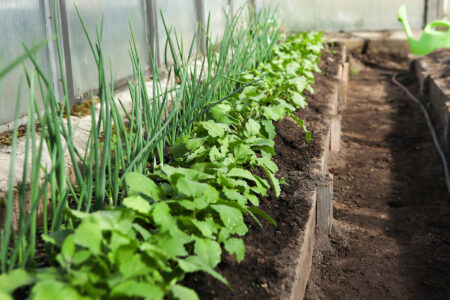
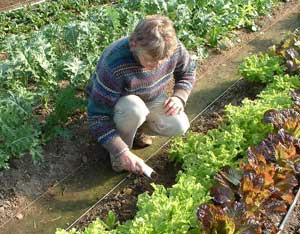
“We’ve been starting seedlings since late January, and the greenhouse is filling up with flats of lettuce, cabbage, kohlrabi, spinach, scallions and broccoli. We’re eating our way through the lettuces that grew overwinter in the compost in the block-work greenhouse beds, and shoveling out the compost to fill our flats. All our seedlings are grown in 100% home-made compost. We screen compost to fill the beds in September and transplant lettuce there in October. When we need the compost for the seedlings, it has mellowed nicely and has plenty of worms. This beats bringing in bags of compost, or chipping lumps off a heap of frozen compost outdoors in January! Our greenhouse has a masonry north wall and a patio-door south wall. It has no heating apart from the sun (this is Zone 7). This space is warm enough and just big enough for most all our seedlings. For growing-on the very early tomatoes and peppers, destined for our hoophouse, we use an electric heat mat and a small plastic low tunnel in one corner of the greenhouse. Many seeds benefit from some heat during germination and are then moved into slightly less warm conditions to continue growing. This means it’s possible to heat a relatively small space just to germinate the seeds in. We als
o use two broken refrigerators as insulated cabinets, with extra shelves added. A single incandescent light bulb in each supplies both the light and the heat (we change the wattage depending on what temperature we’re aiming for). Some people construct an insulated cabinet from scratch, with fluorescent lights suspended above the flats.”
Now here is a guaranteed way to get your early potato crop off to a good start. Prepare to plant your potatoes as soon as possible after St. Patrick’s Day by green chitting. Cheryl Long gives temperatures and tips to help gardeners anywhere green chit. The practice of pre-sprouting seed potatoes before planting encourages early growth. It is widely used abroad, but is less known to Americans. Chitting is simple. Spread the seed tubers in boxes or flats one layer deep with the seed end up. Look closely at a seed potato and you will notice one end was attached to the plant. The other end has more eyes from which sprouts emerge. The end with the eye cluster is called the seed end. Place your flats in a warm area (room temperature – 70 degrees F°) where light is bright but indirect. The warm air stimulates the development of strong sprouts from the bud eye clusters, which, in the presence of light, remain stubby and are not so easily broken off. Allow 1 to 2 weeks before planting (Sprouts should be approximately ½” long; if they’re much longer, they break off easily.)
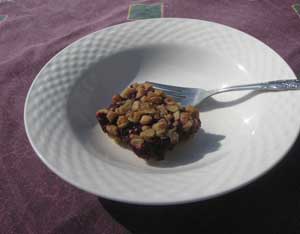
Now for that recipe I promised. (Actually, I promised you a dried tomato recipe last time but that will have to wait.) My friend Heather made these delicious Roselle Dessert Bars for us yesterday with chopped calyxes frozen last summer (the image at the right). She also reminded me that February-March it is not too early to start your roselle plants, especially if you want extra large transplants. I like to have some in 6” or even 8”pots to get the calyxes as early in the season as possible. If you want to know more about growing and using roselle, Cindy Conner of Homeplace Earth just wrote a post on Thai Red Roselle Tea on MotherEarthNews.com.
Roselle Dessert Bars
(you can also make this with rhubarb instead of roselle)
For the crust
1 ½ cups rolled oats
1 ½ cups flour
1 cup brown sugar
½ tsp. baking soda
¼ tsp. cardamom OR cinnamon
1 cup melted butter
1 cup chopped nuts
For the filling
2 Tbsp. cornstarch
1/3 cup water
1 to 1 ½ cups sugar (depending on the sweetness desired)
1 tsp. vanilla
3 cups chopped roselle calyxes (just the red coverings of the seed pods)
1 Tbsp. orange peel (optional)
Preheat oven to 375 degrees. Mix cornstarch with water. Add sugar, vanilla, roselle and orange peel (optional). Cook until thick.
Mix together oats, flour, brown sugar, baking soda, cardamom OR cinnamon, melted butter, and chopped nuts until crumbly. Butter a 9” x 13” pan and pat in three fourths of the crust mixture. Spread roselle filling on top, then sprinkle the rest of the crust crumbs over the filling.
Bake for 25 minutes. Serve warm with ice cream or whipped cream, or allow to cool before cutting into smaller bars for lunches or snacks. Enjoy!
(As I said, in the Spring, rhubarb may be substituted for roselle in this recipe.)
Thanks for stopping by and we hope you’ll come back often to see what we’re growing and cooking.
___________________________________________________________________
Ira Wallace lives and gardens at Acorn Community Farm, home of Southern Exposure Seed Exchange,where she coordinates variety selection and seed growers. Southern Exposure offers 700+ varieties of non-GMO, open-pollinated, and organic seeds. Ira is a co-organizer of the Heritage Harvest Festival at Monticello. She serves on the board of the Organic Seed Alliance and is a frequent presenter at the Mother Earth News Fairs and many other eventsthroughout the Southeast. Her first book, “The Timber Press Guide to Vegetable Gardening in the Southeast” will be available in December 2013.