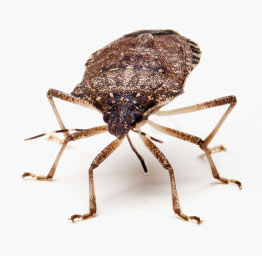
For the past few months, I’ve been sharing space in my office with an exotic insect from China, the brown marmorated stink bug (Halyomorpha halys). Since arriving in Pennsylvania in 1996, this species has invaded gardens and orchards in 26 states, but until now it has made its biggest headlines by seeking shelter inside homes. Like Asian ladybeetles, marmorated stink bugs come into houses and barns on warm days in late fall. This behavior has become extreme in Maryland, where marmorated stink bugs swarmed homes by the thousands in fall 2010.
Scientists have been working to find control strategies since 2004, when USDA entomologist Jeffrey Aldrich began tracking populations and looking for a pheromone that could be used in an effective trap. Significant progress has been made, and a predatory wasp has been found that parasitizes marmorated stink bug eggs. “The good news is that with continued government and state support, there’s a great chance we’ll be able to finish quarantine-based research and get federal clearance to release the foreign parasitoids in outdoor trials,” says Amanda Koppel, stink bug expert at Virginia Tech University.
Meanwhile, the marmorated stink bug is an insect out of control, with some experts warning of an agricultural threat of “biblical proportions” should the marmorated stink bug gain a foothold in North America’s prime soybean-growing areas. The marmorated stink bug naturally thrives in urban and suburban areas because it can use buildings for overwintering and landscape plants for food. Two favorites include the invasive princess tree (Pawlonia) and butterfly bush (Buddleia).
Identifying the Enemy
“Marmorated” means having a marbled or streaked appearance, and alternate light and dark bands on this mottled brown shield bug’s antennae clearly identify it as the invasive species. The spotted antennae are easy to see with a 5X magnifying glass. Like other stink bugs, the marmorated stink bug feeds by puncturing plant tissues with its sharp feeding tube, and sucking plant juices, so insecticide sprays are generally ineffective. Marmorated stink bugs can fly about and feed on an unusually broad range of host plants (they love viburnums, beans and most fruits). Their feeding habits may shift as the season progresses. Last year, late-season nectarines, peaches and tomatoes were hard hit in the mid-Atlantic region, where marmorated stink bugs are fast displacing native species.
Protecting Your Garden
Mid-Atlantic gardeners should be prepared to protect peppers and late-season tomatoes with high tunnels or row covers. If you have pears or Asian pears, intense hand picking (by shaking the bugs down into a tarp) may be the best way to limit damage to fruit.
Trapping these guys is of tremendous interest, though yellow sticky traps that attract marmorated stink bugs also claim beneficial insects. One passive trap that could work consists of an open pipe, painted yellow, set in the soil upright among plants. Theoretically, stink bugs fall in the top of the pipe and can’t get out.
When you find a crop these bugs can’t resist (like millet or sunflowers), plant it in large containers that can be moved around in your garden. Hand pick stink bugs daily from your trap crop by knocking them into a jar of soapy water. Including a yellow pipe or other visual marker can help attract stink bugs to your traps.
The holy grail is a trap baited with a pheromone that attracts only marmorated stink bugs, and such products will likely become available in the future. Until then, hand picking all stink bugs, or supervising patrols by domestic chickens or ducks, are your best control strategies in the garden.
Protecting Your House
My house seems to be a pretty good trap, too, and I can usually gather up at least a dozen stink bugs on sunny winter days. After midwinter, many seem to die from dehydration. Marmorated stink bugs can’t bite or sting, but grabbing them with your fingers will make them release their spicy perfume, which smells different to different noses. Like the herb cilantro, brown marmorated stink bug musk contains fragrance molecules that smell sweet and spicy to some people, musty and rotten to others.
Indoors, most of these bugs will fall right into a collection jar after a gentle nudge with the rim, allowing for odorless collection. When all is still in my collection jar of soapy water, I dump it into my compost pail.
Of course, it would be great if there were fewer brown marmorated stink bugs in the house to begin with, so next year I may try the cardboard/furring strip traps invented by Jody Williams of Delaware Township, N.J. Placed against the side of the house on swarming days, the traps capture hundreds of stink bugs that might otherwise come indoors.
Contributing editorBarbara Pleasantgardens in southwest Virginia, where she grows vegetables, herbs, fruits, flowers and a few lucky chickens. Contact Barbara by visitingher websiteor finding her onGoogle+.
Photo by iStockphoto/BackyardProduction