

The world’s population is off and running and
crying, “Feed me if you can!”
“OK. But give us more ,” answer the
spokesmen of agribiz. “More money and more machinery and
more fossil fuels and more chemicals.” “Wait a minute,”
interject a few thoughtful souls. “There isn’t any
more. Not for long, anyway. We’re going to have to do the
job with less.”
And that’s just what John Jeavons and the folks at
Palo Alto’s Ecology Action of the Midpeninsula in
California are doing.
Who We Are
Ecology Action of the Midpeninsula is a non-profit,
tax-exempt, California-based organization that was formed
in the early 70’s to promote and carry on environmental
research and education. In 1972, we began experimenting
with biodynamic/French intensive food production techniques
on a 3-3/4-acre community garden called “Common Ground”.
Our findings thus far indicate that the method may soon
make it possible to grow an entirely balanced human diet on
1/4 to 1/20 of the area presently required by conventional
means . . . and that such yields can be accomplished using
as little as 1/2 to 1/16 the nitrogen fertilizer, 1/2 to
1/16 the water, and 1/100 the energy expended today by
mechanized agriculture.
Considering the current state of the world (overpopulation,
widespread malnutrition, diminishing availability of land,
dwindling fossil fuel supplies, and all the rest) we feel
that such findings are vitally important. We also suspect
that many of MOTHER’s readers will be interested in sharing
our discoveries. Who knows? Maybe some of you will even
want to start similar experiments of your own!
The Basics of Biodynamic Farming
The biodynamic/French intensive method is really a
synthesis of a number of techniques developed by European
schools of agriculture during the past century. It was all
brought together into one system by Alan Chadwick, an
inspired English horticulturist who now lives in Covelo,
California. Mastery of the concept requires a good bit of
acquired skill and knowledge, but–generally
speaking–here is what’s involved:
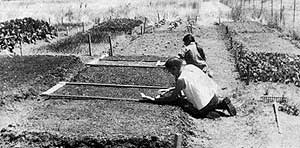
[1] DOUBLE-DUG, RAISED BEDS. Plots three to five feet wide
and of varying length are laid out, and a temporary wooden
form (see photos) is staked around each one’s perimeter.
The soil is thoroughly dug up to a depth of one foot, and
then loosened an additional 12 inches manually with a
shovel. This preparation enables plant roots to penetrate
easily and deeply, and promotes a steady flow of nutrients
to their stems and leaves. Such beds retain moisture well,
erode hardly at all, and are very easy to weed (there’s no
need for two-handed, heave-ho pulling here!).
[2] INTENSIVE PLANTING. Seeds or seedlings are placed so
that each is the same distance from those nearest to it,
and close enough so that–when the plants
mature–their leaves will just barely touch those of
their neighbors and form a kind of continuous green “roof”.
(Two-inch spacing is about right for most vegetables.)
Some folks simply broadcast seed and then thin the
resulting shoots to the desired distance. When we plant,
however, we lay a guide–made by stretching 2″
hexagonal-pattern chicken wire over a frame–across
the bed, and center a seed through each opening in the grid
as shown in one of the accompanying photos. The technique
creates a shaded environment under the leaves (some call it
a “living mulch”) that helps retain moisture, protects the
soil’s valuable microscopic life, retards weed growth,
and–therefore–helps to produce higher yields.
[3] COMPANION PLANTING. Many kinds of vegetables and fruits
grow better when near other varieties (green beans and
strawberries, for instance, make a particularly
compatible–and productive–pair). Some plants
repel harmful insects, while others attract beneficial
ones. (Borage does both: It wards off tomato worms, and
produces blue flowers that attract pollinating bees.)
In addition, many species (including weeds) grow
exceptionally long roots that loosen the subsoil and bring
up previously unavailable trace minerals and nutrients. So,
the biodynamic/French intensive gardener or farmer plans
carefully, places mutually beneficial species together,
and–in so doing–encourages high-quality crops
and helps create (and maintain) healthy, vibrant soil.
[4] COMPOST. All organic gardens, of course, thrive when
treated to lavish amounts of well-decayed manure or
vegetable matter . . . but beds that have been planted
intensively require even more of the material to
feed their more heavily concentrated crops. Compost
improves soil texture, creates better aeration and water
retention, and supports the microorganisms that fix
atmospheric nitrogen and produce disease-preventing
antibiotics in the soil. Conventional farming tends to
destroy such life forms.
It’s important to note that the above “components” of the
biodynamic/French intensive method constitute a whole
system. The well-prepared soil, the closely spaced
plantings, the companion planting, and the liberal use of
compost intermesh to create a complex living environment
for growing fruits and vegetables . . . but no single one
(or just two, or three) of those techniques can effectively
stand alone. (Farmers in Europe who experimented by using
only the intensive spacing factor in combination with
conventional agricultural practices have learned that
lesson well: They soon found themselves beset with
deteriorating soil, nitrate toxicity, poor-quality produce,
diminishing populations of beneficial insects, and lowered
plant resistance to disease and pests!)
Enormous Yields Possible
According to our experience, a simple 24-inch-deep soil
preparation allows four times as many plants as
usual to be sown in a given space, because the roots have
sufficient room to develop downward. That factor alone,
combined with the growth-promoting effects of compost
treatments and companion planting, allows anyone adhering
to the techniques to quadruple his or her
vegetable production! Such harvests can be (and have been)
obtained even in the first year of planting.
Furthermore, research performed at the University of
California at Berkeley indicates that the overall root
health level of produce grown in agricultural soil has
declined : . . and that even a 2% to 4% increase in such
health could result in a two-to four-fold increase in field
crop harvests. The method we’ve been experimenting with
makes such an improvement possible by texturizing,
aerating, fertilizing, and watering the soil as a matter of
standard practice.
So . . . if you combine the arithmetic spacing and root
health factors, it’s easy to see that biodynamic/French
intensive techniques can, ideally, produce sixteen
times more food than is produced by currently accepted
farming and gardening methods here in the United States.
Other factors, of course–such as climate, soil
condition, and type of vegetable, grain or fruit, and the
degree of skill of the farmer or gardener–can (and
do) reduce that optimal figure.
Our Yields So Far
When we began experimenting with b/F intensive techniques
in 1972, our soil was in relatively poor condition (would
you believe a pH of 8.0? ) . . . and our own
skills, of course, required considerable enrichment also.
Since that time, however, both factors have been improved
and our annual harvests–measured under reasonably
controlled test conditions–have shown a corresponding
increase. They have, in fact, varied between two and
sixteen times the national, California, or Santa Clara
County averages.
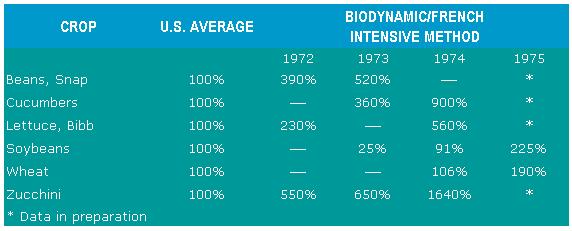
The table in the Image Gallery will give you some idea of how we fared as
compared to the U.S. averages for each year and crop cited:
As you can see, some harvests have actually doubled from
year to year as the soil in our test area has improved . .
. which indicates still another major advantage of the b/F
intensive method: Yields are apparently sustainable in an
environmentally balanced way.
Mechanized agriculture relies on chemical fertilizers
which–because they gradually deplete the earth’s
capacity to produce–must be applied in increasingly
large doses in order to keep annual harvests from
declining. Biodynamic/French intensive techniques, on the
other hand, build the soil and thus encourage better and
better yearly production.
To date, 62 different crops–including rice, wheat,
and fruits–have been test-grown at “Common Ground”
with varying degrees of thoroughness and success judging
from our experience and that of others, it appears that the
biodynamic/ French intensive method will produce four to
six times the U.S. national per-acre average of protein
source beans, grains, and rice, 8 times the average soft
fruit and vegetable yield, and 4 to 8 times as much seed.
As staggering as those statistics may seem, they’re
absolutely mind-blowing when compared to world
averages, which are much lower than those of the U.S. In
fact, the worldwide figure in the bean, grain, and rice
category is 203times less than the yield
which can be expected with b/F techniques!
Minimal Resource Use
Obviously, high crop yields alone do not a viable
agricultural system make . . . not–that is–in
today’s world, where virtually every natural resource is at
a premium. So it’s especially significant that
biodynamic/French intensive farming uses water, land,
fertilizer, and energy in a very miserly way.
For instance, our experiments in vegetable production
required only 1 /2 to 1 /8 as much water per pound of food
produced as that consumed by commercial agribiz . . . and
we were working with relatively out-of-shape soil! The
Community Environmental Council in Santa Barbara, which is
conducting similar tests on better ground, boasts a
water-use record of 1/10 the “normal” amount required. And
once again, the major “components” of the technique,
intermeshed as a whole system, are together responsible for
the figures.
Research has shown that soil containing 2% active organic
matter (such as the compost used in our beds) needs only
1/4 the rainfall or irrigation required by poor land . . .
that shaded areas (such as those formed by intensive
planting) decrease moisture evaporation by 13%–16% .
. . and that earth which contains large quantities of
nutrients (encouraged, in our case, by adding decayed
vegetable matter to deeply dug beds) can reduce
transpiration of water through leaves and stems by as much
as 10% to 75%.
Put all those factors together and it’s easy to see why
biodynamic/French intensive techniques may someday help
countries grow at least four times as much food as they do
currently, under natural rainfall conditions . . . with no
expensive irrigation required in most cases at all! Even
arid lands such as the African Sahel could conceivably
become productive!
Fertilizer, of course, is used in vast quantities these
days, and–worse yet–requires great amounts of
energy (and materials) to manufacture, distribute, and
apply to the land. The primary fuel used to make such
substances is natural gas . . . of which the U.S. has only
a nine-year reserve. And it’s estimated that–by the
year 2000–20% of all the energy consumed in the world
will be needed just to produce nitrogen fertilizer!
Obviously, any reduction of the use of such materials would
be significant . . . and, in our experiments with raising
vegetables, we found that we needed only 1/2 to 1/16 as
much added nitrogen per pound of food as do commercial
farmers. And because the b/F intensive method is manual
rather than mechanized, a further reduction in energy
consumption is apparent. Such savings should be
particularly important in countries which cannot afford
today’s high fuel and fertilizer costs.
A New Kind of Farming
Consider the implications of what we’ve observed so far:
The biodynamic/French intensive method can produce very
high yields on little land almost anywhere in the world,
using few resources and only simple low-capital-investment
manual tools. Together, those factors have fostered a new
concept that may well change the face of agriculture on
Planet Earth: super-productive mini-farming!
Current estimates based on test results indicate that
widespread use of b/F intensive techniques could
conceivably allow 3%–6% of a population to grow all
of a country’s food. A family of four, working a total of
56 hours per week (that’s two hours a day for each
individual) on a little less than two acres, should be able
to raise–within a six-month growing
season–enough food (grains, vegetables, fruits, and
fodder for dairy animals) to supply a complete
2,379-calories-per-day annual diet for 32 people!
Wholesale market value (50% of retail) of such a harvest,
based on current U.S. food prices, would be around $9,600 .
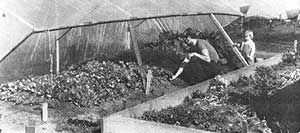
. . and, if inexpensive mini-greenhouses were used to
extend the growing season year round, that output (and the
resulting cash income) could be doubled!
On a smaller scale, a family of the same size working
toward food self-sufficiency alone could use b/F intensive
techniques to raise their entire annual food needs on just
10,000 square feet of soil–less than a quarter of an
acre–by working just one or two hours a day during a
six-month season!
Such stunning efficiencies, of course, cannot be
accomplished overnight. Most soils require considerable
improvement (a gradual process that can take up to five
years), and would be mini-farmers must give themselves
enough time to develop both an intimate understanding of
the concepts involved and a familiarity with the skills
required to produce successful harvests.
Nevertheless, the potential value of biodynamic/French
intensive agriculture–for individuals, homesteading
families, communities, and (perhaps most important) Third
World countries now struggling desperately to feed their
citizens–clearly overrides the relatively
insignificant investment of time and effort that’s
initially required.
A FInal Note
Ecology Action of the Midpeninsula is now eagerly entering
its fifth year of exploration into the wonders of
biodynamic/ French intensive agriculture. We hope that many
of you, too, will recognize the importance and possible
worldwide impact of the system, and begin similar
experiments of your own. With a little patience and work,
you’ll soon see for yourself what the method can produce:
high yields for you and your family . . . and even higher
hopes for Planet Earth and its people!






