

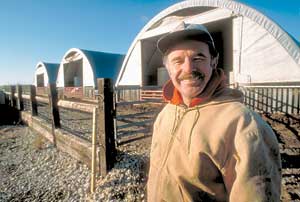
Tom Frantzen, New Hampton, Iowa
Tom Frantzen’s main motivation to go organic was quality of life — for both the humans and animals involved.
He already had started rotating crops and reducing pesticide use on his 335-acre cattle and hog farm. “It wasn’t a big jump for me at all,” Frantzen says. “It was a business plan that supported the quality of life we were looking to achieve on the farm.”
By the late 1990s, Frantzen had moved to an entirely organic hog operation. He was instrumental in helping to launch Organic Valley’s Organic Prairie brand, and he remains a key supplier of pork to the cooperative.
“If you take the life of an average confinement hog, he’s seen little else but stainless steel and concrete walls,” Frantzen says. “My pigs, they’re born in the summer, outside. Later, they are in a hoop building with fresh air, sunshine and fresh bedding every two or three days.”
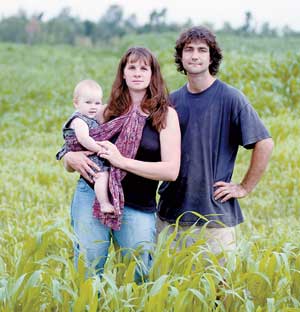
Travis and Amy Forgues, Alburg Springs, Vermont
Travis Forgues grew up on a family dairy farm near Vermont’s Lake Champlain, but he did not have any plans to get involved in the business.
Travis and his high school sweetheart, Amy, married in 1995 and bought the house next door to his parents, so they could start a family. “We didn’t come back here to farm, we came back for family,” he says. Going into farming was still not financially viable for the couple — they worked at different jobs in Alburg Springs for two years, before going to a meeting about organics. “I realized then that the farm was already organic because Dad wasn’t fond of pesticides or antibiotics. All we had to do was buy organic grain,” Travis says.
So at age 23, barely out of college, Travis and Amy became organic dairy farmers with 200 acres near the Canadian border.
In 1999, they joined Organic Valley — becoming one of the first Vermont farms in the co-op. Travis and his father, Henry, continue to milk 80 cows, while Amy and the children take care of the young calves. “I didn’t sign up for this to make a truckload of money,” Travis says. But they are making enough now that staying on the farm will be an option for their children, Emma, 8, Gabriel, 6, and Molly, 2. “We are so happy we made the move,” Amy says. “Organics have changed this farm from what was a struggle for two families to a comfortable living.”
Travis and Amy are hardly the youngest farmers in the cooperative. “We have more and more young people coming in,” Travis says. “The next big thing for Organic Valley will be ‘Generation Organic,’ an educational program for the next group of organic farmers.”
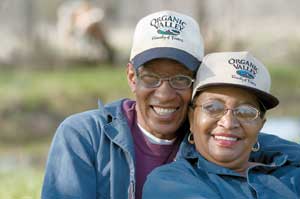
Harry and Billye Lewis, Sulphur Springs, Texas
For Harry Lewis, owner of a 287-acre dairy in northeast Texas with his wife, Billye, and son, Wynton, organic farming is not a new concept.
“What people don’t understand is that we have been using synthetics for only the last 50 years,” he says. “For thousands of years before that, we had done it organically.” Harry says that’s how his father farmed when he first received the land through a federal grant to grow food for U.S. soldiers involved in World War II.
“My father had Grade B milk, he rotated crops and he was self-sufficient — he raised veggies and had a creek with lots of fish in it,” Harry says.
In 2002, Harry went to an Organic Valley recruitment meeting with a tape recorder, which he accidentally left behind. When he got home, Organic Valley’s George Siemon and Wayne Shaker were at his doorstep with the recorder. While they were waiting, they had surveyed Harry’s land, which for decades had been farmed without herbicides or pesticides. The two men told Harry it would be easy to certify the farm as organic. “Something in me said, ‘This is it, this is the right thing to do,’” he says. By 2005, Harry’s herd and land were certified organic. His cows’ milk is now sold under the “Texas Pastures” label in all major cities in Texas.
“When I give out milk samples, I treat them like rare wine and tell people to check out the bouquet,” Lewis says. “The flavor of the milk is the flavor of the diverse grasses on the pasture.”
Read more: To learn about the ideas and operations behind Organic Valley, read The Organic Valley Farmer Cooperative.





