

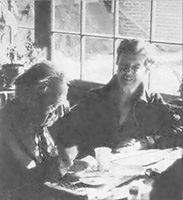
Helen and Scott Nearing share their homesteading advice with MOTHER’s readers, including wild versus garden produce, commercial pesticides for composting and how to socialize home-schooled children.
Helen and Scott Nearing are light-years ahead of most
of us when it comes to living a life of voluntary
simplicity in harmony with nature. Back in 1932 they began
homesteading a run-down farm in Vermont’s Green Mountains,
and later — when the slopes around them exploded into
ski resorts in the early 50’s — Helen and Scott moved
to a rocky inlet on the Maine coast. . . and started all over again.
That’s where you’ll find the Nearings today: They’re
still clearing brush, still building the stone structures
they’re famous for, and still raising most of their
vegetarian diet themselves in productive wholistic gardens
. . . just as they’ve been doing for 50 years.
Naturally, the Nearings have learned a good deal about
homesteading over the years . . . and they’ve agreed to
share that knowledge with MOTHER’s readers in a regular
question-and-answer column. Send your queries about
self-reliant living on the land to Helen and Scott Nearing,
THE MOTHER EARTH NEWS ®, Hendersonville,
North Carolina. Please don’t expect personal replies,
though. The most frequently asked questions will be
answered here — and here only — so that we can
all benefit from what the Nearings have to say.
My wife and I plan to build our home from locally
available materials . . . and we feel that a wood and stone
building would best meet our requirements. We’d like to
construct the dwelling under our own steam, too . . . but
so far we’ve been able to find only limited information
about appropriate hand tools (it seems they’ve all been
replaced by gas- and electricity-powered implements). At
the present time our only tools are a small wheelbarrow, a
hammer, and a couple of wrenches and screwdrivers. We’d
like to know which hand tools were especially useful in the
construction of your home, and which (if any) power tools
were essential. We’d appreciate, too, learning what
particular brands or suppliers of high-quality hand tools,
for both construction and gardening, you might
recommend.
Every job requires specific equipment, and constructing a
home is no exception. For a start, though, you’ll find that
shovels, handsaws, garden forks, hammers, screwdrivers,
pliers, and axes will be useful for a variety of
homesteading chores … including building a house. As for
power tools, when putting up our first dwelling, we had both
a saw and a cement mixer that were gasoline operated.
However, these were soon replaced by hand implements, as we
felt that the power tools were too dangerous to use, and we
found them extremely noisy. The quietness and slower, more
natural rhythm of working with hand tools far outweigh the
convenience of power equipment. Our latest building venture
— which extended over three years — included a
five-room house, a garage, a workshop, and a storage area .
. . all of which were constructed by hand and built of
stone and concrete.
In answer to your last question, most of our tools were
purchased so long ago (some of them are 50 years old) that
the trade names have long since disappeared from the
handles and blades. We’d suggest looking in woodworking and
gardening magazines for suppliers. [EDITOR’S NOTE: Here are
two sources of quality hand-powered implements: Smith &
Hawken Tool Co. (Dept. TMEN, Palo Alto,
California) . . . and By Hand & Foot, Ltd. (Dept.
TMEN, Brattleboro, Vermont). Write for
free catalogs.]
My mate and I like to forage for wild edibles, as doing
so enables us to enjoy the beauty and peacefulness of the
out-of-doorsand provides us with a variety of
free meals. We were wondering whether you prefer wild versus garden produce with the practice of
gathering wild foods is an important part of your lifestyle
. . . or do you prefer to depend entirely on “tame” garden
produce?
We forage for wild crops only occasionally, as our
self-contained garden yields us plenty of fruits and
vegetables for the year. Rather than traipse through the
woods in search of various herbs and edible weeds, we find
it easier to raise some “wild” crops right in our own plot.
Dandelions, for example, can be cut from the lawn . . . but
we also plant a row of the greens in the garden. And
although we do pick sorrel and chamomile when we happen to
discover them growing wild, we cultivate the plants, as
well. The same holds true for blueberries, raspberries, and
strawberries: We gather the delectable wild fruits wherever
they’re found . . . but we grow tame berries within our
garden walls, too.
I’ve been following a vegetarian lifestyle for the past
two years and — largely as a result of my desire to
consume only pesticide-free food — I’ve become
interested in French intensive gardening. Furthermore,
because composting naturally goes hand in hand with growing
vegetables, one of my recent projects was to build up a
sizable pile of decomposing material.
Being short on vegetable matter, I contacted the local
grocery store and worked out a deal whereby I receive all
the store’s rotten produce. However, after layering a
month’s worth of the humus-to-be in a blanket of dirt and
leaves, it crossed my mind that the vegetables supplied to
the store were probably sprayed with pesticides . . . and
that as a result the waste might not be suitable for
composting.
Do you know whether commercial insecticides will break
down sufficiently to be safe in a compost pile?
We’ve never lived close enough to a restaurant or
supermarket to have the chance of using throwaways . . . so
we haven’t dealt with a situation like yours. We’d suggest,
however, that you mix the store-gathered vegetable matter
with your own homegrown leafage and weeds in order to
dilute the concentration of possible poisons in your
compost pile. Adding on layers of well. decayed leaves
should also decrease the proportion of impurities in the
organic matter. And be sure to let your pile heat up
sufficiently — reaching at least 110 degrees Fahrenheit — to
help destroy detrimental organisms that may infest
the supermarket leftovers.
I realize that you haven’t had to deal with this
specific problem . . . nevertheless I’d like to have your
comments.
We are a family of five living on 14 acres in rural
western Quebec. Some time ago we decided to teach our
children at home, since my husband and I feel that removing
our youngsters from the mediocre quality of education found
in the public school system is perfectly consistent with
our goal of living a simple, honest, self-reliant life. We
are a bit concerned, however, with the troublesome issue of
socializing. We’re afraid that the decision not to send our
children to the local school could, perhaps, remove us from
“social acceptance” in the community . . . and as a result,
our youngsters might well suffer for our beliefs.
We assume (from reading the chapter on “Living in a
Community” in your book Living the Good Life )
that — in a similar situation — you wouldn’t
simply adopt an isolationist stance. What are your thoughts
on this subject?
Social acceptance was never a concern of ours . . . and
we’d like to believe that most other mature adults would be
firm enough in their own convictions to stand up for what
they believe in, even if doing so meant running against the
norm. Children, however, are — in general —
quite concerned with the opinions of their peers. We would
hope that, were we in your situation, we’d be able to
influence our youngsters to see beyond that . . . by
formulating our own family standards and living up to what
we believe is right. Moreover, we feel that a bout with
social acceptability now and then isn’t always a bad
experience . . . on the contrary, it can be a valuable
lesson for both young and old!






