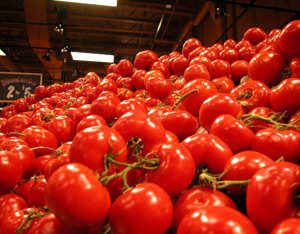
The following is an excerpt from Tomatoland by Barry Estabrook (Andrews McMeel Publishing, 2011). Of all the fruits and vegetables we eat, perhaps none suffers more at the hands of factory farming than the tomato. Tomatoland traces the beloved fruit from its wild origins in Peru to its present-day incarnation in the $5 billion fresh tomato industry based in Florida. Fast-paced and suspenseful, this outstanding exposé of modern agribusiness shows the high price we pay as a society when we disregard sustainability in our food system. This excerpt is from the Introduction, “On the Tomato Trail.”
My obituary’s headline would have read, “Food Writer Killed by Flying Tomato.”
On a visit to my parents’ condominium in Naples, Fla., I was mindlessly driving along the flat, straight pavement of I-75, when I came up behind one of those gravel trucks that seem to be everywhere in southwest Florida’s rush to convert pine woods and cypress stands into gated communities and shopping malls. But as I drew closer, I saw that the tractor trailer was top-heavy with what seemed to be green Granny Smith apples. When I pulled out to pass, three of them sailed off the truck, narrowly missing my windshield.
Chastened, I eased back into my lane and let the truck get several car lengths ahead. Every time it hit the slightest bump, more of those orbs would tumble off. At the first stoplight, I got a closer look. The shoulder of the road was littered with green tomatoes so plasticine and so identical they could have been stamped out by a machine. Most looked smooth and unblemished. A few had cracks in their skins. Not one was smashed. A 10-foot drop followed by a 60-mile-per-hour impact with pavement is no big deal to a modern, agribusiness tomato.
If you have ever eaten a fresh tomato from a grocery store or restaurant, chances are good that you have eaten a tomato much like the ones aboard that truck. Although tomatoes are farmed commercially in about 20 states, Florida alone accounts for one-third of the fresh tomatoes raised in the United States, and from October to June, virtually all of the fresh-market, field-grown tomatoes in the country come from the Sunshine State, which ships more than 1 billion pounds to the United States, Canada and other countries every year. It takes a tough tomato to stand up to the indignity of such industrial-scale farming, so most Florida tomatoes are bred for hardness, picked when still firm and green (the merest trace of pink is taboo), and artificially gassed with ethylene in warehouses until they acquire the rosy red skin tones of a ripe tomato.
Beauty, in this case, is only skin deep. According to figures compiled by the U.S. Department of Agriculture, Americans bought $5 billion worth of perfectly round, perfectly red, and, in the opinion of many consumers, perfectly tasteless commercially grown fresh tomatoes in 2009 — our second most popular vegetable behind lettuce. We buy winter tomatoes, but that doesn’t mean we like them. In survey after survey, fresh tomatoes fall at or near the bottom in rankings of consumer satisfaction. No one will ever be able to duplicate the flavor of garden-grown fruits and vegetables at the supermarket (or even the farmers market), but there’s a reason you don’t hear consumers bemoaning the taste of supermarket cabbages, onions or potatoes. Of all the fruits and vegetables we eat, none suffers at the hands of factory farming more than a tomato grown in the wintertime fields of Florida.
Perhaps our taste buds are trying to send us a message. Today’s industrial tomatoes are as bereft of nutrition as they are of flavor. According to analyses conducted by the U.S. Department of Agriculture, 100 grams of fresh tomato today has 30 percent less vitamin C, 30 percent less thiamin, 19 percent less niacin and 62 percent less calcium than it did in the 1960s. But the modern tomato does shame its 1960s counterpart in one area: It contains 14 times as much sodium.
A couple of winters ago, I bought an assortment of supermarket tomatoes and brought them home for a tasting. I put four on the counter and reached for a cutting board, accidentally nudging one. I was too slow to stop it and watched as it rolled off the counter and fell on our newly refinished pine floor. It hit and traveled for a few feet but incurred no damage. As I retrieved it, my partner came into the kitchen, and I tossed the tomato at her playfully. She shrieked and dodged, and my hardy, store-bought tomato struck the floor with the solid thud of a baking potato. I bowled the fruit through the kitchen door, across the dining room, over a wooden threshold, onto the tile floor of the sunroom, where The Tomato That Would Not Die crashed against the door. No damage done.
The best way to experience true tomato taste is to grow your own. Little wonder that tomatoes are by far the most popular vegetable for home gardeners, found in nearly nine out of 10 backyard plots. Both The Tomato That Would Not Die and the heirloom Brandywines in my Vermont garden are of the species Solanum lycopersicum, and both are red. But the similarity ends there. My Brandywines are downright homely — lumpy, deeply creased and scarred, they look like badly sunburned Rubens derrieres. Nor are they made for travel. More often than not, one will spontaneously split during the 25-yard stroll from garden to kitchen. If not eaten within a day or so after being picked, they develop brownish bruises and begin leaking a watery orange liquid. But that rarely happens. Around our place, Brandywines go fast. They may be ugly. And fragile. Yet there is no better-tasting tomato than a garden-ripe Brandywine. With sweetness and tartness playing off of each other perfectly and juices that burst into your mouth in a surge that forces you to abandon all pretext of good table manners, a real tomato’s taste is the distilled essence of sun, warm soil and fine summer days.
Not everyone can grow a garden or head out to a neighborhood farmers market in search of the ideal tomato. But we all have an alternative to the sad offerings of commercial agriculture. At a lunch spot in the town where I live, a handwritten notation appeared on the blackboard listing the daily specials one June afternoon. “Dear Customers, we will not be putting tomatoes on our sandwiches until we can obtain ones that meet our standards. Thanks.” With that small insurrection, the restaurant’s proprietor had articulated a philosophy that more of us should embrace: Insist on eating food that meets our standards only, not the standards set by corporate agriculture.
Organic, local, seasonal, fresh, sustainable, fair trade — the words have become latitudes that skeptics associate with foodie elitists who can afford to shop at natural food stores and have kitchens that boast $5,000 ranges and larders filled with several varieties of vinegar, extra-virgin olive oil and “natural” sea salt. It’s easy to forget that those oft-repeated words do mean something. Florida’s tomato fields provide a stark example of what a food system looks like when all elements of sustainability are violated.
So, why can’t we walk into a supermarket in December and buy the tomato of our dreams? Part of the reason is that it is essentially against the law. Regulations actually prohibit growers in the southern part of Florida from exporting many of the older, tasty tomato varieties because their coloration and shape don’t conform to what the all-powerful Florida Tomato Committee says a tomato should look like. The cartel-like Committee exercises Orwellian control over tomato exports from the state, and it decrees that slicing tomatoes shipped from South Florida in the winter must be flawlessly smooth, evenly round, and of a certain size. Taste is not a consideration.
If it were left up to the laws of botany and nature, Florida would be one of the last places in the world where tomatoes grow. Tomato production in the state has everything to do with marketing and nothing to do with biology. Florida is warm when the rest of the East and Midwest — within easy striking distance for a laden produce truck — is cold. But Florida is notoriously humid. Tomatoes’ wild ancestors came from the coastal deserts of northern Peru and southern Ecuador, which are some of the driest places on Earth. Taken to Spain, Italy and southern France in the 1500s, they thrived in the Mediterranean’s sunny, rainless summers. They flourish in the dry heat of California, home to the U.S. canned tomato industry, which is completely distinct from the fresh-market tomato industry. Canning tomatoes and fresh tomatoes may as well be apples and oranges.
When forced to struggle in the wilting humidity of Florida, tomatoes become vulnerable to all manner of fungal diseases. Hordes of voracious hoppers, beetles and worms chomp on their roots, stems, leaves and fruit. And although Florida’s sandy soil makes for great beaches, it is devoid of plant nutrients. Florida growers may as well be raising their plants in a sterile hydroponic medium. To get a successful crop, they pump the soil full of chemical fertilizers and can blast the plants with more than 100 different herbicides and pesticides, including some of the most toxic in agribusiness’s arsenal. Workers are exposed to these chemicals on a daily basis. The toll includes eye and respiratory ailments, exposure to known carcinogens, and babies born with horrendous birth defects. Not all of the chemicals stay behind in the fields after the tomatoes have been harvested. The U.S. Department of Agriculture has found residues of 35 pesticides on tomatoes destined for supermarket produce sections.
All of this might have a perverse logic to it if tomato growing were a highly lucrative, healthy business. But it isn’t. As large as most of them are, Florida’s tomato companies are struggling, always one disaster or disappointing year away from insolvency. Cheap tomatoes from Mexico stream across the border during the winter months. Advances in hydroponic technology have enabled greenhouse tomatoes from Canada and the northern states to eat into Florida’s market share during spring and fall.
The industry was nearly dealt a fatal blow in 2008 when it suffered more than $100 million in lost sales after the U.S. Food and Drug Administration erroneously put fresh Florida tomatoes on a shortlist of suspects responsible for a massive salmonella outbreak. Growers lost a similar amount two years later when three-quarters of their plants died during a prolonged freeze. Even at the best of times, commodity tomato farming is a high-stakes gamble. When the replanted fields did eventually ripen after the 2010 cold snap, tomatoes glutted the market and prices dropped so low that it wasn’t even worthwhile for growers to harvest their crops. Millions of dollars of perfectly edible tomatoes were left to rot in the fields.
An industrial tomato grower has no control over what he spends on fuel, fertilizer (which requires enormous quantities of natural gas in its manufacture) and pesticides, but he can control what he pays the men and women who plant, tend and harvest his crops. This has put a steady downward pressure on the earnings of tomato workers. Those cheap tomatoes that fill produce sections 365 days a year, year in and year out, come at a tremendous human cost. Although there have been recent improvements, a person picking tomatoes receives the same basic rate of pay he received 30 years ago. Adjusted for inflation, a harvester’s wages have actually dropped by half over the same period. Florida tomato workers — mostly Hispanic migrants — toil without union protection and get neither overtime nor benefits nor medical insurance. They are denied basic legal rights that virtually all other laborers enjoy. Lacking their own vehicles, they have to live near the fields, often paying rural slumlords exorbitant rent to be crammed with 10 or a dozen other farmworkers in moldering trailers with neither heat nor air conditioning and which would be condemned outright in any other American jurisdiction.
Paid on a “piece” basis for every bushel-sized basket they gather, tomato pickers are lucky to earn $70 on a good day. But good days are few. Workers can arrive at a field at the appointed time and wait for hours while fog clears or dew dries. If it rains, they don’t pick. If a field ripens more slowly than expected, too bad. And if there is a freeze as there was in 2010, weeks can go by without work and without a penny of income. After that freeze, soup kitchens in the state’s tomato growing regions (busy enough during “good” times) saw demand exceed capacity. Charitable organizations exhausted their budgets. Unable to pay rent, pickers slept in encampments in the woods. The owners had crop insurance and emergency government aid to offset their losses. The workers had nothing.
And conditions are even worse for some of the men and women in Florida’s tomato industry. In the chilling words of Douglas Molloy, chief assistant United States attorney in Fort Myers, South Florida’s tomato fields are “ground zero for modern-day slavery.” Molloy is not talking about virtual slavery, or near slavery, or slavery-like conditions, but real slavery. In the last 15 years, Florida law enforcement officials have freed more than 1,000 men and women who had been held and forced to work against their will in the fields of Florida, and that represents only the tip of the iceberg. Most instances of slavery go unreported. Workers were “sold” to crew bosses to pay off bogus debts, beaten if they didn’t feel like working or were too sick or weak to work, held in chains, pistol whipped, locked at night into shacks in chain-link enclosures patrolled by armed guards. Escapees who got caught were beaten or worse. Corpses of murdered farmworkers were not an uncommon sight in the rivers and canals of South Florida.
Even though police have successfully prosecuted seven major slavery cases in the state in the last 15 years, those brought to justice were low-ranking contract field managers, themselves only one or two shaky rungs up the economic ladder from those they enslaved. The wealthy owners of the vast farms walked away scot-free. They expressed no public regrets, let alone outrage, that such conditions existed on operations they controlled. But we all share the blame. When I asked Molloy whether it was safe to assume that a consumer who has eaten a fresh tomato from a grocery store, fast food restaurant or food-service company in winter has eaten a fruit picked by the hand of a slave, he corrected my choice of words. “It’s not an assumption. It is a fact.”
After months of crisscrossing Florida, speaking with growers, trade association executives, owners of tomato-packing companies, lawyers, federal prosecutors, county sheriffs, university horticulturalists, plant breeders, farmworker advocates, soup kitchen managers, field workers, field crew leaders, fair housing advocates, one U. S. senator and one Mexican peasant who came here seeking a better life for his family only to be held for two years as a slave, I began to see that the Florida tomato industry constitutes a parallel world unto itself, a place where many of the assumptions I had taken for granted about living in the United States are turned on their heads.
In this world, slavery is tolerated, or at best ignored. Labor protections for workers predate the Great Depression. Child labor and minimum wage laws are flouted. Basic antitrust measures do not apply. The most minimal housing standards are not enforced. Spanish is the lingua franca. It has its own banking system made up of storefront paycheck-cashing outfits that charge outrageous commissions to migrants who never stay in one place long enough to open bank accounts. Food is supplied by tiendas whose inventory is little different from what you’d find in a dusty village in Chiapas, only much more expensive. An unofficial system of buses and minivans supplies transportation. Pesticides, so toxic to humans and so bad for the environment that they are banned outright for most crops, are routinely sprayed on virtually every Florida tomato field, and in too many cases, sprayed directly on workers, despite federally mandated periods when fields are supposed to remain empty after chemical application.
All of this is happening in plain view, but out of sight, only a half-hour’s drive from one of the wealthiest areas in the United States, with its estate homes, beachfront condominiums and gated golf communities. Meanwhile, tomatoes, once one of the most alluring fruits in our culinary repertoire, have become hard green balls that can easily survive a fall onto an interstate highway. Gassed to an appealing red, they inspire gastronomic fantasies despite all evidence to the contrary. It’s a world we’ve all made. And one we can fix.
Reprinted with permission from Tomatoland, published by Andrews McMeel Publishing, 2011.