
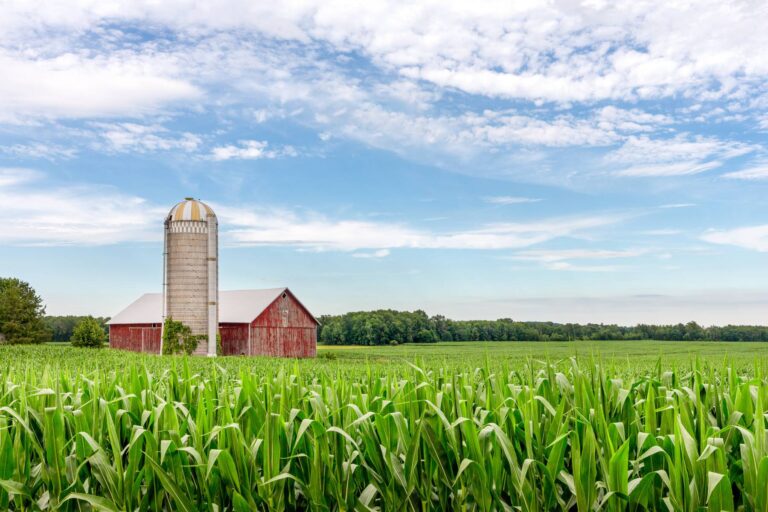
There are plenty of iconic barn shapes throughout America, from different periods in our history and designed for specific types of agriculture. We’ve moved from large, open buildings to structures based around cattle stalls and hay storage. These historic buildings were once an integral part of American life, and remain a crucial element on a working farm.
English Barns
The first barns built in America came from design ideas brought over from England by the colonists. These were simple, open structures built with timber-frame construction. Often windowless, English barns usually had the entrance doors along the eaves and did not have any basement or loft space.
Born out of feudal community spaces in medieval Europe, the designs of the colonists were approximately 30 x 40 feet with a “threshing floor” in the center of the barn. This area would be in front of the eave doors, and would be where the farmer harvested his wheat.
The rest of the barn would be divided into animal stalls and grain storage. English barns were not designed for large-scale agriculture, and the harvesting and storing of grain was their main purpose. The average farmer of the 1700 to 1800s did not have herds of livestock, and needed only a few stables for the family cows and workhorses.
Yankee/New England Barn
Yankee or New England barns emerged from the original English styles, but with an eye towards increasing livestock on the farm. In the 19th Century, farming had shifted to greater livestock production and dairy farming, agricultural needs requiring a new barn style. Changing the barn entrance and exit to the gable ends of the building, farmers were able to set up animal stables along either long side of the barn.
This type of barn would sometimes have a basement for composting manure, and would have haylofts above stalls for easy storage of feed. Usually shingled, the disadvantage of this new barn style was its lack of ventilation. After the moisture of twenty or so cow’s breaths was noticed, most farmers added windows on either end to increase airflow, and even put up cupolas for added ventilation.
The doors on the gable ends allowed the farmer to expand the barn simply by lengthening the original structure.

Bank Barn
Needing still more room for cattle, dairy farmers soon started building barns based off of the Yankee style into hillsides and banks, allowing them to easily add one or two stories to the structure. Most commonly with the entrances on the gable ends, bank barns had cupolas and clapboards for ventilation.
The multiple stories would allow for feed and manure to be kept on the base level, along with a few cattle. The second story would be dedicated to cows, and because of the barn’s hillside design both levels would be accessible from the ground. A third story, accessed by a ladder, would be the hayloft.
Bank barns remained common from the late 1800s through the mid 1900s.
Round Barn
A pinnacle of efficiency in cattle farming, round barns were designed around the idea of housing the maximum number of cows, with as little wasted space as possible. Promoted by agricultural colleges, round barns would house cattle in stalls around the perimeter, with their heads facing into a central hay and feed station. Manure could be easily removed from the outside edge of the barn.
This style was popularized at the turn of the 19th and 20th Centuries, and older designs date back to Shaker communities in the early 1800s. Often a second story would have a walkway for easy distribution of hay. The barns tended to cost less to build, and the central area could house a silo for easy grain storage.
Unfortunately the promotion of these barns as highly efficient was viewed skeptically by conventional farmers and the style never caught on at traditional farms. The shift of agriculture from dairy and cattle to crops, and the spread of modern machinery quickly eliminated the advantages of this type of building, and though rare, it has become one of the most remarkable styles of barn in America.
Prairie Barn
The prairie barn has become an icon of the Western and Midwestern landscapes. Built with an eye toward the maximum storage of hay and grain, prairie barns were large, with several upper story lofts and long, low roof lines. The increase in size reflected the constant need for more space, as cattle now roamed the vast plains of the West.
The expansive roof allowed for liberal floorspace, which could be used for livestock and further storage. Built in the early 1900s, prairie barns would have entrances along the ends, and are very open in design.
Dutch Barn
The majority of Dutch barns were built in upstate New York, New Jersey, and Pennsylvania. The settlers in this area were Dutch and brought these designs over from their homeland.
Outwardly similar in appears to the prairie barn, Dutch barns had long, sloping roofs and mortise and tenoned beams. Built in the early 1800s, these barns were simple and open. Clapboarded, with gabled roofs and smaller side doors as well as large carriage doors on the ends, Dutch barns remain one of the rarest types of barns in America today. Side isles would house livestock, while the center area would be used for threshing wheat much like in the English barns.
Commercial Barns
Combining the ideas of the long, sloping prairie barns and the tall loft space of Yankee barns, in the early 1900s farmers started to change their barn designs again. As agriculture shifted yet again, and the demands of the American people for more fresh milk and beef increased, barns had to once again grow to house more cows and more feed for those cows.
With modern technological advances, barns no longer had to be built with timber frame bases, but could be put together with wire nails and metals roofs. The cost of labor to build the barn had gone down, and the railroad system made getting unusual parts by mail order quick and easy.
The roofs of barns in the 1920s were gambrel, allowing expansive loft space for hay storage. Floors turned from wood or dirt to easy-to-clean cement, and floor plans opened up to house more tractors and other modern machinery.
Other Styles
There are many other barn styles, built for specific needs and regions of the country. Tobacco barns, common in the South, were designed to hang and dry tobacco after its harvest and had open sides for maximum air circulation and extensive poling throughout the barn for hanging the leaves upon. Crib barns, also common in the South, were simple log barns with middle breezeways and lofts for feed storage.
Before refrigeration, ice was stored in large open barns or, in warmer climates, in roofed structures that otherwise were dug underground. Pole barns, still commonly used for hay or machinery storage, became popular during the Great Depression because of their simple, cheap design and ability to protect and cover a large amount of product.
Barns in America are part of our national landscape. These iconic structures not only make up our countryside, but they’ve served vital roles in the development of agriculture in this country, and changed to suit the needs of our consumers. Traditional American barns are disappearing from our landscape, due to negligence and the wear of time, but the remaining structures are a treasured part of our agricultural history.
Kirsten Lie-Nielsen farms about 2 acres of a suburban homestead using geese for weeding and guarding purposes, raising chickens for eggs, bees for honey, and maintaining vegetable gardens for personal use. Recently she has begun work restoring an old farm in hopes of farming full time in the future.
All MOTHER EARTH NEWS community bloggers have agreed to follow our Best Blogging Practices, and they are responsible for the accuracy of their posts. To learn more about the author of this post, click on the byline link at the top of the page.






