

Whether you’re managing five pregnant ewes or 500–as
my husband Mac and I did last spring–you’ll soon find
that establishing a routine lambing procedure can keep
birthing nightmares to a minimum. After nearly six years of lambing and raising lambs, my husband and I have come up with
several shepherding techniques that make our lives a lot
easier during this crucial time of year. Perhaps by sharing
some of our hard-won experience we can spare you some of
the agony and expense that comes from learning about
lambing by trial and error. Using our tools and procedures
won’t necessarily result in the 200% lamb crop
every shepherd hopes for of course, but it may (at least)
keep you from having such a lousy time with lambing that
you give up on sheep raising altogether!
Worming and Flushing
Many of the steps that can help insure successful,
hassle-free lambing experiences should be taken well
before the actual birthing days begin. Indeed,
such preparatory measures are so important that I’ll devote
this entire article to them. In a separate article I will
describe a good shepherd’s duties during those
exciting–and tiring–“birthday weeks”.
Mac and I start our lambing preparations, six months before
we see the first fuzzy babe, by worming and
flushing our herd. Both actions will, by boosting
the fertility of our rams and ewes, improve the chance for
multiple births and increase our lamb crop by as much
as 20%!
We find the best prebreeding wormer to be the oral
medication Levamisole. (Ask your vet for a recommendation,
though, as other medicines might be more suited to specific
problems in your area.) This broad-spectrum parasiticide
kills almost all stomach and intestinal worms in sheep, and
wipes out lungworms (parasites that inhibit breathing) as
well.
The term “flushing” refers to giving livestock a short-term
quality and quantity increase in their feed. A month before
breeding begins, we start feeding each sheep 1/4 to 1/2
pound of grain per day, and turn all the animals out in
lush fall pastures. If, however, the new pasture is
largely legumes–such as clover or alfalfa–we’re
careful to set the animals on the new land for only short
periods of time at first, and then to increase their
grazing time gradually. This precaution protects the sheep
from bloat, a dangerous and often
fatal entrapment of gas in the rumen that can follow
a too rapid ingestion of legumes.
Schedule Breeding
If your ram’s free–as a relative of ours used to
say–to “spread his raw oats” from Labor Day to
Mother’s Day, you won’t know whether your ewes were bred
for a January “drop” in nine-below-zero weather (in which
case you’ll get lamb popsicles instead of sheep if the
newborns aren’t immediately sheltered) or July birthings
(when summer flies can practically devour both mothers
and offspring).
A good shepherd will, therefore, limit the range of lamb
birthdays by [a] pasturing all rams
separately–and securely–until
approximately five months in advance of the desired first
lambing date, and [b] removing the sire from the ewe
pasture five months before the date upon which he or she
hopes the season will end.
Or, to be more specific: A sheep’s gestation period is
roughly 143 to 150 days (it varies some from one breed or
individual to another). So if you want your first lambs to
arrive soon after February 24, let his highness start
breeding the ewes on September 28. Then if you plan to stem
the tide of newborns after, say, May 25, you’ll have to
sentence the stud to celibacy by December 27.
Since the estrus (heat) cycle of a ewe is approximately 17
days, that 91-day sheep breeding program would allow each ewe
five cycles to become pregnant … and believe me, a well
cared-for animal that hasn’t been successfully bred
after five tries simply isn’t worth feeding. In fact, on
our large farm, we allow breeding during two heat cycles
only. Those females that turn up barren at lambing time (an
average of 5% annually) are culled; that is, sent to
either the auction block or the freezer.
There’s a good reason for our establishing a shorter
breeding season, too. After all, 91 consecutive days of
making nightly (3:00 a.m.) lamb checks, attending difficult
births (sometimes for days at a stretch), and trying to
keep track of the separate feeding requirements of pregnant
and lambed ewes would seem like an eternity of labor. By
limiting the breeding time, we guarantee a shorter lambing
season, keep our farm functioning on a practical basis,
and avoid nervous breakdowns!
Identify Your Ewes
You won’t be able to tell which animals should be culled at
the end of the season unless all your sheep are properly
identified. Of course, if you’ve got only a few
wool-bearers, you can name the
individuals–we started out with Granny, Fancy, and
W.B. (Wild Bastard) ourselves–but anyone with more
than five sheep will find numbered ear tags essential. Be
sure to attach the markers to your flock members well ahead
of lambing season so you won’t put the expectant
mothers through potentially stressful experiences just
prior to delivery time.
Our ewes each wear two tags: a slim metal label in one ear
(put on when the animal was a youngster) and a large,
plastic, double-sided tab–which is easy to read from
a distance–in the other. The bigger labels can be
really helpful in the long-range “detective work” a
shepherd often gets involved in during lambing time. (It’d
be great if a ewe would walk up to you and confess, “Hi!
I’m No. 161, and I just had twins back there behind the
barn. One’s dead and I don’t much care for the other.” That
kind of cooperation, however, is a bit rare.)
Supplies and Equipment
Two months before the first lamb is due, we organize all
the birthing equipment we have and order any new items
we’ll need. Keep in mind, though, that Mac and I have a
large operation, and almost all the births occur out in the
fields. A small-scale shepherd, especially one who keeps
any expectant ewes in a barn–as could well be the
case in cold weather–might not need all the equipment
described here.
[1] Iodine. We use a 7% solution of the
disinfectant (it’s available from a veterinarian,
veterinary supply house, or feed store) to coat all the
newborns’ navel cords immediately after birth.
This procedure will help to prevent bacteria-caused “navel
ills” (infections) and/or lamb scours (diarrhea).
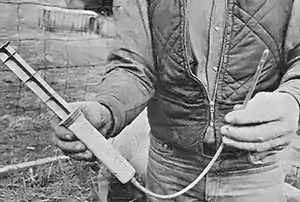
[2] A 60-cc. syringe with a small-bore rubber
catheter When my husband and I are nearly exhausted
from long days and nights, foul weather, and
uncooperative mothers, the last thing either of us wants to
do is try to con a reluctant ewe into standing still or convince a starved but confused infant that it needs to
nurse. With the syringe and a 14″ to 16″ catheter (both
should be available from a local drugstore or medical/ veterinary supply company), we can quickly and
easily tube-feed a small lamb some of the vital
antibody-laden colostrum (the milk a mother produces the
first day after birth) that it needs to survive.
[3] Cow colostrum. Emergency supplies of ewe
colostrum are hard to come by, and there is no reliable
synthetic substitute. Cow colostrum, though, can provide a
newborn lamb with the necessary antibodies and vitamin A,
as well as help set its digestive system in motion …
and the calf nurser, is readily available. (In fact,
dairies often have to discard surplus colostrum!) So we
try to obtain a gallon or two of the defense-giving fluid
from a local dairy at calving time, and freeze it in
plastic rneat trays.
We can then defrost the “first milk” when it’s needed (be
careful, though. Colostrum can easily be spoiled by
cooking, so if there’s not time to thaw the liquid at room
temperature, it must be warmed very gradually in a
double boiler), load the syringe through the catheter tube,
clear the air from the dispenser, and give any weak
youngster a two-ounce swallow of milk. To do this, we
slowly slide the catheter tube down the lamb’s gullet and
squeeze–gently–on the syringe’s plunger to
squirt the milk out. You have to be careful not to send the
liquid down the newborn’s windpipe (if you can feel the
tube traveling down the animal’s neck and see it pressing
against the lamb’s flesh as you install it, you’re doing
fine) and to inject the milk slowly, so it doesn’t bubble
over into the windpipe. Otherwise, the youngster could come
down with pneumonia.
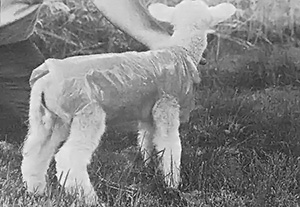
[4] LamDry Covers. Believe it or not, we’re crazy
about these plastic lamb raincoats! In cold or wet weather,
a baby sheep can lose 50% of its body heat within half an
hour after it’s dropped. Since most of our lambs are born
in April–when a gentle spring rain can suddenly turn into a
nasty ice storm–we dress all the newborns in LamDry
covers to help lock in their body heat. And to lessen the
(remote) possibility that a ewe will reject her
trench-coated offspring, we also smear some of the mother’s
afterbirth on each newborn and its wrapper. Three days later when we dock the youngster’s tail we then remove the rain gear. LamDrys are available from Sheepman Supply.
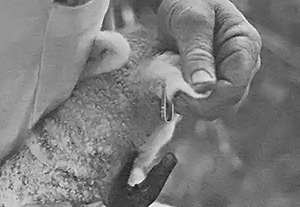
[5] Lamb tags and pliers. We’re reminded of the
importance of lambs–and ewe–identification each time we discover a lost youngster.
The little one’s tag enables us to restore it to family
security in an instant.
To label the babes, we use specially designed pliers that
punch through the animals’ ears and attach small aluminum
tags. (Both items are available from sheep supply houses.)
And we make sure the loops hang free to allow room
for the animals’ subsequent growth.
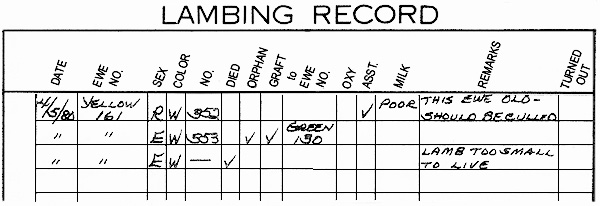
[6] Lambing records Since it’s necessary for any
serious sheep-raising operation to keep track of which ewes
are good breeders and which will need to be
culled, we maintain record sheets that can provide us with
a wealth of detail at a glance.
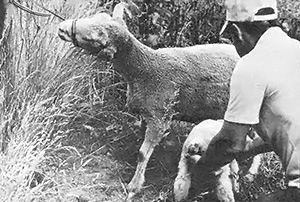
[7] Halter. Since Mac and I alternate lamb check
shifts, we each often single-handedly cope with
emergencies–such as a lamb that needs to be pulled
out of a skittish yearling ewe–in the field.
Therefore, we always carry a sheep halter to snub a ewe to
the fence in such situations. (A restrainer can be made
from baling twine–just tie a simple noose–or
purchased from a sheep supply house.)
[8] Hurdles. These folding half-pens are made of
two five-foot-long, lightweight-lumber fence sections that
have been hinged together. We position hurdles near the
lambing area’s fenceline to form temporary pens. Since
twin-bearing ewes sometimes reject one offspring when in
open pasture–while a short period of confinement
together can help cement family
relationships–we “jug” (as hurdle-penning is often
called) all mothers that give birth to two lambs until the
parent seems to accept both children. At other seasons the
conveniently mobile–if somewhat flimsy–fence
sections serve as chutes for pasture rotation, stalls for
worming, temporary fence patches, and hospital pens.
[9] Antibiotics and a syringe with I8-gauge
needles. We keep both oxytetracycline and
dihydrostreptomycin-penicillin on hand during lambing.
Oxytetracycline is administered to any ewe that’s just had
a birthing trauma. [EDITOR’S NOTE: We’d recommend
consulting a vet when a ewe has serious lambing
difficulties.] And one-half milliliter of
dihydrostreptomycin-penicillin is given to lambs
to help prevent a pinkeye irritation that can be
caused by nursing through dirty wool. (Ideally, expectant
ewes should be “crutched”–that is, shorn around the
crotch and udder-before lambing time. Since we don’t always
manage to shave every ewe on our busy farm, we occasionally
have to fight pinkeye with appropriate medical artillery.)
[10] Docking and castration equipment. Most
shepherds have strong opinions about which docking and
castration tools are best. We’ve experimented with
all the common techniques, though,
and–through experience–have come to feel that
the most humane yet thorough methods for the two procedures
are to dock tails with a burdizzo (a clamping instrument)
and knife, and to castrate with a knife alone. Both
operations can be accomplished quickly–thereby
causing less extended trauma for the lamb than
other techniques do–and don’t usually cause much
bleeding.
Useful Options
Here are some optional tools that have proved very
useful around our farm.
[11] Long-handled aluminum fishing dip nets. If
your sheep are all pets, this sort of lamb-snatching device
may seem outrageous, but if–like us–you need to
catch a number of speedy and agile three-day-olds each year
for tail docking, a net can help a lot!
[12] Lamb milk replacer, lamb nipples, and pop
bottles. When a mother dies or rejects a twin and
there isn’t a substitute parent available for the orphan,
you’ll have to raise the foundling yourself. Lamb milk
replacer and nipples that fit a standard soft-drink
bottle–the usual tools for this job–are
generally available at feed stores. Properly formulated
lamb replacer, by the way, has an entirely
different salt balance and fat content from calf
replacer, so don’t use the bovine compound.
[13] Thermal vacuum bottle. We carry an insulated
jug filled with warm colostrum on every lamb check so that
we can tube-feed any weak newborns on the spot.
[14] Wagon. A garden cart–or even a child’s
toy wagon–is a useful vehicle for carrying supplies
around in a field.
[15] Bedding. Since we use lambing pens only
occasionally, clean bedding is largely an optional item for
us. It’s essential, however, when lambing occurs in a barn.
The floors of such areas must be kept scrupulously
sanitary–and the bedding changed often–to ward
off lamb scours and other evils. Clean hay is excellent for
this purpose. Sawdust bedding, on the other hand, may get
tangled up in the wool and–if it does–sharply
reduce the fur’s salability.
[16] Selenium and vitamin E. To prevent an ailment
called white muscle disease, many shepherds routinely
inject their lambs with a selenium-vitamin E combination … especially if the animals will graze on soils deficient
in these nutrients. (Consult your vet for more
information.)
Health and Nutrition Before Lambing
Four to six weeks before lambing begins, we put pregnant
ewes on maternity grain rations. Textbooks suggest starting
out with 1/4 to 1/2 pound of grain per sheep per day, and
increasing the diurnal ration to 1 1/2 pounds per animal.
We’ve found, however, that applying a set recipe to a whole
flock doesn’t work well, since some ewes will need more
feed than others. (Fat animals, for instance, don’t lamb
easily while skinny ones have weak offspring and
produce little milk.) So we either match the middle range
of our herd’s requirement or, if necessary, divvy the flock
into two or even three feed groups.
In addition, since strong sheep give birth more easily than
do weak ones, we make sure the ewes get plenty of moderate
walking exercise by setting the grain rations out at some
distance from the animals’ grazing area.
A good prebirthing diet and exercise program should also
help prevent pregnancy toxemia, or ketosis, in your
expectant ewes. This serious, and frequently fatal, malady
is caused by a disturbance of the animal’s sugar
metabolism. Afflicted sheep will tend to be weak and
listless. They may also grind their teeth, lose their
appetites, become constipated, and develop an “off” breath
smell. Consult a vet if you suspect toxemia in any of your
sheep so you can treat the deficiency immediately. (The
doctor will usually recommend a commercial ketosis
medication, propylene glycol, or glycerin.)
Then, at least two weeks prior to lambing, we vaccinate the
ewes for enterotox emia (also called pulpy kidney or
overeating disease). One of the most common causes of lamb
deaths, this quick-striking killer has no known
treatment and often gives no visible warning symptoms. It is
caused by a germ known as Clostridium perfringens
Type D. The bugs are normally present in small numbers in
the lower bowels of sheep, but can–when heavy feeding or
rapid growth occurs–spread to the small intestine and
create a lethal poison.
Fortunately, though, by vaccinating the ewes at least two
weeks prior to lambing, we can be sure that the youngsters
will pick up the immunity through their mothers’ colostrum.
The lambs should also receive booster shots at four to
eight weeks of age, as further insurance against this
disease. (See your veterinarian for medication.)
Finally, Mac and I attend to our own health and
nutrition. During the lull before the lambing storm, I
stock the larder, bake extra bread, freeze heat-and-serve
meals, and prepare lots of yogurt to eat on the run! With a
whole farm full of ewes to help through birthing, the
lambing weeks figure to be rather like a marathon. We’ve found that poor nutrition makes poor shepherds. So
regardless of the hectic pace we keep up while our
flock is growing, my husband and I do take the time to
maintain a healthful diet.
EDITOR’S NOTE: Information on administering livestock injections
properly can be found inRandy Kidds article “You
CanToo Give That Animal an Injection!”
Raising Sheep the
Modern Way by Paula Simmons is a fine textbook for shepherds.
A Few Sources of Sheep Supplies
Sheepman Supply Company
Omaha Vaccine Company
Mid-States Wool Growers Cooperative Association






