

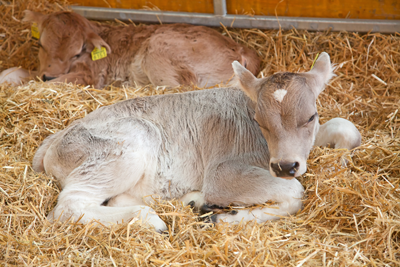
The milk cow shifts around the calving stall and eyes us
with some exasperation. She’d just as soon we left. But we
stay standing at the other end of the barn where we won’t
annoy her too much, smelling the good sweet smell of green
hay and healthy animals. Through the gloom we see that she
has dropped her calf, and we hurry forward to look at it.
Raising a Dairy Calf
There on the clean straw lies a wet little creature, weak
and spangled with tissue and blood. It lifts its head, its
ears back, and lets out a small blat. We can see that its
nose and mouth are clear, so we stand and watch. The cow
has turned to find out what in the world happened back
there, and — intensely interested — she stretches
her head out to the calf. Then she utters the peculiar soft
moo kept only for this occasion: the bovine equivalent of
an old woman’s “Oh, isn’t that sweet!” She reaches out her
long, rough tongue to begin the grooming which will warm
and strengthen her new baby.
“So what’s the problem?” you say. “Let’s all go back to
bed.”
The problem is that that dairy calf represents centuries of
severely selective breeding. For generations, man has bred
a high production milk cow to the son of a high-production
milk cow . . . and repeated that process until we now have
milk machines known as dairy cattle. And something happened
to the calves along the way: They lost the ability to
survive on their own.
While the beef calf can get on well outside with its
mother, the dairy calf is more prone to disease. . . and in
any case can’t be left with its mother for more than a day.
She produces far more milk than the baby needs, and the
overfed youngster will soon be sick with scours (diarrhea).
Nevertheless, the little creature is a valuable animal and
worth the extra attention it requires.
My husband has the iodine dip ready and enters the calving
stall. The cow, who knows him well, lets him admire her new
baby. By this time the calf is trying to stand, with the
mother’s tongue alternately helping it up and knocking it
down. My husband checks to be sure the newcomer’s nose and
mouth are clear, raises the baby to its feet, discovers
that it’s a heifer (female), covers the navel cord with
iodine dip to prevent infection, and heads the critter in
the direction of its first meal.
Ideally a calf should suck within fifteen minutes after
birth, but many healthy babies aren’t ready for an hour or
an hour and a half. If the youngster hasn’t fed in that
time, help it to the teat and squirt a little milk into its
mouth until it begins to nurse.
Occasionally a first-time heifer won’t claim her offspring.
When this happens, sprinkle a little grain on the calf. The
cow should lick up the feed and then go ahead with the
normal grooming. If she refuses to do so, rub the calf
vigorously with an old turkish towel or a clean burlap bag.
Be energetic about it . . . this procedure dries and warms
the little animal and helps its circulation.
Once in a while, a new mother may refuse to let her calf
near her (some will even kick at their young). In that
case, put Ma in a stanchion and the baby in a clean, dry
calf stall. Milk the cow, put one quart of the warm fluid
in a nipple bottle and do the feeding yourself.
Congratulations! You have just become a mother.
If a fresh cow claims her calf you may leave them together
in the calving stall for one day, after which the youngster
must be put where it can’t suck. (Dairymen separate the two
as soon as possible after birth and absolutely by the third
day.) The cow will be happiest if she can see her
offspring, but won’t suffer if this arrangement isn’t
possible. Some, in fact, are upset by the responsibilities
of motherhood and show relief when the baby disappears.
We’ve never seen a cow mourn, but we’ve always kept more
than one and it’s possible that the herd instinct overcomes
the maternal urge.
For the first six milkings after the birth of her calf, a
cow yields a substance called colostrum instead of milk.
This highly nutritious food is rich in antibodies which
help the young animal fight off the many diseases and
infections to which it’s prone. Now you know why it’s so
important for the baby to have its first meal soon after
birth. Without colostrum, in fact, the calf won’t survive.
In the past, excess colostrum was fed to chickens or pigs .
. . or just dumped. (Or, in northern Europe, eaten
by humans. See MOTHER EARTH NEWS NO. 23. — MOTHER.)
Today, dairymen are saving the surplus and feeding it until
it’s gone.
Here’s how to store colostrum: For the first three days
after a calf’s birth, put one and a half quarts from each
of its mother’s milkings — morning and
evening — into a clean pail, nipple bucket, or bottle
and feed the baby. All excess milk should be poured into a
clean milk can, a garbage pail with a tight-fitting cover,
or any container which can be kept sanitary. When the
collection has soured, it’s referred to as “pickled
colostrum” and is the absolute best food for calves
available anywhere. Young animals started on it maintain
fine coats, are much less prone to pneumonia, are almost
free of simple scours, are vigorous, and grow well. This is
understandable, since colostrum is a completely natural
diet. (No food alone can prevent illness in newborn calves,
of course, if the babies are neglected.)
Begin to feed pickled colostrum when the new calf is three
days old. Stir the sour milk well and measure three cups of
the thick fluid into the same amount of hot water. Mix and
feed the warm ration to the calf twice a day. (Large
youngsters may be given up to two quarts at a time.) When
the colostrum begins to run out — or if you’ve bought a
calf to raise — you’ll have to decide whether to finish
the animal on whole milk, skim milk, or commercial dry milk
replacer.
At about ten days of age the calf should be offered a
little dairy grain mix and green leafy hay. Put the feed in
a clean grain box and replenish it as the baby eats the
mixture. In fine, warm weather, calves as young as one week
can be put out on clean pasture where they’ll soon be
nibbling a little grass (and thriving on the sun and fresh
air).
At one month of age, larger breed calves (Holstein and
Brown Swiss) should be getting four quarts of milk daily,
0.7 pounds of grain, and 0.2 pounds of hay. They may be
weaned at six weeks if they’re doing well. Smaller calves,
such as Jerseys and Guernseys, need three quarts of milk a
day, 0.3 pounds of grain and 0.2 pounds of hay. They’re fed
milk until seven or eight weeks of age and thrive on
less rather than more per feeding (never more than
a quart and a half at a time).
Sometime before weaning a calf you’ll probably want to
teach it to drink from a bucket. This isn’t difficult if
you remember that the critter has a natural tendency to
butt its mother’s bag to make her milk flow more quickly.
It also has a natural tendency to butt the milk pail . . .
so hold tight, or you’ll end up with a bucket hat.
Put the milk ration in a clean pail. Back the calf’s rump
into a corner, straddle its back — facing
forward — and hold the animal firmly between your legs.
Grasp the milk bucket by the far rim with your left hand.
Put the middle finger of your right hand into the critter’s
mouth (it won’t bite) with your palm over its nose. When
the baby begins to suck hard, lower its mouth into the
liquid and — once it’s taking the milk
well — slowly remove your finger.
Some calves learn the first time, others take a week or
more to get the hang of it. A youngster that declines to
drink won’t be hurt by missing one feeding and will learn
more easily when hungry. Occasionally one will refuse to
suck your finger and will have to be fed with a nipple pail
or bottle for the duration. Whatever, every utensil used to
feed calves must be washed and sanitized after each use.
Until they’re weaned, the animals should be tied or stalled
separately to prevent the spread of disease or infection.
This also facilitates feeding and prevents the young ones
from learning to suck one another.
Maybe you’re thinking that this feeding business sounds
like a lot of trouble when you have a perfectly good cow
handy. So OK. In spite of what I’ve just said, some people
do let their calves nurse, with satisfactory results. I
never do so myself, however, because I can’t tell how much
milk the young one is getting . . . but if you want to try,
the accepted procedure is to let the baby suck out one
quarter of the mother’s supply and no more. Good luck.
Shelter is simpler than feeding, but just as important.
Calves must be kept dry and out of drafts. Although they
can stand a lot of cold, temperatures far below freezing
are hard for them to cope with because too much of their
energy must go to keeping warm. If you haven’t enough
livestock to keep your barn comfortable, wall off a small
area where a few animals can keep each other warm . . . or
start to build your herd with small calves during the warm
months.
Then again, a satisfactory draft-free calf stall can be
made of two 4 by 8 sheets of plywood. Just build a 3 foot by 5 foot
bottomless box raised several inches on legs of scrap
lumber, and place enough bedding inside directly on the
barn floor to reach up to — and overlap — the lower
edges of the four plywood walls.
The best method of bedding, we’ve found, is to start with
an ample layer and let the material build up under the
calf. Fork out the manure daily and add clean straw or
whatever . . . and the baby will soon have a clean, warm,
well-drained bed up off the floor. When a calf is moved,
clean out and sanitize the stall before putting down fresh
bedding for the next one.
Simple preventive measures like those I’ve been describing
are the best medicine for your animals. Observe common
sanitary procedures in everyday handling, intensify those
procedures if disease breaks out in your barn, and you’ll
be able to raise most of your calves. If any of our own
herd are really sick, though, we use antibiotics to help
them fight off the infection. It’s worth the expense: A
healthy two-year-old springing heifer (one that’s about to
calve) will sell for over $500 anywhere in Wisconsin today,
and a dairy bull will fill our freezer for a long time with
meat as good as or better than most we can buy. A dead
calf, on the other hand, is of no use to anyone.
If you give your baby too much milk, or if it gets loose
and nurses, it may develop simple scours (a foul-smelling,
pasty bowel discharge). Skip one of the calf’s meals, then
resume feeding the baby half as much of the formula as it
received before it got sick. You can also dissolve
one-quarter cup of pure rennet in the milk — one-half
cup may be necessary in severe cases — or give the
youngster a dose of Pepto-Bismol or Kaopectate. When simple
scours is brought on by unclean utensils, drafts, etc.,
correct the cause and treat the condition as described . .
. but watch much more closely for signs of infection which
may require antibiotics. (Medicines and syringes are
available at farm supply stores everywhere and should be
kept on hand at all times when you’re raising calves.)
A calf weakened by scours is apt to develop other
illnesses. When a scoury youngster stands with its head
slightly drooping, its ears back, its rump slightly tucked,
and its tail drawn under, that’s a sick animal. Watch it
closely for signs of pneumonia: sneezing, coughing,
wheezing, difficult breathing and/or nasal discharge. If
any of these symptoms appear, immediately inject
antibiotics as per the directions on the bottle. Blood in
the discharge may mean bloody scours, a very serious
infectious disease which also requires antibiotic
treatment.
If you intend to sell your heifers or your milk, by all
means have female calves vaccinated for Bang’s disease
between the fourth and eighth month of age. Many farmers
won’t buy an animal unless it’s protected against this
condition, which is transmitted to humans as undulant
fever.
When the vet comes by to vaccinate a new batch of babies,
we also have her castrate our bull calves. It’s a quick,
painless, bloodless procedure when done with a crimper
(which destroys the semen channels without cutting). If
you’re inclined to keep an uncastrated male, remember that
the vicious beasts of storyland weren’t the beef bulls we
see so often. They were dairy bulls . . . and dairy bulls
are still by far the more dangerous (Jerseys being the
worst of all).
Once your male calf is a steer, however, you can keep him
safely while he grows into a source of excellent eating.
The only obvious difference of dairy cattle meat from that
of beef cattle is the color of the fat in the Channel
Island breeds. The jersey’s fat is cream-colored rather
than white, and that of the Golden Guernsey is definitely
yellow. This in no way affects the flavor or the quality of
the meat.
Is raising a dairy calf worth all the trouble? Yes! And not
just for the future meat and/or milk it represents. A
healthy baby romping around a sweet, clean pasture is a
sight you won’t soon forget. The sleek coat that glistens
in the sun, the clear eyes, the fun-loving, affectionate
nature are all part of the “extra dividends” you’ll get in
return for the proper care of your newborn calf.






