

Hi everyone! We’ve just wrapped up week two – another busy week. I feel like I’m getting more accustomed to the work routines, but overall, I’m tired! I think I’d have to have been an Olympian prior to coming here to not be tired and a little sore. Chores, projects and all the other farm tasks tend to be very physical work and can take a lot out of you. I remember reading on Polyface’s website before applying for the internship that the interns tend to have a rough time for the first few weeks adjusting to new people, surroundings, water, workload and the like and for me, settling in hasn’t been difficult. Everyone is really nice and I’m thoroughly enjoying myself. I’m just tired! I have a feeling this will dissipate in the next few weeks as I get stronger and I keep bulking up on the delicious farm food. Enough about that – on to the week!
Monday, June 9th
Monday morning started out with watering the broiler shelters. We usually have teams of three working on the broilers; one to move the shelters, one for watering and one for feeding. After chores and breakfast, we split up into groups and each did different projects. The group I was in unloaded and stacked four wagons of hay making sure to salt each row before stacking more hay on top. Joel and Daniel told us this cures the hay, makes it taste better to the animals and prevents moisture. It was nice to be able to do this under the roof because we had some pretty intense showers that morning. After hay, I helped one of the apprentices fill the pig feeders using a grain buggy hooked up to the tractor, did some clean up projects around the farm and packaged ‘parts and pieces’ (parted up chicken pieces) for the walk in freezer.
After lunch, I went with one of the apprentices to a farm property Polyface manages to move cows into their new paddock. In Joel Salatin’s book Salad Bar Beef, the cross fence/cow days process is explained, but I’m going to wait until we have our presentation from Joel (this is supposed to be in the next week or so) before I go into greater detail. Essentially, the cows are allowed to mob graze a particular section of paddock until it is eaten down to a certain point. They are then moved on to the next section through a system of electric fencing (“cross fences”) that are very easy to set up and dismantle. The cows learn this routine, love getting fresh pasture and are thus very easy to move.
My evening chore was to feed the turkey poults, which was a lot of fun. Baby turkeys, and turkeys in general, are pretty friendly, amiable and funny. I haven’t had the chance to work with the turkey poults in the morning, but at night they are given additional feed and water along with some grasses, which they love.
Tuesday, June 10th
Tuesday morning’s chore was working with the rabbits. I split this with one of the apprentices, so my job was to feed the rabbits their greens and move the mobile rabbit shelters. The rabbit shelters are pretty handy and do a great job of keeping the grass low. I’d recommend building one if you’re looking for an urban homesteading project. (Last week’s blog post shows a photo of a mobile rabbit shelter.) After breakfast, my group of interns went to sort pigs with one of the apprentices. Polyface has this nifty hydraulic pig trailer where the back end lowers to make it easier for the pigs to get on and off. The goal was to remove twelve of the largest pigs from the herd for processing. We end up herding most of the group into a makeshift corral and letting out the ones that are too small, too young or otherwise not suitable until we have the twelve that we want. Once that was completed and the pigs were brought back to the barn from the field, the same group of us went to get Polyface’s bulls that are kept in separate farm managed properties. This was the first time I had ever seen cattle loaded into a trailer, so it was a pretty interesting field trip. This was also the first time we were able to practice our cattle calls, which was pretty funny. We were all being bashful and not wanting to bellow out the wrong sound, so it made for a fairly quiet cattle drive.
After lunch, we unloaded two more wagons of hay, using the same salting and stacking method. With as much help as we have, the unloading goes quickly, but it is still hard work. This was followed by dismantling a retaining wall that has seen better days, my being allowed to drive the tractor for the first time (Yay! It was for about three minutes, but still, yay!), pulling up old garden plastic and prepping a garden area for sweet potatoes.
Wednesday, June 11th
Wednesday was for the most part a poultry day for me. I started out by moving the broiler shelters. Earlier in the week, another group had removed broilers from the shelters at another farm that Polyface manages, and after breakfast we interns took a trip to this property with Daniel and the other apprentices to learn how to prep the shelters for the next group of birds. Prepping the shelters includes scrubbing out the water pails that sit on top of the shelters, the chicken waterers themselves and water trough and also repairing any shelters that may have suffered some wear and tear. I’ve included some photos so you all can see the way the shelters look, but for the sake of not passing on incorrect information, I’m going to ask that you refer to Pastured Poultry Profits for any technical questions. (I’ve only been here a few weeks, so I’d feel weird pontificating to you all about how to build one.) In any case, we shored up any boards or braces that had cracks, stapled down any wayward chicken wire and moved the empty pens to their proper positions. We then helped Daniel as he repaired some wire fencing and cleared brush to make room for a new fence the property owner plans to build.
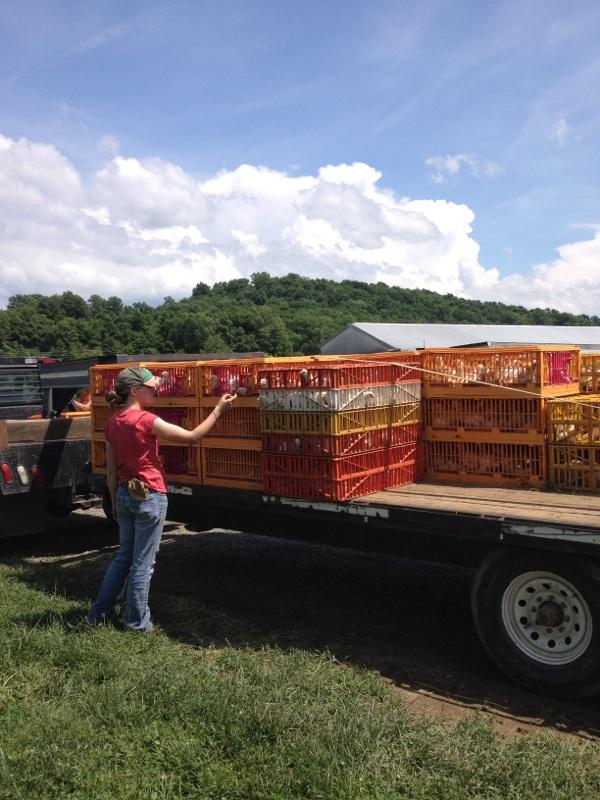
After lunch, we went into the brooder where the broiler chicks have lived for the past few weeks, put them in their crates and sent them off to greener pastures (literally) to live in the shelters we prepped for them that morning. It was nice seeing them ride off as I knew they would enjoy the fresh grass and nice prepped shelters. After they left, we prepped their brooder for the new baby chicks that we were expecting and my evening chore was putting the broilers to bed. I didn’t actually do that, but that’s how I like to think of it. We check their shelters, make sure everyone is doing well, top off their water and make sure they have enough to eat.
Thursday, June 11th

Thursday morning was moving broilers again for me. Along the duration of having interns moving the shelters, the spacing (not surprisingly) had gotten a little off kilter and one of my roommates and I had to correct their placement. I’m sure I had something to do with the off-kilterness, so it was a good lesson to have to correct them. The rest of the morning I spent packaging part and pieces (See Monday’s blurb to remind yourself what that entails), helping our inventory manager organize the freezers and then helped at the sawmill until lunch. The corral we were conceptualizing last week with Daniel will be coming to fruition and boards needed to be made.
After lunch, we went to one of the properties Polyface manages to move a herd of cows and chop thistles. I wish I had photos to show you all, but I was too busy making sure we didn’t have a traffic jam that I didn’t think to take any. Sorry. We ended up herding the cows up the road to their next pasture and two of us needed to stop any oncoming cars. After the cows were settled in, we each took a machete and hacked the top of the thistle plants that were encroaching on the pasture. I recommend that everyone in their life hit a thistle with a machete at last once. It’s awesome. I then wrapped up the day by putting the broilers to bed and washing eggs.
Friday, June 12th

Friday morning I moved the feathernet (the laying hens and their netted fencing) with one of the apprentices and another intern. To move the feathernet, we set up a new area for them using electric netting, guide the hens in, use the tractor to move the large mobile coop the girls call home to fresh pasture and move their waterer. All in all, this takes us about a half an hour. I’m sure it can be done faster once we all get more proficient at setting up netting (which can become a tangled mess if you’re not careful) and are more used to driving the tractor. The rest of the morning was spent doing clean up projects around the farm and weeding in the hoop houses where we grow our vegetables.
The afternoon was devoted to setting up the posts for the corral. Last year’s interns didn’t have a chance to do this, so I think the apprentices who were interns last year were as excited as we were. Daniel and Joel both taught me how to dig a posthole and my job was to use the digging bar (others refer to it as a pry bar) to loosen the dirt so the posthole digger would have something to remove. Just like I’m not super handy with a sledgehammer (yet), I’m not all that handy with the digging bar (yet). I have to give the Salatins props- they are very patient. We dug the deep holes for the corner posts, as they were longer pieces of wood, but we used a hydraulic post pounder to install the posts. Watching that thing work made me grateful for machinery. After a few weeks of consecutive hard work, I really appreciate when there is a machine that can do the work for you. We stayed all afternoon and by the end of the day, we had installed the posts and set up the supports. All it needed was boards.
At dinner that night, I spoke with Sheri Salatin about her new website www.EagerFarmer.com. Sheri came up with the idea for a website that connects farmers and property owners who need help (managers, interns, etc.) with those who are looking to work on a farm. It hasn’t fully launched yet, but I’d encourage you all to go to the website and sign up for the email updates. The more people we can get connected, the better!

Saturday, June 13th
I worked this past weekend, so you’ll have an extra day’s worth of entries this week. Interns generally work one weekend a month, three interns per weekend. This past weekend, I worked with Erik and Tim who both like to sing while they work, which made for a pleasant weekend soundtrack. We started the morning with moving the broilers and filling the feed bins using the grain buggy. I was also able to drive the tractor again, which was fun. After breakfast, we had the good fortune of being able to go to a farm estate auction for the morning. This was a big treat because I love auctions and even though I purposely left my wallet behind, I still managed to buy a few things (a small sythe and a kind of broken pair of nippers – for $4, I couldn’t resist.). There was also a tractor for sale, some mowers, some antique farming equipment and lots of tools to look at. We interns peppered Daniel with questions, “Daniel, what does this do?” “Daniel, what’s this?” “Daniel, how much should this cost?”, so I’m not sure how relaxing of a time he had. After we returned, we worked on the sawmill making more boards for the fence, moved some of the pastured pigs and wrapped up the day with homemade pizza.
I hope you all enjoy the coming week. We’re planning on making a lot of hay and finishing the corral, among other things. See you next week!






