The birch leaves are falling, convincing the beech to follow suit, and the sugar maples are showing off their brilliant reds and golden hues. The evening breeze is reliably cool, and the mornings are laden with dew. The autumnal night is arriving quicker and quicker; the days, shortened, are filled with the hurry for winter.
Even as the end of this growing season is suddenly, rapidly in sight, the preparations for the next one are in front of us.
Compost.
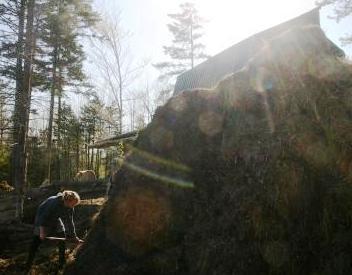
In these cool mornings, the steam from our scattered compost piles is easily visible, a wispy indication of the powerful, perpetual decomposition process transpiring within each mound of compost. Each pile is full of microbial action. Having been turned through the summer, our compost is active and alive.
If we want to talk science, compost can be understood in terms of two elements: carbon and nitrogen. In layman’s speak, this is the “brown” and the “green.” Regardless of linguistic preferences, a healthy compost pile should offer a robust mix of woody materials (woodchips, straw, old hay, dry grass clippings, woody debris) and fresh matter (food scraps, weeds, manure, fresh grass clippings). In combination with oxygen introduced into the pile through frequent turning, a hot, active microbial environment is fostered, essentially “cooking” the pile’s contents. Decomposition happens fairly rapidly in this manner, providing quality soil for use in the gardens within a season or two.
Which is exactly what we are preparing ourselves to go. As our garden beds are harvested from and weeded out this fall, a fresh layer of finished compost will be added, introducing new organic matter and increasing the fertility of the garden bed. This process is essential. Finished compost releases nutrients slowly over time, preventing soil from becoming depleted and helping to ensure plant health.
But that’s not all. Some of our younger compost piles will sit over winter, awaiting use in late spring and early summer. Our spring planting of potatoes, in particular, is an event in which we incorporate significant quantities of organic matter into an agricultural area.
More importantly that that, however, is the sifting of compost this fall in preparation for our early spring starts. Between now and the freeze, we will sift compost from our best-looking piles, eliminating any woody chunks and woodchips that remain, then storing this within large drums in our basement. This will provide us with great quality dirt as we start seeds indoors in February and March, a time when compost piles outside our still frozen and unusable.
Compost, therefore, is an integral, essential component in the health and longevity of our garden system. Rich, dark dirt: generating and promoting this essential fertility is our task at hand.