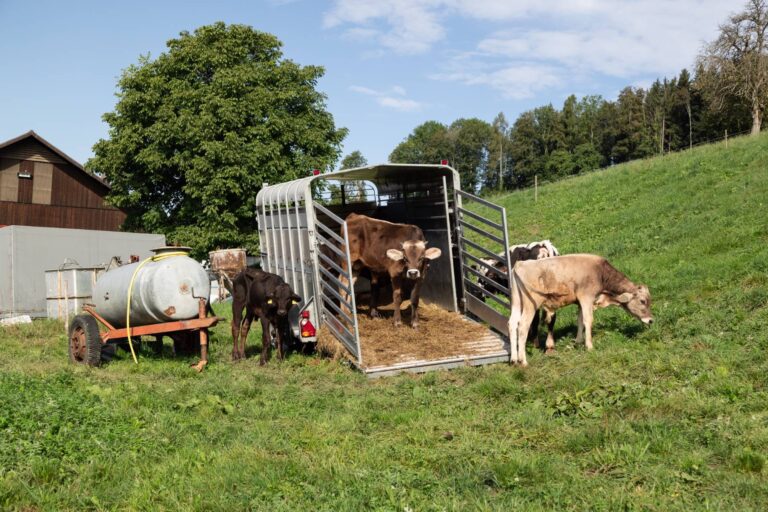
Help to transport livestock as smoothly as possible by learning these tips for how to prepare, load, and unload livestock trailers.
Loading livestock trailers is one of those skills they just don’t teach in school! At Misty Morning Farm, we run into some interesting situations. Especially when purchasing from a hobby farm where, as a rule, there are few facilities. I hope that by sharing some of these experiences and loading savvy, you can avoid potential problems and have a good experience loading your new cow. Going to pick up your cow should be a fun adventure. My husband and I always say, “Let’s go on a date and pick up our new cow!” If it’s nice, we take a picnic. We look up coffee shops along the way and try to have fun each time.

Tips for How to Prepare Livestock Trailers
- If you can, test for BVD (Bovine Viral Disease) and Johnes (pronounced “yonnees”) before purchasing your cow. You can test by drawing blood serum or milk. We send our samples to AntelBio and have the results back in 10 days or so. Ideally, buy from someone who already tests.
- If you are borrowing a truck or trailer, make sure you have the right plug to hook the trailer onto the truck. There is more than one “universal” plug that makes the lights and brakes work on the trailer. You can buy adaptors at auto supply stores, or the person you’re borrowing from may have one.
- Put shavings or straw on the trailer floor for the cow to lie on during the journey home and to prevent her from slipping when you unload. It’s easy for a cow to slip on the wet floorboards when stepping down; they will usually be wet from her excitement.
- To prevent your cow from having a tall step off the trailer, pull up to a hill to unload. Make sure you have clearance to open the door all the way, or the cow could try to come off the trailer with the door only partially open.
- If using a two-horse trailer, remove the divider (most have pins you can slide out). With an open-type stock trailer, you are set to go.
- If you are using an open stock trailer in the winter, travel during the “warmth” of the day and slow down to reduce windchill. Watch the weather forecast and travel on the warmest day you can. In the summer, if there is extreme heat and humidity, travel early in the morning or late in the evening to avoid the hottest part of the day.
- Bring a bucket for water and fill it up at the farm your new cow came from. If you’re traveling more than 4 to 5 hours, take a 20 minute break and give her time to relax and drink. The only time you might consider not stopping would be if the heat was pounding down on the metal trailer and you couldn’t find a shady parking spot. In this case, tie the water bucket inside the trailer — high enough so your cow can drink but not poop in it — and keep driving to provide her with a breeze.
- Ask the owner not to feed the cow much on the morning you plan to pick her up, or at least 4 to 6 hours before you arrive. NEVER withhold water. You want her to be just hungry enough to be persuaded to load up for some yummy hay and grain.
- Talk to the owner about the loading situation; there are so many variables. If the cow is halter broke and very tame, you have not only found a gem but your loading will be much easier. With cattle, a little patience and the smell of that wonderful hay and grain will work quite nicely, so allow plenty of time.
- If the cow is not halter broke or tame, you may want to consider not purchasing it because there is no guarantee you will be able to gentle a mature cow.
- For a nervous cow, your biggest challenge will be to find a good loading spot. You can create a shoot by backing up to a gate and using the gate for one side and the open trailer door for the other. As the cow moves up the back of the trailer close in behind her with the gate or trailer door. Be careful not to close the door on her legs because you can cut tendons. Hopefully the owner has some gates you can use.
- If the owner has no gates suitable for a shoot, you can take along an extra gate or two that are securely tied to the inside wall of the trailer. They must be secure, as it would be a disaster if one fell on your cow. You will have to load the gates back onto the trailer after you load the cow, which can be a little tricky.
- With a cow, patience is of the essence. However, don’t be shy about closing in on her when she gets in place.
- Cows are, by nature, reserved and shy to changes. We try to keep things as calm and quiet as possible; this is not the time for any little children to run around excitedly.
Learning How to Back Up Livestock Trailers
Whoever is the best at backing up should do the driving. Whether it’s you or the person you are purchasing from. Don’t be shy; we can’t be good at everything! If your choices are very limited, go into a large parking lot and practice. When you have the truck and trailer lined up straight, put your right hand (if you’re right-handed) on the steering wheel at six o’clock. From this point, if you’re backing up and you move your hand to the right, your trailer will move to the right. If you move your hand to the left, your trailer will move toward the left. Don’t be frustrated if you have to pull forward and repeat; that’s how we all learn!

What to Bring
There are certain “just in case” items we always take along to pick up a new cow. For starters, we bring a couple quarts of organic — or at least non-GMO — grain with lots of molasses swirled on top. This is to entice your reluctant rider to hop on board! You can buy a gallon of molasses at places like Tractor Farm Supply. Molasses comes in handy for many other uses around the barn, including a top dress for supplements the animals don’t care for. We store it in a clean dish or ketchup bottle for application to the grain. We also like to add a probiotic supplement. The molasses and probiotics will help the rumen with the stress of moving. If you do not have access to probiotics, just use molasses. Probiotics for ruminants can be purchased at farm supply stores. This supplement is critical if your cow is thin or particularly stressed. In these cases, we continue the treatment for a few days after arriving home.
We also bring a shovel. There are times when the cow is short and needs a little help with the step up (you would not need this additional help with a trailer that has a fold-down ramp). Dig out a small ditch under the trailer tires to back into; this lowers the trailer 3 to 4 inches. You can accomplish this by backing to where you want to be and making a mark with the shovel in front, side and behind the rear trailer tires. Then, pull forward far enough and dig out, then back up again until the tires are settled.
If you want to be really creative and are loading a very short or very pregnant cow, you can also bring an air compressor. This tool allows you to let all the air out of the trailer tires and lower it another 3 to 4 inches. After loading, use the compressor to re-inflate the tires. We bring these tools “just in case” we need them. They won’t be necessary in most cases, but are a possibility for those unusual situations.
Home Again, Home Again
When you get home, pull right into the field to unload. If that’s not an option, get as close to the field as possible and use gates to build a guiding shoot into the paddock.

Here is an excerpt from my blog post Who Let the Cows Out?! where I describe unloading a cow.
“The other one, Emma Lou, I am babysitting over the winter and keeping her in milk. She is beautiful too. Neither of these girls has ever been handled up close and personal, but Emma actually did quite well. She does not lead and has never had a halter on, so we put the halter on at the farm before traveling. I had to unload her by myself and decided to try it on my own this time, as it seems I am always calling my neighbor to help me. When I arrived, I tried to back the trailer up to the barn door where I would have a straight shot into the barnyard. But, I accidentally jack-knifed the truck and trailer in the narrow space and ended up 30 feet away. That’s a big distance with a nervous cow that doesn’t lead! Backing up is not as easy as my husband, Adam, makes it look!
I went into the trailer with the cow and used a natural horse-training technique where you approach and retreat. This takes the pressure off and proves to the animal that it doesn’t hurt to have you close. I did this for 15 minutes to a half hour and gradually got to the point where I could touch her and then retreat. As is typical, she would only let me near her back end. It’s much harder for cows to get comfortable with you near their head, which is more vulnerable. Using this technique I was eventually able to snap my 35 foot lead to the ring under her halter (very quickly once I got my hand close). I let her settle a little, and then opened the door.

I had previously kicked straw over the wet boards near the stock trailer door. I didn’t want her to slip down the step and hurt herself (that udder needs protection from mishaps). I said a prayer and opened the door. It only took her about thirty seconds to unload. But of course, she instantly started pulling against the lead rope and went in the opposite direction! I gave her some line so she would relax, then I tried to pull and release (release is the reward, another horse-training technique that we use). I got a random step here and there, but dark was approaching and I still had to milk this lovely lady. After an hour or so of this, I relented and called my neighbor. He graciously came over and it was only a matter of minutes — with his gentle “pressure” from behind — that she decided to walk forward. Because she had a halter on, I could now guide her in the right direction.
Offer free choice, good-quality hay. Don’t over-feed her on grain and alfalfa hay which will make the transition harder. Too many rich foods are not good for a cow because they have to work hard to digest them. It will complicate her transition to a new situation.
Finally, we separate a new cow for 30 days to make sure all is well with her health.
Congratulations on your new adventure, and don’t forget to give back scratches!
Adam and Faith Schlabach are the owners of Misty Morning Farm.