

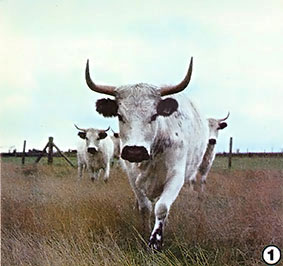
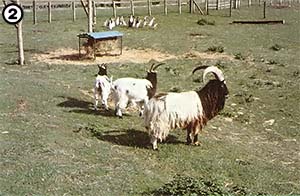
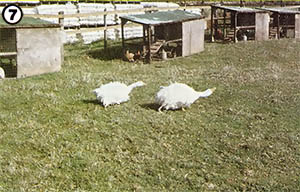
If white cattle, Bagot goats, and Sevastapol geese were whales
or dolphins, pandas or white tigers, or even blind albino
fish the length of your little finger, they might be
protected by law. But these beasts are all examples
of domestic species that have been nudged out of farmyards
by “improved”–which often translates as more
fashionable–breeds … to the extent that they’ve
become endangered. In fact, many of our tame animals face
extinction simply because such creatures have to please the
fickle fancies of humans to survive.
Most farmers find they can’t afford to go on raising
unpopular–and thus unprofitable–animals, and
zoos won’t accept tame species unless the creatures look
exotic. Animal preservation societies ignore our endangered
livestock breeds because such beasts aren’t wild (although
few would be very tractable pets). So there are no
heart-tugging documentaries, no boycotts of governments
that approve the slaughter of rare livestock, nor even
“Save the Tamelife!” bumper stickers to bring the cause of
vanishing domestic breeds to public attention.
An Irreplaceable Gene Bank
You may be surprised to know that some farm animals have
actually passed from popularity to extinction in as little
as six years! In this century, for example, more than 20
separate British livestock breeds have ceased to exist … while six species of pigs were allowed to die out in just
20 years.
Nor is the problem confined to England alone. Since World
War II, Denmark has–in the name of
progress–systematically killed off all its “obsolete”
livestock, and France was in the process of doing so, too … till some concerned Britons explained the possible
consequences of such acts. Now the French are actually
seeking out endangered tamelife to preserve, as are the
Dutch and Austrians. But many other major agricultural
nations–including our own–are doing nothing.
One Man to the Rescue
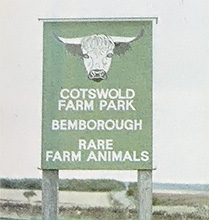
Fortunately, a few people are aware of the problem. Joe
Henson, for example, is an English farmer who–with a
partner–grows rye and barley on 2,000 windswept acres
of Oxford University land in the Cotswold Hills. About ten
years ago, Joe found out that his country’s Zoological
Society planned to slaughter the ancient livestock kept at
Whipsnade Zoo to feed the institution’s lions
and–at the same time–provide more space for
wild animals.
Henson–who had for years been fascinated by old
domestic breeds–offered to shelter any Whipsnade sheep and
cattle that the Royal Agricultural Society or Reading
University (Britain’s premier agricultural college) hadn’t
room for.
Since he knew it would be expensive to keep the animals,
Joe created a “farm park,” where visitors could pay to
picnic and to peer at historic British livestock. This
enterprise enabled him to gradually gather in more remnants
of old breeds. In fact, today he maintains 8 rare species
of cattle, 12 of sheep, two of goats, four of pigs, four of horses,
and 15 of poultry … all in all, the largest such
collection–public or private–in his country.
And Henson, more than any other one person, urged into
existence the Rare Breeds Survival Trust: a unique,
non-profit organization dedicated to finding and preserving
unwanted, endangered domestic breeds.
Seaweed-Eating Sheep
The Trust’s first major project was the saving of the
Orkney sheep, which is the world’s only ovine breed that is
able to thrive on seaweed. Introduced to Scotland by the
Vikings–and common throughout the Highlands until
Bonnie Prince Charlie’s defeat–the animals no longer
exist on the island whose name they bear. Almost all the
survivors were found on St. Kilda Island, where they were
isolated from commercial flocks by a stone wall that kept
them on the beaches. But that wall was rumored to be
crumbling, and the shepherds were said to be thinking about
slaughtering the Orkneys to keep their other flocks pure.
Joe Henson visited St. Kilda and found the wall intact, but
he thought the rare sheep were no less endangered for all
their well-enclosed security. “If something like
hoof-and-mouth disease had swept the island,” he explains,
“all of its animals would have had to be put down … and
the seaweed eaters would have become extinct.”
So Joe moved some of the sheep to his farm, where they
learned to eat grass. The first lambs, however, had longer
bones than those of their sires and dams, and Henson
realized that new grazing conditions would radically alter
the beasts’ shape over the years. So the Rare Breeds
Survival Trust spent all its initial funding–some
10,000 pounds–to buy an entire island in the St.
Kilda group and move some of the Orkney sheep onto it.
Now that the breed is established not only there, but on
the Cotswold farm and on St. Kilda itself, it
should survive … and careful crossbreeding among the
three colonies can probably keep the species’ bloodlines
strong. At Henson’s farm, some Orkneys are also being
crossed with a related variety, the Flemish Landrace, to
supplement the Orkney gene pool.
Strange, Big, and Beautiful
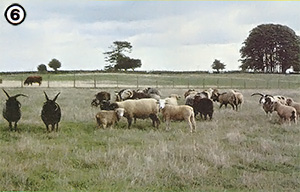
St. Kilda Island once had its own “native” sheep breed,
which was probably another Viking introduction. None
survives on the island, but the animals are still found
elsewhere. Black and multihorned, they are strange enough
in appearance to attract the attention of zookeepers.
Still, only 250 of the animals existed when Henson
assembled a flock at his park.
Some beasts of the Soay species–Europe’s oldest-known
sheep, which has remained unchanged since Neolithic
times–also survive only on other islands in the St.
Kilda group. Lambs of the breed are, at birth, almost
certainly the world’s largest in proportion to their
mother’s body weights, and the species may someday be in
demand again. Henson and other Trust members made a point
of assembling several flocks.
The prettiest sheep in Britain–without a
doubt–are the Jacobs, said to be the breed in the
Book of Genesis that provided the fleece for Joseph’s “coat
of many colors.” The British animals descend either from
sheep that swam ashore from the Spanish Armada or from
animals that arrived in the dowries of Continental brides
of English farming gentry centuries ago. After World War
II, the British Wool Marketing Board (a state monopoly) no
longer bought mottled fleece, making the Jacobs suddenly an
endangered breed. Fortunately, the Trust discovered that
several city park departments–as well as a number of
private estates–are keeping Jacobs flocks to use as
“living lawn mowers.”
Other Endangered Livestock
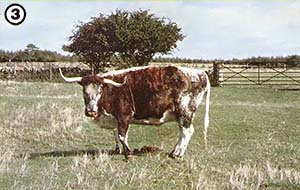
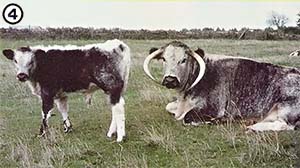
Warwickshire Longhorn cattle–which are almost twins
in appearance to the beasts Neolithic artists painted on
cave walls in France–were, like Jacobs sheep,
believed to be endangered. But the Survival Trust was able
to find several breeders who still raise the Longhorns
(which, incidentally, are among the ancestors of our
“traditional” Texas breed). Although they’re considered too
rangy by most modern butcher shops, the “obsolete” cattle
do have an exceptionally high growth rate and will be
wanted–at least as bloodstock–if and when
British housewives again demand leaner beef.
Some rare breeds, the Trust discovered, had been neglected
too long: Only one Norfolk Horn ram remained in all the
British Isles, and no ewes. The Norfolk Horns are therefore
considered extinct, at least in Britain. All that have
been found are some Norfolk-Suffolk and some Norfolk-Manx
Loughtan crosses.
In order to prevent another such tragedy, Henson is already
assembling a flock of Southdown sheep … a native
English breed rapidly dwindling in its homeland, but still
popular all over the rest of the world. In fact, the
Survival Trust is continually looking abroad for examples
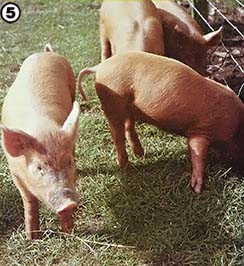
of this and other rare British breeds. Tamworth and
Berkshire pigs, for instance, were so few in number in
Britain that they were becoming hopelessly inbred …
until the Trust was able to bring home fresh lines from
Australia.
“Recently, we got a letter from a woman in Kenya,” Henson
recalls, “whose grandfather, years ago, had taken a flock
of old Scottish Dumpy chickens down there. The family had
kept the flock going, and now it had about 100 hens. She
wanted to know if we were interested in having some. Were
we! Only ten of the birds still existed in Britain, and she
had 100!”
Saving endangered poultry, he says, has always been a
problem … “unless you have something with feathers
growing out of its head and a tail about eight feet long,
which will be of interest to zoos.” The average British
bird fancier doesn’t favor old utility fowl–like the
Light Sussex, the Utility Rhode Island Red, or the North
Holland Blue–which tend to eat more than do newer
varieties. Therefore, such species are often endangered in
Britain, though some are still numerous abroad … and
the Trust, of course, wants to import enough
birds to keep the rare breeds going.
Help From Homesteaders
Interestingly enough, Joe has found that British communal
farmers are also helping to preserve many types of
endangered livestock.
“A good number of the ‘back to the land’ people get in
touch with us,” Joe explains. “Often, ten families or so
will get together, buy one of the more ramshackle stately
homes, and produce their own food on about 20 acres. Such
individuals are finding that a lot of the traditional
livestock survive without as much cosseting as
the ‘improved’ breeds require.
“These men and women are the kind of people–and there
are many of them in your country too, I believe–who
are attracted to such beasts as the Dexter cow … the
traditional Irish house cow. Half the size of, say, the
Friesian, it produces half as much milk–or half as
much meat–on lessthan half as much food.”
Because of the work of the Survival Trust, a lot of rare
old breeds are being scientifically evaluated for the first
time. Recently; for example, a white Chartley Park
bull–a member of a breed that dates back to Britain’s
Roman occupation–was picked at random from a herd and
put on test at the British National Agricultural Center.
“It was done largely as a joke,” Henson admits. “The animal
was being compared with bulls that had been selected for
growth rate for generations, the best animals that had been
bred that year … in short, the nation’s top beef bulls.
“Amazingly enough, the Chartley calf matched all the
competition for weight gain per day. And not only that,
but–when his excess back fat was X-rayed–the
testers found that the beast had less fat than any other
bull in the test … which means that he’d probably
produce more lean meat than any of the others. So now the
Agricultural Center is testing Longhorns, Gloucesters, and
all the other rare breeds.
“As a matter of fact, a Longhorn just beat all the modern
breeds for live-weight gain per day … and, at the end
of the test, the ‘outdated’ bull–unlike the more modern
animals–had not yet attained his full growth!”
You Can Get Involved
The Rare Breeds Survival Trust keeps a priority list of
breeds the organization hopes to save. What matters, Joe
says, isn’t just the number of survivors, but rather the
number of bloodlines … the number of viable males …
and the animals’ geographical distribution.
“You might find only 300 of a breed left,” he explains,
“but if they’re scattered all over the country–and if
there are enough bloodlines–the breed can be
considered secure.
“On the other hand, there are 3,000 North Ronaldsay sheep,
yet the breed is considered rare because the beasts are
almost all on one island.” Henson has recently installed a
small flock of the animals at his farm park.
There are a dozen similar parks in Britain now … some
on farms and some on the grounds of stately homes. Six of
these, including Henson’s, are approved Trust “Survival
Centers.” The Trust also keeps lists of members who are
willing to raise herds or flocks on their land, but not to
open their acreage for public show … and the
organization has friends and members all over the
world–people like you–who keep an eye out for
rare livestock.






