

In Part I of “Living Through Lambing,” I discussed both the long- and
short-term preparations that sheep farmers need to make
before the lambing season gets underway. It’s only when
those all-important weeks arrive, though, that the real
work of a shepherd’s year starts.
As a ewe’s delivery day nears, we begin to watch for the
unmistakable signs that’ll tell us the animal is
approaching her due date. Most ewes “bag up” or “make a
sac” — that is, sport enlarged udders — and will
often “spring” (show a slightly swollen, pinkish vulva)
several days before lambing. (A protruding, reddish genital
area, however, can be a symptom of a serious problem . . .
usually a prolapsed vagina.)
Since it’s not always possible to predict a birth by an
animal’s size and shape, you’ll need to look for other
tell-tale signs showing that a sheep is indeed “near her
time.” At this point, some shepherds like to confine the ewe
in a warm, dry lambing pen. Our system, however, is to make
frequent lamb checks around the barn or pasture —
searching for newborns with our ears as well as our eyes —
because a new mother will murmur distinctive sheep-love
sounds to her offspring. It’s always a good idea to
listen carefully before barging into a potential birthing
area (especially at night, when an unexpected flashlight
beam might scatter a family before you have a chance to tag
the new arrivals).
Labor and Delivery of Lambs
Many novice shepherds have asked us how long a ewe will
normally be actively in labor. Some experts say that
delivery ought to occur within half an hour after the onset
of contractions while others insist that two hours
isn’t excessive. Our experience runs the gamut between
those extremes: We’ve found that the time will vary,
depending upon such factors as the animal’s weight and age,
the size of her baby and her strength. Your best bet is to
rely on firsthand observation — rather than a
particular timetable — to determine whether a ewe is in
trouble or just having a long, but not dangerous, labor.
A normal presentation in the birth of a lamb will begin
with the appearance of the front legs, followed by the nose and then — once the shoulders pass through the
birth canal — the rest of the delivery will proceed
quickly and easily. Of course, lambs can emerge from their
mothers’ wombs in a variety of positions, many of which may
require the attention of an experienced shepherd or
even a veterinarian. For a handy
review of abnormal births, we consult our copy of an
article printed several years ago in The Shepherd
magazine “Obstetrics in the Sheep Barn,” which tells how
to deal with 10 difficult delivery situations.
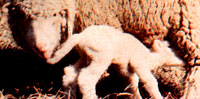
Once the fuzzy babe has arrived, a good ewe will clean the
veil of mucus covering the newborn’s mouth (to enable it to
take its first breath) and lick it dry. However, some
mothers — particularly if they’re young, inexperienced
or just plain exhausted — may be slow to perform those
instinctive duties, so we occasionally have to lend a
helping hand. If all goes well, though, we like to give the
ewe and her infant an undisturbed half-hour immediately
following the birth so they can get acquainted and
form a family bond. After this postpartum reverie, we swing
into the normal lambing routine that’s really the heart of
our whole system.
A Lambing Schedule
It’s often difficult to remember while overwhelmed
with the euphoria of the first birth of the
season, how tired, irritable and slightly befuddled
we’ll become after a month or two of the intense activity.
So we’ve learned that the most effective lamb- and
temper-saver is a standard procedure that can be performed
by rote. Such a system should be worked out well in
advance, so that it can carry the burden of
performance when that inevitable battle fatigue sets in on
weary shepherds.
Here’s the schedule we follow when handling a normal birth,
beginning soon after the lamb is dropped.
[1] Swab the umbilical cord with iodine.
[2] Tag the lamb and write down its number, sex and
mother’s number in the field record.
[3] Bag the lamb . . . that is, put on its LamDry raincoat.
(We do this even in pleasant weather, since we know that
the skies can turn threatening in a matter of minutes.)
[4] If the lamb is an only child, verify the ewe’s milk
flow and leave mother and child alone in the field (or
wherever the birth occurred).
[5] If a ewe delivers twins, move the family into a
separate pen and then check the sheep’s milk flow.
Finding out whether the animal’s milk has started can be
tricky — especially if you’re dealing with flighty
pasture ewes — but the job has to be done, since some
lambs will be too weak to dislodge the waxy plug that may
initially seal the orifice of the teat. Failure to
clear such a block can result in not only a swollen,
mastitis-afflicted udder, but possibly a starved lamb as
well.
The best method I’ve found to snag a suspicious mother is
to fool her into believing you’re kidnapping her baby. I
kneel and hold the lamb where the ewe can see it, letting
her approach the bait and being careful not to look
directly at her. When she comes close enough, I grab her
front foot before she has a chance to retreat. I hang on
tight while getting my footing (and releasing the lamb),
then I grasp the ewe under the chin and stand up. That puts
her into as almost helpless position with her head pointing
skyward. Once she quiets down, I open her teats with a
gentle, downward squeeze-strip motion. (If a ewe is
particularly skittish, you can always restrain her with a
halter secured to a fence.)
Build Relationships Between Mother and Baby
Newly arrived baby sheep need not only nourishment, but
also a great deal of maternal affection. Believe it or not,
a lamb — which isn’t as resilient or aggressive as a
piglet or a calf — can die as a result of feeling
rejected! The problem is sometimes especially delicate when
multiple births occur. If a ewe has twins, the best way to
assure that Mom will accept the babies equally is to
isolate the new family by means of a temporary, portable
pen called a “hurdle.”
To lure the sheep into that enclosure, I again use the
newborns as live bait: Holding a lamb under each arm, I
walk backwards toward the pen so that the ewe can see her
babies disappearing. Often the lambs will help by crying
pitifully to attract Mama’s attention. If they
don’t, I’ve learned to produce a fairly believable “meeeah”
myself (an F-sharp seems to work well). As long as the ewe
can see her lambs, she’ll usually follow me straight into
the hurdle and then contentedly nuzzle the babes while I
lock the gate safely behind the group.
The amount of time the young family remains penned together
will depend upon what happens next. If after half a day,
for instance, I see that the group is closely knit, that the twins are nursing well and that their mother
obviously intends to care for them both, I turn them out
into an uncrowded location. On the other hand, if the ewe
seems to be favoring one of her lambs, I move that sibling
to a separate pen for several hours of enforced vacation,
to give the other newborn a chance at the chow line. It may
sometimes be necessary to assist the rejected lamb by
actually putting the nipple into its mouth, but
tube-feeding the little critter shouldn’t be necessary
unless the mother completely refuses to cooperate.
When I’m sure that the formerly neglected lamb is being
nursed and loved, I return its twin to the hurdle confident that, after yet another short period of
undisturbed confinement, the ewe will accept them both.
Finally, once the babes have been with their mother for
three or four hours, we use the finger-in-mouth test on the
sleeping lambs to check their status: If a newborn has been
nursing, its mouth will be warm while sick or
rejected animals usually have cold or just lukewarm mouths.
Anytime the test reveals an unloved lamb, we milk the ewe
directly into a 60-cc syringe, fit the syringe with a 14-inch
to 16-inch small-bore catheter, and tube-feed the lamb with its
own mother’s milk and being careful not to send the
liquid down the babe’s windpipe. When obtaining the
life-giving fluid, I again rely on a halter, which is
an invaluable tool in such situations. I simply secure the
ewe’s nose, fasten the line’s free end to the hurdle, butt
the sheep’s hip into the fence with my head, and go to
work!
Emergency Care For Baby Lambs
Even though we make frequent lamb checks, we sometimes
arrive at a delivery site too late to prevent what I call a
“flat lamb,” one of those little ones that’s laid out
on its side, looking all too ready to pack it in. The
pitiable creatures are suffering from either lack of food
and love or — in more serious cases — “white muscle
disease,” which is a deficiency of vitamin E and selenium. But, we can often save them. Should a newborn have the
latter malady, an injection of nutrients will revive the animal. (If, as some
breeders do, you’ve given the ewe herself such an injection
a few weeks prior to lambing, white muscle disease is not
likely in her offspring.)
A flat lamb that simply needs basic nourishment and
affection is usually so cold that its bodily functions will
have slowed to a snail’s pace. I hustle it up to the house
and run a sinkful of water — not hot, but warm enough
to bring feeling into cold hands. Before immersing the
lamb, I tube-feed it with warm colostrum. Once the tiny
animal is submerged to its neck in warm water, I gently
flex its legs — moving them as if it were
running — to stimulate the circulation. As strange as
it may seem, it also helps to “baaa” at the lamb while
you’re working with it. This deception seems to go a long
way toward reviving the sickly critter’s spirit and a
lamb will sometimes even weakly answer my call,
thinking — I suppose — that Mom really does care,
after all.
As soon as the youngster seems fairly well thawed, I take
it out of the bath, drip it dry for a moment, rub
it vigorously with an absorbent rag or towel and then
cuddle it near the stove or fire for a while. After an
hour or two the revitalized creature will usually be
stronger and ready to be reunited with its mother.
Whenever the weather is foul (during rain, ice, and snow
storms . . . or simply in bitter cold temperatures), we
don’t wait for lambs to go flat before pitching in.
Experience has taught us that hostile conditions often
cause a just-born sheep to draw up and huddle to keep warm. Chances are that — in such cases — it
won’t bother to nurse at all. We make it a habit to tube
every “bad weather” lamb that’s born — without waiting
to find out whether it will get up to nurse — right
after we tag and bag it. We’ve found that an initial forced
feeding will usually give the animal enough energy to stay
warm and seek out its mother.
Help Orphaned Lambs
Sometimes, in spite of all our encouragement, a ewe will
refuse to accept her lamb. This is perhaps because she favors
another baby, because she has udder problems,or because a
flat lamb has been revived too late to fit into her closely
defined circle of affection. Some people call the rejects
pet lambs, but other shepherds — including
us — refer to them as bummers. Sure, they’re cute when
they follow you everywhere, but the toddlers are also real
nuisances to any busy farmer!
When we began sheep raising, we used to keep all the
rejects in our flock . . . but after a season or two, we
realized that the special feeding schedule required by the
orphans was simply too time-consuming and expensive. You
must begin by giving such an animal 60 cc of milk four to
five times a day, and gradually increase to 120-cc helpings
by the end of the first week. Or the orphan can simply be
fed every three hours during the first week of life and
then every six hours thereafter until it’s about a
month old and able to survive on three daily feedings.
After its initial two meals of colostrum, an abandoned baby
can dine on lamb replacer and “creep feed,” which is
nourishment that’s placed in a trough accessible only to
the small animals. It’s possible to coax the youngsters to
accept creep feed by sprinkling lamb replacer over the
rations and forcing a little bit into their mouths.
Some shepherds — in an effort to save time and
trouble — like to train their orphan lambs to eat from
automatic nursing setups, but we haven’t found such devices
as helpful as they first seemed. Training the tiny,
starving animals is no easy task and the milk
containers require a lot of attention, since they must be
kept clean and free of bacteria and be filled at set
intervals.
Our present strategy is to keep orphans only as long as
needed to replace stillborn lambs. (We tube-feed rather
than bottle-feed them until they’re adopted, because a
dependency on the artificial nipple shape may make the
animal reluctant to accept a foster mother’s natural teat.)
If we find they’re not needed for that purpose, we sell the
motherless babes, at whatever price we can get, to folks
looking for pets.
Adopting by Grafting
Before putting an abandoned lamb on the market, however, we
always attempt to have the orphan adopted by a ewe that has
lost her own offspring. Shepherds commonly use one of
several “grafting” methods to encourage a bereaved mother
to accept a substitute. The only foolproof technique we
know of is called hide-grafting, which incorporates another
procedure known as slime-grafting. The combined practice
entails confining the ewe in a hurdle, then skinning her
dead lamb (the sooner after its death the better) and
dressing an orphan in that jacket-like covering so the
mother will assume it to be her own.
To remove the dead lamb’s skin, I use a sharp knife to make
a linear slit up the belly . . . then a ring slit around
each leg above the knee joint, and another around the neck
to meet the belly cut. Next, with one hand I pull the skin
to one side of the center opening and run my other hand
along the length of the body between the skin and the
carcass to free the membranes. I follow the same procedure
on the other side of the carcass, sometimes using a knife
to cut through membranous layers. Then I work the
blade — or one finger — down through and around
each leg hole and, finally, cut through the tailbone at its
base, leaving the tail attached to the skin (and being
careful to retain any fetal dung, since that’s the first
place a ewe checks for the scent of her own newborn).
I fit this rather grisly coat over the back of the
prospective adoptee, rubbing its head with the hide as
I do so, in order to grind the smell in. If I can find it, I take some of the
placenta from the dead lamb’s birth and rub that, too, all over the orphan. (This last
step is slime-grafting, which some shepherds use alone . .
. preferring it to the messy, unpleasant task of skinning a
dead lamb.)
In order to complete the ruse, we often have to tie two of
the orphan’s legs together — especially if it’s already
a frisky two- or three-day-old — so that it will struggle to
get up and convince the ewe that it is indeed a newborn
babe. (After all, if I allowed a foster lamb to make a
beeline for the teat as soon as I placed it with the
tentative mother, she’d know full well she hadn’t just
hatched such a lusty child!) I generally remove the
leg binding after about 30 minutes, and watch the
relationship bloom from there. Of course, we always keep a
record of the adoption, including the reason for the
natural lamb’s demise. If there’s no acceptable
justification for it, we usually cull the ewe at the end of
the season. If you prefer, you can have a vet perform an
autopsy on the dead newborn. (In some states this service
is available free of charge.)
When a lamb dies and no graft is available, we have to dry
up the ewe, especially if she’s a heavy milker. To do so,
we milk her out once, keep her penned with low-quality
hay and no water for 36 hours then milk her out again
and give her along, satisfying drink. One more round of
this procedure should get the drying-up process off to a
good enough start to make her udder flaccid and prevent the
formation of hard spots — or mastitis — in the bag.
And, to be sure the ewe dries up completely, we keep her off
lush pasture until we see her bag diminish.
Docking and Castrating Lambs
Once a shepherd has safely delivered the season’s crop of
lambs and knows that they’re all well cared for, he or she
may be tempted to heave a sigh of relief and head for the
house. Unfortunately, two of the more unpleasant tasks
associated with sheep raising are yet to be done. Docking
and castration may seem pretty diabolical, but there’s
sound reasoning behind these practices.
Docking is the process of cutting tails on three-day-old
lambs so that the mature sheep will be free of a long,
woolly appendage that would collect manure and attract
flies. Tailed sheep are prone to flystrike, a hideous
infestation in which fly eggs are laid in the dirty wool
and later hatch to release maggots, which feed on the
living flesh of the unfortunate animal. Docking also makes
shearing easier, and some folks claim that tailless ewes
breed more readily.
We’ve come to prefer — after
plenty of experimentation with various
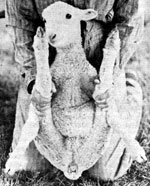
methods — docking by burdizzo and knife. The lamb is
held across the shepherd’s knee, rear end forward. Then the
skin of the tail is moved up toward the lamb’s body while
the burdizzo is clamped in place . . . positioned to leave
enough of a stump so the animal can later swish away flies.
A sharp knife — cleaned with a mild antiseptic solution such
as Zephiran — is used to cut the tail off inside the
instrument’s jaws. The burdizzo is then left in place for a
full minute, and when it’s removed, the skin that was
pushed forward will spring back to help seal the wound.
There are two good reasons to castrate young rams. First,
the males mature so quickly that — if left
untouched — they can sometimes breed before they’re
even weaned, which is a most untimely and undesirable event!
Just as significant is the animal’s carcass development.
The masculine ram frame favors the growth of less expensive
cuts of meat (those in the shoulder and neck areas), whereas the wether, or castrated ram, develops more
valuable meaty hindquarters and loins. We believe that
castration by knife alone is the most humane method
available.
In summary, lambing season is an extremely busy time of
year, even for the owner of a small flock . . . so it pays
to be prepared for whatever problems may arise.
Fortunately, emergencies are the exception rather than the
rule. Most ewes have no difficulty with delivery, claim all
their offspring, and generally give their masters
little — if any — grief.
First Aid For Ewes
One of the unhappiest sights a shepherd can see as he
or she surveys a flock of nicely fattening
mothers-to-be-is a red, bulbous protrusion decorating
the rear of his prettiest ewe. The animal will appear to be
hunched over, straining to relieve her condition. But,
although vaginal prolapse looks alarming, it can usually be
treated on the spot and often without the help of a
veterinarian.
Many circumstances can cause this condition, but here’s
what usually happens: Toward the end of pregnancy, the
increased level of estrogen in the mother sheep’s blood (in
preparation for lambing) and — in some cases — an
inherent muscle weakness cause the birth canal and all its
supporting musculature to relax. Well, some ewes just “let
down” a little too much, and the whole thing falls out!
The best approach is to deal with the situation immediately
after discovery, and proceed as follows:
[1] Keep on hand a supply of “Ewe Bearing Retainers,” which
will allow you to replace the prolapse. These flat plastic
tongues with handles on either side are available from
sheep supply houses.
[2] Secure the ewe, using a halter, in a clean, dry area just in case she should take a notion to lie down
during the restoration process. You might also find it
helpful to elevate her hindquarters by propping a bale of
hay under her.
[3] Wash the protruding muscles and the retainer thoroughly
with Zephiran or another antiseptic.
[4] If the prolapse is minor, you can insert the retainer
directly by holding the prolapse in position and placing
the holder above your hand, so the paddle pushes up against
the cervix. (Every package of retainers contains
illustrated instructions.) The handles of the device are
then tied firmly to clumps of wool on both flanks of the
sheep. The ewe will be able to lamb normally past the
retainer.
[5] If the prolapse is too large to be manipulated into the
animal’s body, you may have to shrink it a bit. Some people
swear by a method that we, too, have found to be quite
effective. Coat the prolapse with sugar, and then wait for
it to draw up enough to fit back inside. It may take more
than one application of sugar — and several hours of
waiting — but the technique does sometimes prove successful.
[6] Give the ewe a shot of antibiotic as insurance against
infection.
Once her vagina is replaced, the animal will stop straining
and — more than likely — have a normal delivery.
Note the sheep’s prolapse on her record, however, so she
can be culled at the end of the season (since the problem
would otherwise likely occur again) and don’t keep
any of her lambs for breeding, because the tendency to
prolapse is thought to be an inherited characteristic.






