

This story is from Miranda Sieh and the LeDuc-Simmons Historical Estate in Hastings, Minnesota, submitted as part of our Wisdom From Our Elders collection of self-sufficient tales from yesteryear.
Is there a way to keep perishables cool in the summer months without modern refrigeration? Ask grandparents or great-grandparents what they did when they were young. Some may remember waiting for a visit from the ice man who used an ice clamp to carry a 50-pound block of ice inside for the ice box. That block of ice was cut from a local river or lake during the winter and stored in an ice house for delivery to customers in the warmer months.
In the 1846 editions of The Horticulturist, Andrew Jackson Downing published drawings and building instructions for ice houses. These plans were reprinted in his posthumously released collection entitled Rural Essays in 1853. In 1866 William and Mary LeDuc had an ice house built on their estate based on the writings of Andrew Jackson Downing, who had been the prominent voice of landscape-architecture. This ice house still exists today at what is now the LeDuc-Simmons Historic Estate in Hastings, Minnesota. The Estate was the dream-home of the LeDucs, built from 1862-1866, during the Civil War. It is listed on the National Register of Historic Places and is one of the few surviving examples of Andrew Jackson Downing’s design still around today.
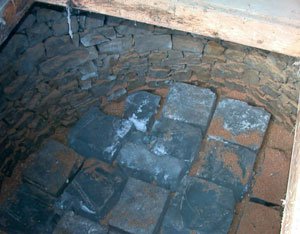
The ice house is a wooden, 8-sided (octagon) structure framed with 4-by-4-inch wooden posts. The exterior is covered in wooden board and batten siding. The roof was originally covered in wood shingles, but is now covered in asphalt shingles. In the wooden floor of the ice house is the trap door access to the circular pit below. The walls of the pit are lined with about 20 courses of native limestone held together with a high-lime mortar bond. The floor is packed dirt. When it was used as an ice house, large blocks of ice were packed inside the pit and covered with straw or sawdust for insulation. Ice harvested in the winter would be kept for use in the spring and into the summer inside the ice house.
On February 10, 2007, an old-fashioned ice-harvest was held on Lake Rebecca as part of the city of Hastings’ sesquicentennial celebration (150th anniversary). Members of the community were invited to participate in this living history experience. The harvest area on the ice was posted for safety (Caution – Open Water) and the snow was swept off the ice. The 12- to 18-inch-thick ice was cut with long ice saws, chisels, and a gas-powered circular saw. (The weather was very cold, so modern power tools were also used to help along the ice harvest!) The blocks were pushed with ice poles, pulled from the water with ice hooks, ice clamps, and ice tongs, and packed onto trucks with the help of chains, rope, a winch, pulleys, and a Bobcat loader. When the ice was brought to the LeDuc-Simmons Estate it was packed into the ice house with each layer of ice covered with sawdust. When the ice house was filled, the trap door was closed and people began to guess how long that ice would stay frozen. 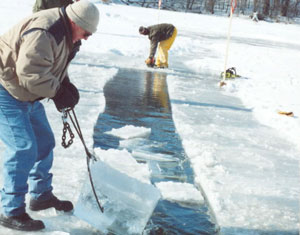
All spring and summer of 2007 the temperature in the ice house was monitored. Blocks of ice were brought out on weekends and put on display to show the function of the ice house. In October, there were still bits of ice in the bottom of the ice house. The 2007 ice harvest proved the effectiveness of the ground’s insulation and the wisdom of our forefathers for preserving winter’s ice for use in the spring and summer.
Sources:
Landscape or Building report by Carole Zellie
Ice Harvest report by Heidi Langenfeld
The Horticulturist 1846 and Rural Essays 1853 by Andrew Jackson Downing
Photos supplied by Miranda Sieh and the LeDuc-Simmons Historical Estate. 1. The interior of the ice house, packed with lake ice. 2. Mike D. pulls ice from the lake.
Please send email submissions to Letters@MotherEarthNews.comwith the subject line “Elder Wisdom” or send mail to: attn: Heidi Hunt, Re: Elder Wisdom, Mother Earth News, 1503 SW 42nd St., Topeka, KS 66609.





