

In pursuit of the good life: Finding that perfect country place. (See the real estate information diagrams in the image gallery.)
Here is what real estate ads don’t tell you, trendy books don’t feature and what brokers don’t want you to know: advice on how to read real estate ads to find a country home.
How to Read Real Estate Ads to Find a Country Home
For most of us, a move to the country means declaring our
freedom from an office or a plant or lifelong local roots.
But freedom has a cost. Do you worry that six-figure real
estate prices, high property taxes, and rising bank
interest rates will just have you swapping the urban rat
race for a country-mouse version of the “Good Life”? Let’s
see if I can’t convince you that the major purchase in your
life — a home and a little land — needn’t be
nearly so expensive and constraining as . . . what is the
going price for a home and lot today in one of the “prime”
areas . . . $140,000 or something equally ridiculous. To get
control of your own life, all you need do is throw off the
view that all the nice people live in a city or suburb,
surrounded by automated appliances, new cars, and debt.
Begging for the moment the cheapest and most rewarding way
to establish a homeplace (building it yourself on $400/acre
“unimproved” land), the property descriptions you see above
include not one word of fiction, but are taken from ads
clipped from country periodicals and rural real estate
flyers from the eastern and midwestern parts of the country
I know personally over the past year or so (1995-’96).
These places aren’t hovels either … or lost and forgotten
in some backwater. Backwater hovels don’t get advertised.
The homes are all solidly-built, livable, and located in or
near fine little country communities. You can buy most of
these places (if you can’t avoid taking a conventional
mortgage) for from $250/month to perhaps twice that. With
one or another system of “creative-financing” you can
usually tailor payments to your income. I’ll get to that in
a moment.
A 150-acre-plus farm for $400/acre?
Let’s go a little deeper into that first ad. You might be
tempted to think what far too many people already believe,
that decent farm land costs $2,500/acre minimum, right? So
how can you get that fine old Wisconsin (cheese-country)
dairy farm for less than $400/acre? Well, the land has
probably been in hay for two years . . . I’d guess that a
farmer retired, had no heir to keep the farm going, so he
sold the herd and equipment and put the land and buildings
on the block. Asking price is $67,000. Offer 40 and pay 54.
I wouldn’t encourage you to take up dairy farming from
scratch, but you could commute to a good day job in Eau
Claire, rent a neighbor’s equipment to plant and harvest a
typical 50 bu/acre small-grain crop. In one good or two
mediocre years the land will buy itself with cash left to
buy next year’s seed. Or, leave the land in hay, shift it
gradually to alfalfa and clover, and start a grass-fed,
organic beef herd. Or, if convenient to a good highway to
town, plant a pick-your-own strawberry operation. Or plant
a modern apple orchard; dwarf apple trees will produce more
than the same acreage of standard trees and they don’t take
a generation to mature. No ladders are needed for harvest
either, so you and your family, or a small crew of local
high school students can start picking in two or three
years. You’ll have the land paid for by the fourth or fifth
year and, with a 150 acres planted to orchard as you can
afford time and planting stock, you can be financially
independent for the rest of your life in six to ten years.
I am not kidding! (More about “retirement-income
orcharding” in the next issue.)
The ad from Maine may raise an eyebrow as well. Everybody
knows that state-of-Maine coastal property goes for
thousands of dollars a waterfront-foot, right? Mebbe for
that stretch of storm-lashed “Downeast” pink granite that
some movie actor bought for a Hollywood price, or down on
the sand coast an hour’s drive from Boston and in walking
distance of George & Barbara Bush’s place. But the log
cabin on a high bluff in an “undiscovered” area of Maine
cited above would cost you less than $100/ft. Chain a
flotilla of pinelogs in the deepwater bay out front, use a
new state-funded program to start raising gourmet kelp for
the Japanese and domestic sushi markets, and pay for your
oceanside retreat in short order with seaweed that’s free
for the picking. Begin to look at each ad differently and
start dreaming better.
Lower-Cost Housing
MOTHER regularly features articles on earth-berm, hay-bale,
earthship, and many other forms of hand-made homes. Here
are some other low-cash-outlay options to consider.
Mobile homes
The under-$5,000 mobile home listed above is an estate sale
of an old but solid trailer in one of the many
50-year-or-older south Florida parks, so thick with palms,
citrus trees, and flowering tropical vegetation you can
barely see the homes — all on termite-proof concrete
foundations with terazzo-floored glass/screen “Florida
rooms,” car ports, and wall-to-wall air conditioning. Many
of them are better built than a brand new, $85,000
counterpart. In Florida, mobile prices seldom fall under
the teens, but low-price ads like this one appear in
northern newspaper classifieds from time to time when heirs
to their late grandmother’s retirement retreat don’t have
the time to manage and pay lot-rent and utilities for a
place that’s a continent’s length away.
Start with getting photos of the inside, outside, and the
park surroundings. A phone call to neighbors can alert you
to problems and teach you something about the local social
life, stores, pubic transportation, and other small but
important details. Next, call the local Realty Board for
the name of a nearby realtor/appraiser and spend a little
for independent value and structural appraisals. The Better
Business Bureau can let you know if the park operator has a
bad reputation.
Fix-ups
When the back-to-the-land movement began in the ’60s, we
all yearned for an old New England farmstead we could
restore as we lived the life. Many who stuck with it and
did the restoration right benefited from the inflation of
the ’70s and ’80s and parlayed a four- or five-figure
investment into a place that would be advertised now as
“Pristine c. 1790 Restored Colonial with 4 working
fireplaces plus beehive oven on 5 acres with post &
beam barn, brook and pond … only $399,900.” Run-down New
England Colonials are hard to find, cost a bundle … and
the RE-inflation boom is over for our generation.
To parlay a small initial investment into a family home
(say nothing of a six-figure fortune) these days, many of
us will need to emulate the way the original homesteaders
built those rambling Colonials … by adding on in
increments as prosperity and family increased. And —
as modern homesteader Scott Nearing advises — they
“paid as they went,” building with their own labor, buying
what materials they couldn’t supply themselves with saved
cash . . . and avoiding that single greatest obstacle to
independence: a long-term mortgage.
With few of us able to afford huge Colonial families, hired
hands, or take up farming for a living — and few of
us willing to wait generations to realize our dream —
the incremental approach to homestead-building takes forms
unknown in the Colonial days.
Camps
MOTHER has published plans for mini-homes, and by all means,
consider building a small place from scratch and adding on
as time and cash permit. But a trend that hasn’t been
picked up by the national press to my knowledge is the
upgrading and winterization of ready-made small homes:
hunting and lake-side vacation cabins — collectively
called “camps” in the North East. “Camps” range from tiny
tar paper ice-fishing shacks to the log mansions built in
the Adirondacks by the Vanderbilts, Jay Gould, and Will
Durant back in the Golden Age.
Most reasonably-sized camps hark back to the 1920s or
earlier, and come with a few acres of land sectioned out of
what was thought to be worthless woods after it was logged
off. Most structures are of basic wood-frame construction,
uninsulated, with summer-only water systems. Many are
half-abandoned. Tin roofs are common. Many I’ve seen sell
in the low five-figures, and most have been fully paid-for
for fifty years or more and owners are often happy to take
a note or a private mortgage for a year or two.
Their big advantage over new construction is that in most
places the building is “grandfathered” — meaning that
it can be lived in as is indefinitely (at least for
“seasonal” occupancy). So often-restrictive building codes
don’t apply until you make major changes, which must then
meet the code. You can use the old wood-burning camp stove
and outhouse while you work on the place, install a
code-acceptable septic system, rebuild foundations or add
rooms as needed. I can show you a dozen lovely small homes
salvaged from what was little more than a shack — on
a cash-as-available basis — by young marrieds or
almost-retired couples. “Sweat-equity” at work.
But, be sure the local Code doesn’t contain a “sleeper”
clause requiring that if one major alteration is made
— say, a new roof — the whole place (frame,
doors and windows, septic, water, etc.) must be brought up
to code before an occupancy permit will be issued.
Partly-developed land
The countryside everywhere is sprinkled with false starts
where folks only partially realized their own country
dream. The landscape is dotted with plots of land with only
a foundation in . . . or a driveway and utilities . . . or just
a septic system installed. I can show you a half-dozen
house shells: log cabins, modern solar homes, conventional
frame dwellings that were framed and roofed but are empty
inside. Many still carry a mortgage, and if the bank likes
your credit history and prospects, they’ll happily let you
assume mortgage payments — in effect, getting the
former owners down-payment and much of what has been built
for nothing.
This technique — taking over a mortgage from some
unfortunate soul who’s lost a job or otherwise can’t keep
up payments — is all there is to those
“Make-a-million in Real Estate” courses you see advertised
on TV in the wee hours. So avoid the course, read on, and
save another $300.
Look in the country-paper RE ads for the terms “possible
owner-financing” or “assume Mtg. pmts.” and drive a hard
deal — especially if you have a strong credit rating,
a good income, and are dealing with a bank or a real estate
speculator. I know one such situation where a local S&L
bank had been stuck with an old place they’d foreclosed on
for over a year (banks hate being in the real estate
business). The price was gradually lowered from the high
twenties to $15,000. They finally sold it for $3,900, no
money down, and financed the full sum with a
no-added-collateral personal loan — same as a used
car.
One aside about those TV courses. As often as not, the poor
victim you end up buying from is another buyer of the TV
course who has over-extended himself. At its worst, the
technique suggested is dealing in slums — buying
rental properties and milking them — taking rent but
putting nothing back into the building. The TV ads promise
“an immediate cash income” after buying a property “no
money down.” That’s rent money, folks, usually from people
who have genuine difficulty getting it together each month.
Lots of luck getting it from them.
At best, however, by assuming a mortgage you can often get
a real bargain and free someone who has had hard luck from
a burden he’ll be glad to relinquish.
First Comes the Land
To you and me, at least as important as structures is the
lay, look, and arability of the land. At first, we all
think we want big acreage — or at least want to own
“both sides of the road” — if only to protect against
having unwanted neighbors. The cheapest way to accomplish
this is to find a small parcel butting up against a state
or national park or other government-owned preserve or
against a major wetland of any ownership. Finding such
properties takes a lot of looking — much of it map
research (see “Four Must-Have Maps”).
You may scope out an ideal piece of unimproved land that is
privately owned. If it is in an isolated location, or if
nearby farmers don’t know the owner, go to the land office
(town office in municipalities) and find out who owns it.
Often, large tracts are owned by corporations, estates,
banks, or absentee landlords as an investment.
It may take some persuasion to work a deal, but raw land
can be cheap: a few hundred dollars an acre compared to
$1,000/acre and up (and UP) for typical country parcels
with road frontage in the East. Surveyed and subdivided, a
five-acre lot can cost $20,000 or more — a sum that
can get you 100 acres and more bought “raw.”
You’ll need a lawyer and may have to pay $2,500 and up for
a survey. But try to purchase a small parcel and buy a
“first refusal” on all the surrounding property. Then, for
a few hundred dollars, you have a legal right to buy
specified parcels of land (at market price) before it can
be sold to another buyer. In areas that are not undergoing
development, your little sale may be forgotten but for
documents on file. You could then enjoy an estate and pay
taxes on a house lot.
In other parts of the country, you may be able to lease a
plot for 99 years at a reasonable cost per acre. In 99
years (unless the lease is renegotiated) your heirs lose
any building you erect, so don’t build a mansion. In the
Northeast, land-leasing is common around lakes and in
scenic mountain areas, and can be a bargain. Again, hire a
lawyer to assure having full vehicular access and building,
water, etc., rights.
Zoning in many populated areas requires that building lots
be a minimum size and have a minimum amount of road
frontage (or that an approved road be built in and by
you ). Be sure your lot satisfies the zoning laws
before you put a cent down.
Some areas ignore road frontage, and approve rights-of-way
to back-lots through abutting property. In lake country,
many properties not on the shore may have a deeded
right-of-way to the water. Logging or fire-access roads may
exist on paper only. I know of a luxury mountain-home
property where a logging-road ROW goes up the drive, under
the living room bay window, and on up the road and through
the middle of their new garage/barn. If the mountain is
ever logged off, they cannot stop the skidders and
timberjacks. Some ancient ROWS may not be in your deed
— but exist in someone else’s. This can lead to
expensive litigation. Where land-ownership is concerned,
even low-cost back-country deals need to be expertly
lawyered.
In most populated areas, your land must pass a percolation
test (be able to absorb a given amount of water in a given
amount of time) before a septic system plan or permit is
approved. Be sure your land perks or you will not be able
to build without paying to haul in tons of gravel to make a
septic leach field. I know one couple that paid more for
their gravel bed (at $250/dumptruck load) than for their
land.
A “perk test” is not done by digging a hole with a shovel
and dumping in a bucket of water. By law, a backhoe digs a
pit and it is filled from a tanker. Then, an engineer has
to measure how fast the water level drops. I know of one
glorious mountain property (called “The Lookout” by us
locals) that has a spectacular view of ocean islands, a
stream with a waterfall, mature pines and all — but
is located on a ledge. The too-shallow soil is pockmarked
with unsuccessful perk-pits dug by a succession of
disappointed would-be purchasers lured by ads placed by the
latest owner. Will Smoot, the local excavating contractor
who has to haul his ($250/hr. point-to-point) tractor three
miles up the mountain to dig each set of pits, says:
“Selling off ‘The Lookout’ was the smartest thing that
granddad ever done. This is the second tractor its bought
and paid for and I don’t see no end to it.”
Some enlightened locales will award a residency permit on
unperkable land if you install approved composting or
gas-incinerator toilets and convince them that your “grey
water” — wash water — will go into the garden.
But get approval in writing before you buy. Again, you must
invest $200 to $1,000 — more for complex matters
— in the services of a locally-experienced RE lawyer.
The cheapest (and, often the most scenic) land is found in
the far boondocks. “Jeep roads” as labeled on topo maps are
boulder-strewn mud or sand tracks that can bog any wheeled
vehicle in shifting sand or spring and fall slop and be
unplowable in a snowy winter. If you have to build an
all-weather road for any distance, you are in for major
costs (a big bulldozer or road grader costs upwards of $800
an hour).
You can eschew roads and live a primitive life in remote
isolation if you like. I like, but only in good weather and
not for very long at a time. My own cabin in the woods
functions with an outhouse, hand-dug fresh rainwater
cistern, wood heat, and kerosene light and utilities. I’ve
not yet spent a whole winter mushing or boating in all my
supplies and doubt I ever will; I have work to do, and it
is a full-time job just to stay warm and reasonably
well-fed in winter when everything must be done by hand.
Plus, I’m no longer a kid. In total isolation, a strained
back can be a major problem, and a broken leg could be
fatal.
Providing even the most basic modern amenities to a distant
location is not easy. If you plan to live “on the grid”
— using commercial electric power and phone lines
— figure paying the electric utility $30,000 a mile
to set poles and string cable. That’s not a mistake: thirty
thousand dollars a mile … on flat land. If you go “off
the grid,” you can buy a solar-electric, diesel-electric or
hybrid power plant and run it for a lifetime for that sum.
Cell phones do reach into some remote areas, and they
aren’t exorbitant compared to stringing Ma Bell-style
lines. A top-grade marine-style private satellite phone
link costs $7,500 plus a hefty time-charge these days, but
that price is falling. Bone up on alternative power and
communications technology and save your pennies before
deciding to live off-grid. It is the ultimate in
self-reliance, but it may make that remote piece of land
less of a bargain than you’d bargained for.
The Search
Now to cut to the chase. How to find that property?
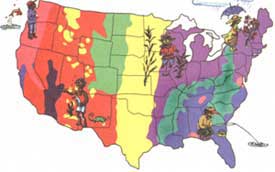
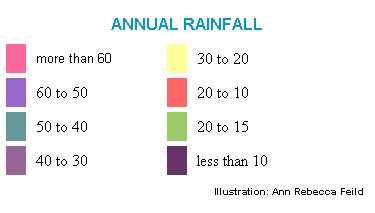
The climate maps seen on these pages will lay out the broad
temperature, rainfall and growing areas of the country. In
my experience, you’ll do best staying close to the climatic
zone you were raised in. I know Yankees who just can’t take
week after week of 90 degrees Fahrenheit, Texas humidity,
and find okra slimy and grits tasteless. Then there are the
Johnny-Rebs who gag at the mere thought of clam chowder,
think winter squash is bitter, and are miserable in six
months of Maine snow.
Consider carefully how near/far you should be from
relatives (yours or your spouse’s — despite the tired
old mother-in-law jokes). “Being closer to grandchildren”
or “being able to see my mom more often” is the reason many
people in our Community Survey reported for disliking or
wanting to change locations.
Now, start collecting charts, maps, and other research
material (See end of the article “Four-Must Have” Maps).
Your phone book has a number where you can order any phone
book in the land and have it billed to your own account.
Get the books for all areas you are interested in. The
Yellow Pages will give you a wealth of information about
business in the area. If your last name is Svensen and you
find three pages of Johansens, Johnsons, Jorgensens and
other Scandinavian names in the White Pages, you ought to
fit right in.
Find the address of the local newspaper and subscribe
— both to the weekend edition and the issue
containing the most real estate ads. Don’t be shocked if
most country places you’ll be looking at will only have a
weekly — and that if you’re lucky. After a few weeks
of reading the paper you will not only know the area, but
have an idea of land and property availability.
If you have a computer with a CD-ROM drive, you should get
“Street Atlas U.S.A.” for Mac or Windows by DeLorme
Mapping. They have made one-off copies of the
1:2,5000-scale Geological Survey maps of the entire
country, recolored it and put the entire nation on one
disc. You can locate (and print out in color if you like)
maps that show every highway, road, street, and named or
numbered goat path in the US. of A. Cost is about $50
through any mail order computer-goods catalog. The CD
offers more detail for towns and cities than for open
country, as elevation lines weren’t taken off.
Computers and the Internet
Then again, you can call up sections of the DeLorme CD from
the Internet (but it is slow unless you have a super-fast
modem and computer). Which brings me to the best way to
prospect for real estate — on “the Net.”
Upwards of 10,000 real estate brokers, large and small, are
advertising homes on “the Net.” Cost is so low that every
real estate broker who takes the business half seriously
will have a “Home Page” on the Internet by 1997. You’ll be
able to find (and print if you like) photos and specs of
every property for sale in North America —
and eventually the world — from the Internet.
If you really want to move to the country and have any use
at all for a data-processing device, there is no better
investment than a computer, high-speed modem and printer,
and a $20/month account on the Internet. If you don’t want
to give in to the computer revolution or spend the $2,000
it takes, get an Internet account of your own to access
using the machines at your public Library. Or wait till
early 1997 and get one of the new Network Computers. These
hand-held electronic devices built primarily to surf the
Internet and display information on your TV set will sell
for about as much as a new Sega computer game. A single
protocol was agreed to by IBM, Apple, and all the major
industry firms but Microsoft. Oracle is leading the
consortium, making the major access software and exhibited
a prototype to the industry last spring that was made from
off-the-shelf components costing about $300.
OR you can spend a lot more than $500 in phone calls,
mailings, and pavement-pounding. See Sources for by-mail
information. However you do it, you’ll end up dealing with
Real Estate Brokers.
The Brokers
Brokers make a business of connecting property buyers and
sellers, and work on commission — typically 6 to 8
percent of sale price for close-in-town properties, 10 to
12 percent for properties a long drive from the office.
Sellers pay the commission, so the broker works for them.
Not all states require that this fact be made known to the
buyer. Most brokers in good markets subscribe to the local
MLS (multiple-listing service) where all brokers list most
properties after they have tried to sell them as an
“exclusive” for a few weeks. The listing and selling
brokers split the commission 60/40, or another
locally-accepted formula.
A stylized “R” on a sign means that the broker at least has
signed a code of ethics, and real estate agents must pass a
state licensing exam. Neither of these hurdles,
unfortunately, guarantees that your broker is honest or
knows his or her business. A better indication is a local
firm that is affiliated with one of the big national
“chains” of independently-owned offices such as Century 21,
United Farm, Coldwell-Banker, and others. However, brokers
join the nationals in large part to have their listings
exposed to executives who move from city to city. As a
result, they tend to list the more expensive
“executive”-type homes.
Smaller, more rustic, less expensive rural properties are
often exclusive listings of small, strictly local brokers
— who may or may not be members of the regional
multiple-listing association. Anybody can get licensed to
do this kind of business, and many job-holders moonlight as
realtors after hours and on weekends when activity is
greatest. But I can honestly say that I have never dealt
with a country broker who failed to take me (first thing)
to the place I eventually purchased or leased (even if I
insisted on seeing a dozen others) . . . at a more than fair
price . . . and who did not later become a valued friend. You
can’t miss them: they could stand to lose a few pounds,
wear really comfortable walking shoes, and look you
straight in the eye from the very start.
Creative Financing
In conventional real estate financing, you make out a
lengthy net-worth statement revealing everything you own or
owe, and sign a waiver giving a mortgage banker permission
to investigate your personal and financial history from
birth. Using your name, birth date, maiden name of your
mother and Social Security Number, they get your records
from semi-secret regional credit-reporting firms to which
most lenders report every credit transaction each month. If
you’ve had a disagreement over a car loan or forgot to mail
the electric bill or missed a payment for more than a
month, they’ll know it.
Assuming you pass, they then tell you how much you can
borrow. Formulas vary, but depend on income and “credit
worthiness” (to a banker, money is Life, loan-repayment is
phrased in high moral, ecclesiastical terms). Banks
generally expect you to put 20 percent of the sale price
“down” — so you have your own cash in the deal and
will be disinclined to risk losing it by defaulting on the
loan.
Then, they reduce your monthly income by state and federal
income taxes, alimony and child support, car payments,
credit card payments, and insurance on the house you want
to buy. If there’s anything left, they take about half of
that and figure you can use it to buy a house. (Or they
will let you assume a mortgage cost that is between 28 and
36 percent of monthly “gross income” — your paycheck
less taxes, union dues and repayment of bad debts, IRS
liens, and other financial sins against Mammon.)
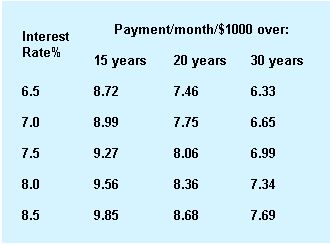
You can get a mortgage-calculator on the Internet, in
Personal Finance computer programs and in many books, but
here is a basic one:
So, say you have $500/month left for the mortgage-payment,
and interest rate for a 30-year mortgage is 7.5 percent
this week, a bank would let you borrow $71,500 to buy a
homeplace (500 divided by 6.99). Grossed up by your 20
percent down, that will get you a place selling for
$86,000.
That won’t get you much in San Francisco (highest-priced RE
market in the U.S. in the latest survey by the National
Association of Homebuilders — data for last quarter
of ’95). But, in the NAH’s lowest-priced market, Lima,
Ohio, $86,000 would get you a brand-new four-bedroom family
home in the latest cornfield being consumed by a housing
development. (By coincidence or not, Lima is in one of
MOTHER’S “Top Ten” areas to live the Good Life as revealed
in our Community Survey. Still, it is debatable which is a
better contribution to the economy by an acre of prime Ohio
farmland: production of 50 bushels of grain per year
forever or the combination of some land speculator’s 1,000
percent profit, sales of a house-load California
Fir-lumber, a month or two of local construction jobs, and
decades of future property taxes that combine in a new
split-level dream home.)
The Penalties of Voluntary Simplicity
However, if you reduce your income needs sufficiently to
escape the system, you may not meet a bank’s income
requirements. Or the run-down, sagebrush-choked sheep ranch
in New Mexico may not qualify in their steely eye. Or, you
may want to pay for the place over the two-and-a-half years
you plan to continue scrimping as you labor in your town so
as to be mortgage-free when you Make The Move to the
country.
Here is where creative financing comes in. The books can
give you details. But do your best to have the property
owner take a note for whatever you can’t pay up front
— for the shortest repayment period you can handle by
practicing frugality and diverting money from that new car,
those restaurant meals, and the vacation to Acapulco into
the new place. That’s called Owner Financing and owners of
unusual or hard-to-sell properties become more amenable to
the idea the longer the place is on the market.
You might do a Bridge-Loan, where you hold onto your
current home till you get a good purchase-offer (maybe
renting it in the interim if the rental-housing market is
tight). Cook a bridge-mortgage to cover both properties
while the old place is on the market.
Another option is Lease-to-buy or Rent-to-buy where you
don’t need a cent of down money, but apply part of a rental
or lease payment toward purchase.
Realtors these days can come up with all sorts of crafty
formulas to move a property — such as “Balloon
Payments,” where you pay small amounts for a certain time,
then deliver the balance in a lump sum… say, when our
original home sells, or when you get paid for that first
giant order of baby cactus from Japan. Especially if
there’s no bank involved, be sure you have a good lawyer
working for you.
DO NOT let yourself get suckered by a Finance Company.
These sharks advertise in all the real estate media and
you’d think they are giving mortgage money away to
“No-Credit, Bad-Credit, Divorces, Bankruptcies, Payoffs.”
Not being a chartered lending institution, they are not
licensed or regulated by federal or state banking agencies.
They answer (if at all) only to consumer-protection
regulations — and can charge any rate a credit card
is permitted in your state (and, they can add on any “Fees”
they like–to effectively raise rates higher still).
Finance Company offices are invariably headquartered
outside your state, making governmental oversight or
regulation of their practices even harder. Few of them
retain the same business name or charter very long, so can
be impossible to trace. Checking on the principal’s
business history is equally difficult. Plus, if stiffed,
their collection techniques can be right out of The
Godfather. Guess why.
FOUR MUST HAVE MAPS
You will need a variety of maps to research a potential new
country home area.
Roadmap. A national road map such as
Rand-McNally contains a wealth of information, and is a
bargain at under $10. Available at any newsstand.
Smaller-scale — thus more detailed — “Grand
Maps” are published by regional firms.
3D State Maps. The best way to visualize
the topography of a state at a glance is to get the Real
Goods catalog (Ukiah, CA) and order a Raven 3D map for $25 (available
only for Eastern and western states, as most of the
midwestern Great Plains is flat).
Marine Chart. To prospect country near
navigable water, order marine charts that give details of
the waterway as well as inland for a mile or so from any of
the marine supply outlets that advertise in the boating
magazines. Be sure to get (free), “Chart #1” that tells you
how to interpret the maps.
Topos. Once you narrow down your locale
choices, get topographic maps of areas of interest.
Developed by U.S. Geological Survey (Dept. of
Transportation) these highly detailed color maps show
elevations, waterways, and natural features —
including every house, pond, barn, baseball field, and golf
course visible from the air or a mapping satellite.
Available folded for $2.50 apiece from government printing
offices (Pueblo, CO or Reston, VA), but rolled
topos are obtainable a lot faster (and for a bit more
— $4.00 is typical) from your local sporting goods
store. Get a guide to reading the maps if you are a novice.
A topo will tell you more than you can learn by walking the
land.
INFORMATION SOURCES
Following is a list of telephone and on-line numbers, mail
and Internet addresses, TV programs, books and magazines
where you can find information on locating, evaluating, and
buying country real estate.
Locating an Out-of-Town Broker
Real estate brokers can be expert in only a very limited
geographic area, so have welcomed “information-age”
technologies that connect them with allied brokers all
across the continent. You can tap these networks as well in
researching a new location.
“Gallery of Homes,” with its walls of color photos, mounted
an early effort to give brokers a nation-wide perspective.
Other national networks of (individually-owned and
operated) offices include ERA, Century 21, Coldwell Banker,
and others — many affiliated with large, well-funded
parent companies such as American Express or a major
insurance company. Each local office can connect you with
an affiliate nearest to where you are going. So call them
all. Then begin going through the following list.
United National Real Estate, Kansas City, MO is successor to the old United
Farm Agency that, along with Strout Realty, began offering
national advertising and connections to rural realtors back
in the 1930s. United’s 200-page seasonal magazine of
nation-wide rural real estate listings, United
Country is sold (currently for $4.95) on news stands
or by mail at $7.95 for two issues ($13.95 in Canada).
They’ll help you with a property search as well. Send the
home office a note giving your name, address, and phone
plus type of property, location, acreage, and price range
you are interested in. You’ll receive flyers from several
associated realtors in the area, and can take it from
there. Many United associates are small offices in small
towns — just the folks who may know about the
property you are looking for.
National Association of Real Estate Publishers
(NAREP) is a consortium of independent
HOMES-type magazines from coast to coast. Send a postcard to The Moving Line, 378 Allison Ave
SW, Roanoke, VA 24016 for a copy of their
subscription form and questionnaire. You’ll be able to
order real estate magazines from Colorado, Hawaii, both
Carolinas, W. Virginia and 15 or 20 more states. For $2 to
$3 you can have the quarterly to bi-weekly magazines
printed in the areas you are considering mailed directly to
your home. At no charge, you can also order a relocation
kit, plus information on moving, mortgage, and banking
services.
Magazines
HOMES magazine is one of the
above-mentioned freebies. You see — and ignore
— them in the front entry of the supermarket until
you begin looking for a new place. Then, you can’t wait to
devour each new edition. Published locally for most states
(or sections of states), they list properties chosen by
major realtors in the areawho may or may not be associated
with a national marketing firm. Call and they’ll be glad to
send you magazines from one or several locations. No
charge. Internet: http://www.homesmag.odc.com.
The Real Estate Book is another free
magazine-this one in full color.
Television
Your New House is an exception to the
brain-dead TV shows that assume million dollar budgets for
home improvements. A new, innovative and fast-paced new
series out of Dallas Tex., it features short, meaty
segments on all aspects of housing — including the
purchase decision and buying process. It offers tapes of
programs and much hard “you-can-do-it” type info, including
mortgage calculators by mail or Internet. Your New
House, Dallas, TX. lnternet: http://YourNewHouse.com.
Off-to-the-Country Books
Authors of the titles below are former or current
California RE brokers, RE lawyers, or relocation
consultants who are also unabashed self promoters, so the
books are not produced by real publishers but by marketing
and “self-help” presses. MOTHER readers may find them
environmentally-insensitive and mercenary in outlook. They
are best on Western lands and laws — they seem to
assume that all states have water problems and are laid out
in nice square sections, whereas here in New England we are
overwatered these days, thanks to an errant Jet Stream, by
precipitation that belongs properly in the parched
Southwest. And our country property lines are described in
200-year-old deeds as “… a stream to along stone wall to
a large chestnut …” where the stream has meandered into
the next township, the wall is crumbling and the chestnut
died of the blight in ’29.”
But one or more of the following is must reading for anyone
new to country living and real estate. The best are sold by
MOTHER’S Book Store.
Finding and Buying Your Place in the Country, Les and Carol Scher. Dearborn Financial
publishing. 410 pages, $25.95.
Third edition of a fat, large-format book that has sold
steadily since first published in 1974. Worth the price …
even if the authors seem to hurry through sections on
locating and evaluating land and buildings to drone on for
page after page on legal technicalities of property
transfer. Proof if you need it that you need a RE lawyer.
You do (and the authors obligingly provide their own office
address and phone number at the end of the book).
COUNTRY BOUND! Marilyn and Tom Ross. Communication
Creativity. 430 pages, $20.
Subtitled “Trade Your Business Suit Blues for Blue Jean
Dreams,” its “Living on the Land” segment takes up less
than two pages and suggests that growing all your own food
and the other labors of rural self-sufficiency take too
much time and effort; authors tried living on an isolated
ranch, but gave up and returned to town. But they aren’t
the only ones, and their book is positively crammed with
practical tips and a whole list of lists — of tax
rates, what to look for in scoping out a house or a
potential hometown, and more. Buy it for the check-lists
alone.
Discover the Good Life in Rural America. Bob
Bone. Communications Creativity, $12.95.
By a United Country broker/lecturer who could probably sell
sno-cones in the Arctic, this little 150-page primer covers
all bases quickly, but with an infectious excitement that
will go far to convince skeptics that your country-living
dream is possible.
Rule of Thumb XXV: The Standard in Pricing Small
Business. Chad Simmons. Simmons Investment
Company. $12.95 .
Get this ugly little home-published book before you get
half-serious about buying that quaint little General Store
with a real cracker barrel, a potbelly stove, and (most
likely) a two-decade history of losing money. Written by an
executive with United National, this was originally meant
to train real estate sales people, so it pushes the numbers
and pulls no punches in pointing you toward “what you need
instead of what you (think you) want.”
Government Publications — 250 of them cheap or free
— on housing, education, farming, health, food, and
more. For ordering info by mail: Government
Publications Document Distribution Center, Pueblo CO.






