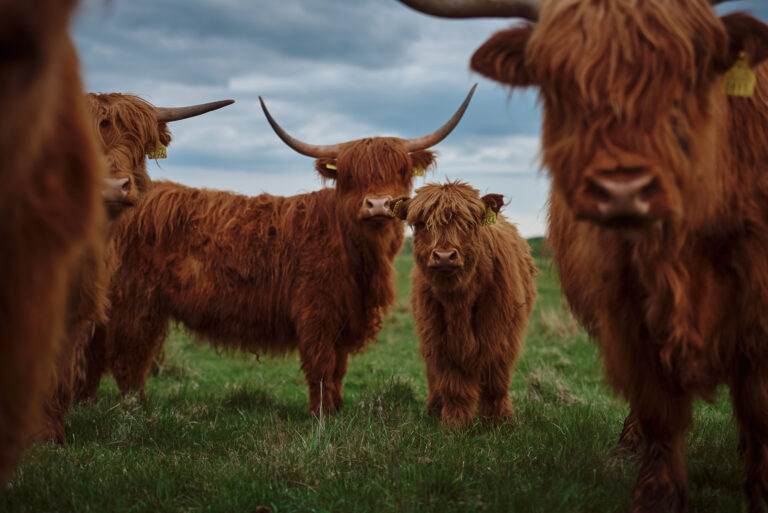
Learn about Scottish Highland cattle facts, a heritage breed unique in appearance and raised primarily for their lean beef. These Highland cow facts highlight why this breed is so admired around the world.
A heritage livestock breed known for its ability to thrive on rocky terrain, Highland cattle are known by their shaggy mane and for their ability to produce lean, healthy meat off of rough pastures. The Scottish Highland cow is one of the most recognizable breeds, often referred to as a Scottish Highlander, admired for both its resilience and beauty. The Scottish Highlands are famed as a mystical and romantic place of rugged mountains, moors, glens, ocean fjords, islands, barren rocks, and steep valleys falling into icy streams or lochs. The weather can be harsh, the landscape battered by cold, driving rain and snow. The small folds, or herds, of Highland cattle have been part of this landscape for thousands of years. These shaggy cattle are descended from the Hamitic Longhorns brought to Britain in the second millennium by Neolithic farming peoples. Through the centuries, Highland cattle were raised mainly as a beef and working breed but were occasionally milked.
Cattle raising was very important to the Scottish economy. Many observers also noted the continuous and numerous cattle raids, known as “reiving,” that occurred back and forth across the borders. The trade in cattle began in the Middle Ages and continued for centuries, interrupted only by war.
Early attempts to describe and standardize types of Highland cows have retained in greater uniformity the same characteristics as a distinct breed than the Highlanders have done, and this seems to point to the conclusion that there has been little change in the character of this class of cattle, except that produced by a more careful system of breeding, so far back as any information on the subject can be obtained. The breeding of cattle has been so general over the whole Highlands and Islands that no single breeder can be credited with the distinction of having started the breed. These are some of the most interesting Highland cow facts that explain their long-standing heritage.
West Highland or Kyloe Cattle
The 1884 herd book describes the two distinct classes, or types, of Highland cattle to be found at that time. The type known as the West Highland, or Kyloe, was found mainly in the Western Isles of Scotland. The usual color of the Kyloe was black, and the cattle were smaller and shaggier than the mainland Highland cattle. It is not known whether this size was due to the harsher conditions of the islands or to a distinctive trait of the Kyloe. The herd book noted that colors besides black had been noticed only in “recent years” and came with introductions of cattle from Perthshire. These variations contributed to the different types of Highland cows seen today.

The Kyloe cattle may have received their name from the kyles, or straits, across which they swam when they were driven 50 miles or more to market on the mainland at Crieff and Falkirk. Because the breed is slow-growing, these market cattle were generally four to five years of age. Many English drovers purchased the cattle at market and drove them over the Pennines into England. In 1723 alone, about 30,000 cattle were sold at Crieff to English drovers. After their journey, they were fattened to a slaughter weight of about 550 pounds. These historical movements are important Scottish Highland cattle facts showing their economic importance.
Mainland Scottish Highland Cattle Facts
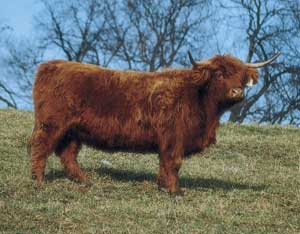
The mainland Highland cattle were very common in the north of Scotland. Besides exhibiting a greater variety of color, this Highlander type was fed on better pasture and was larger in size. By the nineteenth century, many breeders were known for their excellent folds developed exclusively from mainland and island cattle without outside breed influence. In the first herd book, the founder animals were drawn from the two intermingled types of Highland cattle. They were mainly black or dun in color. Bulls stood about 44 inches tall, and cows were slightly shorter. At present, Highland cattle are most commonly colored red, tan, or yellow, although they can be black, brindle, white, or silver-white. Brindle is defined as a tawny or gray color with streaks or spots of a darker color. Many breeders enjoy keeping a multicolored herd. They believe that not selecting for a specific color keeps the genetic pool large and maintains vigor. The hair coat of the Highland is distinctive. The long forelock can flow down over the eyes or even the nose, giving the animal a bemused expression. The body hair is profuse, long, and slightly waved. A downy undercoat beneath the long outer hair can reach 13 inches in length. The undercoat provides warmth, and the slightly oily outer coat sheds wetness. When Highland cattle are raised in a hotter, drier climate, they shed much of their hair coat in summer.
A long fringe of hair often obscures a Highland’s ears. This hair can hide the curious “dock” ears that are often seen. These ears are short or split with ragged edges. The Highland Cattle Society of Scotland views the crop ear as an undesirable genetic defect but permits registration and breeding of such animals. This trait has been present for many generations.
The Highland has an appealing and picturesque head. Short but broad, the head is crowned by lovely horns. The long horns of bulls usually grow out level from the side of the head, inclining slightly forward and rising upward. Some breeders favor a downward curve. Cows are horned in two different patterns.
The Highland bull does not have a heavy dewlap under the neck. The neck forms a straight line to the shoulder in the cow. Bulls can have a masculine crest. In both sexes the body is well rounded, deep, and long. The legs are short but strong, broad, and well feathered. The long tail is hairy.
In Scotland, the Highland remains smaller in harsher environments and larger on lowland pasture. In spite of its slow growth and smaller size, producers like the Highland’s economical production on marginal land. Grass-fed steers finish up to 1,000 pounds at two years. Because of their heavy hair coat, Highland cattle deposit less fat under the skin. Highland beef is considered distinctive and lean and is the choice of Britain’s royal family, who raise them at Balmoral Castle. In North America, bulls can sometimes weigh 1,500 to 1,800 pounds and cows 900 to 1,100. Grain is sometimes used to finish off the steers.
Importation to North America
Highland cattle were exported to Manitoba, Canada, in 1882. Although they may have made their way to the United States earlier, the first recorded American imports were made in the early 1900s to ranches in Wyoming and Montana. Four bulls and 45 cows were included in the first American herd book, all from the Montana herd. In the 1920s, there were more imports to the eastern states, and further imports have occurred more recently.
The American Scotch Highland Breeder’s Association was founded in 1948, registering purebred cattle only. The descriptive “Scotch” was dropped in the 1990s. Highland cattle are now present across the United States, even in some warmer states. The Canadian Highland Cattle Society was founded in 1964. Although upgrading was allowed before 1994, part-bred cattle are no longer eligible for registration. Highland cattle are most numerous in Alberta, British Columbia, Ontario, Quebec, and Saskatchewan.
Benefits of Highland Cattle

Highland cattle have done especially well in the northern areas of North America, employing the same strong traits that have served them so well in the rugged conditions of Scotland. Highland cattle have an almost legendary hardiness and are excellent wintering cattle, doing well in harsh weather even without shelter. They are a very long-lived breed, with average cows raising 12 or more calves. Highland cattle are noted for their intelligence and self-reliance. Some breeders feel that this confidence borders on indifference to humans. The long hair also provides protection from flying insects, although they can have a greater problem than other breeds with lice and fly-strike in hot weather. The cow’s mothering instinct is highly developed, and birth is generally easy. Highland hides are desirable as floor rugs, and the horns are valued as decorations. The lovely and unique Highland also makes an attractive oxen team.
Able to handle tough terrain, the Highland is known as a browser. Although Highland cattle need access to pasture, they are able to suppress brushy invaders such as thistle, blackberry, gooseberry, raspberry, alder, sumac, aspen, pigweed, cherry, willow, and milkweed. The Highland will work on the underbrush, converting woodland into park-like areas over a few years.
Because the Highland is genetically different and pure, this breed imparts great hybrid vigor in crossbreeding. Dairy farmers can use Highland bulls to father small calves for easier births. Calves can tolerate late winter storms and thrive the next winter on minimal feed and attention. Crossbred calves are also hearty, with less external carcass fat. Highland-Hereford crosses have a higher weaning weight and percentage of calves weaned than either parent breed.
In Britain, the traditional Shorthorn-Highland cross has been developed into a recognized breed called the Luing. Originating on the island of Luing off the western Scottish coast in the 1940s, this breed has been exported to Canada and other countries. Unfortunately, the Luing has not fared well in Canada and failed to register a single animal by 1993.
Preserving the Breed Internationally
Although the Highland population in the United Kingdom may be as high as 15,000, there is importance in preserving the breed in separate places. Highland cattle have been exported from Britain to Argentina, Australia, Sweden, Germany, South Africa, New Zealand, and elsewhere. In 1970, there were about 500 registrations annually in the United States and 124 in Canada. Twenty years later, the American numbers had increased to more than 750 and the Canadian registrations to 500 to 600. The ALBC estimates the total Northern American population at about 10,000. Some of the breed’s success in North America is due to the Highland’s exotic and highly recognizable appearance.
North American breeders are now enjoying an export market for Highland cattle. Canadian Highland cattle breeders are sending about 100 animals each year into the United States and elsewhere. Frozen embryos have been exported from the United States to Argentina. Both Canada and the United States have exported purebred cattle to Europe.
The importance of preserving the Highland as a pure breed in North America may become more crucial with the European Union requirement requiring that herd book rules be compatible from nation to nation. Some European registries allow upgrading and so have introduced outside blood into their cattle. If other registries are forced to accept these crossbred cattle, the Highland breed will be genetically diluted. The traditional Highland is a genetically separate breed formed through centuries of isolation and is valuable because of that purity.
In the United Kingdom, the Highland Cattle Society has always allowed unregistered female cattle into an appendix section of the herd book if they are physically inspected and judged to be of “true Highland type” by experienced fieldworkers. This would apply to any cattle coming from other herd books as well. Both males and females would have to comply with the society’s appendix rules. This situation is somewhat different from recognized programs of upgrading as practiced by other cattle registries.
Highland breeders face additional concerns. In North America, most Highland cattle are raised without stimulants on natural grazing. The Highland is well suited to the natural, lean, or custom meat markets, and the value of this product can compensate the raiser despite the breed’s slower growth rate and smaller size. If Highland raisers choose not to raise and market naturally lean beef, they are forced to finish out on grain to meet the market grading requirements for fat. The Highland horns and hair can also be a disadvantage at sale barns where buyers do not want horned and hairy animals even though they serve a valuable purpose in harsh climates or for protection from predators. The alternative is to dehorn and shear the hair.
North American breeders accept a variety of appearance in their stock, and the associations use a breed description, not a breed standard. There is increasing pressure to select for faster-growing young stock or cattle that conform to accepted market conformation. Some breeders feel that this emphasis is creating problems with feet, udders, and diminished mothering instincts. It is most important that the hardy functional traits of the Highland are not damaged in pursuit of show cattle or marketing trends.
Our thanks to Yale University Press for their kind permission to post this profile from The Encyclopedia of Historic and Endangered Livestock and Poultry Breeds (Copyright 2001 by Yale University), by Janet Vorwald Dohner. This 500-page book is a definitive reference about heritage livestock, describing the history and characteristics of almost 200 breeds of poultry, cattle, pigs, goats, sheep and horses.
Frequently Asked Questions
What are the most interesting Highland cow facts?
Highland cow facts include their long shaggy coat and their ability to survive harsh climates. These Scottish Highland cattle are also known for producing lean, high-quality beef and having a long lifespan compared to many other cattle breeds.
What is a Scottish Highland cow known for?
A Scottish Highland cow is known for its iconic long horns, thick double-layered coat, and ability to thrive in extreme weather conditions. These cattle are also valued for their calm nature and efficient grazing habits on rough terrain.
What are the different types of Highland cows?
There are different types of Highland cows, mainly divided into mainland Highland cattle and West Highland or Kyloe cattle. These types vary slightly in size, color, and environmental adaptability based on their geographic origin.
How long do Highland cows live?
Many people ask how long do Highland cows live, and typically they can live between 15 to 20 years. With proper care, nutrition, and environment, some Highland cattle may even live longer than average cattle breeds.
Why are Highland cattle so popular today?
Highland cattle are popular due to their unique appearance, sustainable farming benefits, and high-quality lean beef. Their ability to adapt to various climates makes them a preferred choice for farmers globally.
Are Highland cows good for farming?
Yes, Highland cows are excellent for farming, especially in rough or marginal land conditions. Their low maintenance, strong immunity, and ability to graze efficiently make them ideal livestock for sustainable agriculture.
What makes a Scottish Highlander different from other cattle?
A Scottish Highlander stands out because of its long hair, horns, and adaptability to cold climates. Unlike many other breeds, Highland cattle require less intensive feeding and produce leaner meat.