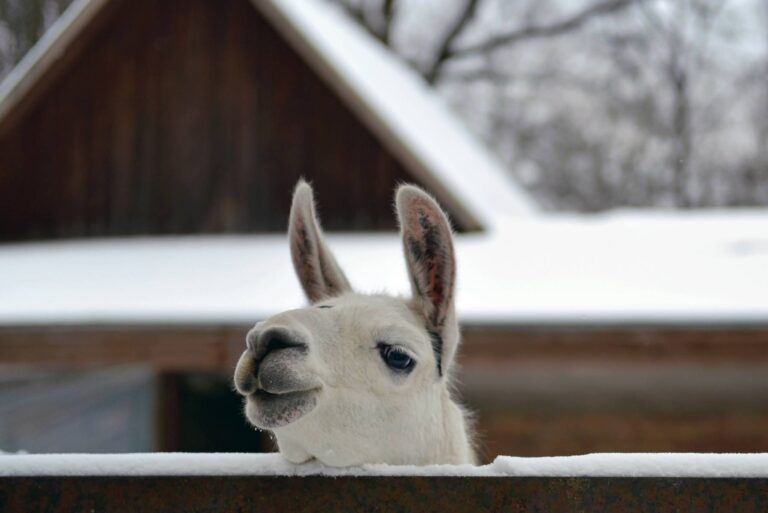
When a livestock guardian dog is not right for your farm, what other choices do you have? Jan Dohner takes an honest look at another option: the guardian llama.
If you are unsure of which livestock guardian animal to choose for your place, let’s take a look at the possibilities of a guard llama. Although either females or males can make a good guardian, gelded males are most commonly used because they are larger and less expensive than females and safer than intact males. In their natural environment, the dominant male llama guarded a small group of females and he was the primary defender against threats. Generally speaking, a male will be a better choice although a retired breeding female might also be a good prospective guardian. The llama’s size and maturity are very important factors in good working ability and predator control, so your guard llama should be at least 18 to 24 months old. Size is also the reason that alpacas, which are considerably smaller and lighter than llamas, are not used as livestock guards.
What are the advantages and disadvantages of guard llamas? Would a llama be a better choice for your situation? Would you be more comfortable with a llama rather than a livestock guard dog?

Livestock Guardian Llama Pros
- A llama is naturally social and if he is the only llama in the area, he will usually stay with his pasture mates. After a careful introduction to each other, llamas usually bond fairly quickly to their companions. There is no need for the extended training period you might have with a LGD. Some sheep, goats or other stock are frightened or skittish around dogs, but will accept a llama in their field. Llamas are able to guard sheep, goats, cows with calves, deer, alpacas and poultry.
- Llamas are naturally aggressive towards foxes, coyotes and dogs, as well as some other predators. This protection will extend itself to the llama’s companions. Some llamas assume a leadership role in their flock, patrolling their territory and seeking higher areas to observe their surroundings. Guard llamas usually respond to a predator by watching it intently and posturing, sounding a shrill alarm call, spitting, or herding their flock mates away from the threat. Most guard llamas will also move towards the predator and attempt to chase or strike out at it; however, very few guard llamas actively attempt to kill a predator.
- If you are raising sheep or goats, a llama has similar maintenance, shelter and feeding requirements. He will primarily eat or graze the same food as the flock or herd.
- Llamas do not actively challenge fencing. They do not roam, dig, bark or chew on wood as a dog might. They do stick their heads and necks through things, making non-electric, high-tensile wire fences somewhat dangerous to them, as well as fences, gates or panels with large openings. Barbwire fences can be very dangerous to llamas for the same reasons but also because they can catch their fleeces.
- Llamas have a calm temperament and do not generally pose a threat to human beings. They may appear less threatening to your neighbors or farm visitors than a large dog. Llamas do need to be handled and socialized with people or adult llamas can become dangerous. Llamas need to accept regular handling, shearing, toenail trimming, and veterinary care.
- An experienced guard llama will provide immediate predator control when you buy him. Llamas also have a long working life since their lifespan is 20 to 25 years.
- Llamas can produce fiber, which may be of interest to you or your customers.

Livestock Guardian Llama Cons
- Llamas are also the prey of coyotes, dogs or wolves; as well as bears, bobcats, mountain lions and other large predators. Llamas cannot protect against these more serious threats. While a guard llama may be able to deal with a single coyote or a roaming dog, they cannot confront groups of them. In fact, most llama and alpaca breeders use livestock guard dogs in predator situations. Llamas generally do not provide protection against feral hogs or small predators such as raccoons, opossums, or large birds. Since llamas do not bark loudly like a dog, you may not be aware a predator is threatening your stock especially at night. If your predator pressure is light and you are able to keep an eye on your pastured animals during the day, a guard llama is more likely to be successful.
- Llamas do not provide protection for your family or farm.
- Guard llamas are less successful on pastures with dense vegetation, on large open range, or situations with heavy predator pressure. Since their native environment was the high, arid Andes Mountains, llamas can have difficulty in extreme heat or humidity over an extended period of time.
- Not all llamas are peaceful flock companions. Some llamas will injure or harass livestock and they may interfere with the birthing process. Some llamas do not adjust to living without other llamas or will live apart from their stock.
- Llamas generally cannot be used with livestock guard dogs or herding dogs.
- If you are not familiar with llamas, you will need to learn how to handle and care for them. You should find a knowledgeable person to help you select your llama, examining both health and behavior. I will discuss how to select a guard llama in a later post.
- Shelters for llamas obviously need to be taller than those used for goats or sheep. Llamas also cannot use hard salt or mineral blocks and they need copper in their mineral mix, which may be toxic to sheep. You will need to provide your llama an appropriate loose salt or mineral mix.
- If not trained or socialized, adult male llamas can be dangerous to humans.
- Some llama breeders will not sell you a llama as a guardian if they believe the llama itself will be in serious danger due to predators.
Jan Dohner is the author of Livestock Guardians; Using Dogs, Donkeys and Llamas to Protect Your Herd, by Storey Publishing. She has over 30 years of experience with livestock guard dogs and wrote this book to help all owners and potential owners of livestock guardians to achieve greater success. She is also the author of The Encyclopedia of Historic and Endangered Livestock and Poultry Breeds.