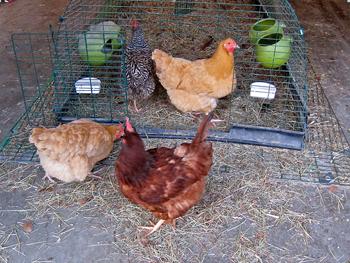
We are nearly two years into raising our Flock-of-Four:
Amelia (Barred Plymouth Rock), Ruby (Rhode Island Red), and Buffy and Dixie (Buff Orpingtons). Hatched in May 2010, they
spent their first summer as pullets in the Eglu which we moved around the
backyard, shifting its position every day as the birds scratched up the lawn. We
were amazed at how quickly they grew from fuzz-balls into handsome birds with
distinctive plumage.
As they were nearing six months, we moved them into our
garage to provide them greater protection from the New England
winter, putting the Eglu on a tarp covered with a 3-inch layer of hay, which we
changed weekly. We added a light to give them 14-hour artificial day-length to
encourage egg production. That turned out to be quite a winter in New England! With record snowfall outside, the Flock-of-Four, cozy in the garage, averaged over 2 dozen eggs per week. We
figured the abundance of fresh eggs more than made up for shoveling out the car
that no longer fit in the garage.
The ease of keeping the Eglu in the garage vs. moving it
daily onto fresh grass led us to leave it in the garage permanently. We let the
hens (now the “garage girls”) out each day to free-range the property and they
always returned to the coop at dusk and also during the day to lay their eggs
or to drink water and consume the feed that we provided.
Molting Begins
As summer gave way to autumn with its shorter day lengths,
we decided not to add artificial light and to see what happened with a
natural daylight cycle. It didn’t take long to find out. One morning in
mid-October it looked like a poultry crime scene in the coop. Golden-tan
feathers everywhere, yet all of the flock was present, strutting about and
making their customary morning clucking sounds. What happened was Buffy had
abruptly started to molt. Feathers were falling out by the handful and her comb
and wattles were distinctly paler than the week before. She was a rather
bedraggled version of the elegant Buff Orpington she had previously been. For
the next month of molting her egg production declined to less than half of what
it had been, and continued to be vastly reduced through the winter, even after
she had regained her full plumage by mid-December. By then Dixie,
the other Buff Orpington, started her molt. Through the molting the combined
egg production of Buffy and Dixie was an egg
or so per week, but picked up to an egg or two per day with the advent of
spring.
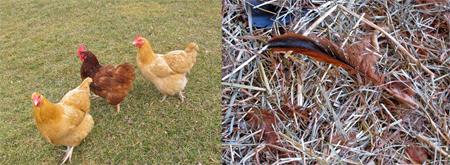
Not until March did Ruby, the RI Red, begin to molt, her red
feathers flying all over the place with the March winds. Up until then
our best layer, she abruptly went on strike and for three weeks didn’t lay a
single egg. During that time of non-laying, her newly bare patches grew
pinfeathers with shafts that looked like quills which then erupted from
the tips, blooming into new feathers that looked like little paintbrushes
(photo). As her feathers returned, so did Ruby’s egg laying. Her first effort
was an egg, that while larger than the eggs she had been laying before, was
lighter in color and distinctly two-toned. Happily, her laying then
quickly returned to champion status.
So, what about Amelia, the Barred Plymouth Rock? Usually
chickens molt in the autumn in response to shortening day-length. But even
without artificial light, at 22 months, she has not yet had an abrupt molting
event. Every once in a while we notice a black-and-white feather floating
around, but we can’t tell whether she has been slowly molting, or will molt
abruptly later this spring, or is skipping the process all together. She
remains one of our most productive layers. We’ve appreciated that each of the
Garage Girls has had a different schedule for renewing their feathers since
we’ve had a constant supply of delicious eggs all winter!
Storey Publishing will bring several authors to both 2012 MOTHER EARTH NEWS FAIRs. You can learn more about chickens in the book Storey’s Guide to Raising Poultry by Leonard Mercia.
Please visit the FAIR website for more information about the Puyallup, Wash. FAIR June 2-3, and the Seven Springs, Pa., FAIR Sept. 24-25. Tickets are on sale now.
You can also get FAIR updates on our Facebook and Twitter pages.