

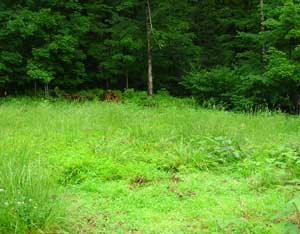
We live very much in the woods. The property, nonetheless, is not entirely forested. We now have The Clearing – the open area in which the cabin and the garden are situated – and The Meadow, also known as the Upper Field – a patch cut that now boasts clover and grass, as well as a once-wild-now-sort-of-tamed raspberry patch.
These open spaces are a source of pride and mutual smiles as Ryan and I relish the magnanimous tone we impart to their titles. Why? Because their existence implies much work.
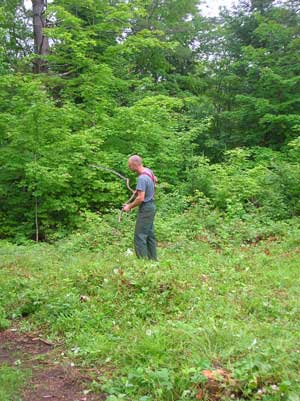
The Meadow, granted, had the assistance of goats a few years back to stall the natural process of forest succession. For this we are grateful, but to maintain it as “pasture” we must work to keep it as such. Thus enters the scythe in the story of our homestead. This is self-propelled mowing in the original sense of the phrase: human powered, muscled powered. Indeed.
With the scythe, we can trim the clover and the hay grasses. This encourages vigorous growth, as well as keeps passage through the area comfortable. A wildlife niche distinct from the surrounding woods is created with this lush “pasture” setting. Too, the clover is a source of nutrient-rich mulch, and the grasses a straw substitute (we must be careful to cut prior to setting seed) used for smothering weed pressure and retaining moisture within the garden beds.
The Clearing, however, has a different story in that no animals have helped us in its progression from forest to field. The process began with the felling of trees and the stacking of brush. In the time we were able to create a garden and erect the cabin, a whole new genre of flora replaced the pines which once stood in their place. While we’ve been fortunate to have many grasses, clover, and wildflowers appear, brambles, virgin’s bower, and shrubby beaked hazelnut have been equally vigorous.
We do, of course, cut back the plants of the latter list, in the hope that those of the former will dominate. This necessitates much handwork, and spot-by-spot care in picking and choosing how to best nurture our particular style of “lawn.” Before the scythe can be used, there is woody debris, slash, rocks, and uneven topography that must be dug, moved, rolled, hauled, and re-shaped – all for the pursuit of the repetitive, meditative, powerful swing of the scythe blade.
Predictably, there are always corners, edges, and tiny nooks that require finer handiwork – and for this we have the hand scythe. Commonly recognized as the sickle blade, this curved hand tool is excellent for precision and detail work in close proximity to the garden or other plants that must be preserved.
Ryan in particular enjoys the rhythm and labor of working with the full-sized scythe. Hours of sweat have gone into the basic and essential work of sculpting an open environment. I, by contrast, enjoy the hand scythe – a satisfying means to tame the vigor of plants in and around the garden. In this way we are cultivating our lawn – not, perhaps, of suburban style, but certainly of utility. A “lawn” not simply for lawn’s sake (and yes, it is with a broad definition of the word that we use it), but for the multiplicity of functions it offers, and the aesthetics that accompany it. With the use of beloved hand tools, we keep the forest at bay, encourage the garden, and welcome the sun to shine on our little home.
For ecological garden design and maintenance, or weeds pulled from your garden or landscaped housefront, please contact Beth via b.a.weick@gmail.com.





