

Corn Wages Chemical Warfare
When caterpillars attack corn leaves, corn fights back.
First a signal is emitted; then the corn kernels call in a
troop of parasitic wasps to surprise attack the
caterpillars. Female rescue wasps lay their eggs directly
into the enemy caterpillars, and when they hatch, the
larvae feast on the caterpillar’s insides. As the larvae
mature, they crawl out of the caterpillars as wasps and fly
away. Mission accomplished.
All right, you buy the part about the wasps, but what is
this corn-signaling-for-help nonsense?
According to researchers Ted Turlings, Ph.D., and James
Tumlinson, Ph.D., of the U.S. Department of Agriculture in
Gainesville, Florida, corn emits a distress chemical, or
turpenoid, when it senses caterpillar saliva. (Call it the
“spit factor.”) Wasps then pick up the turpenoid’s scent
and fly over to save the day.
The two researchers are currently trying to figure out why
the corn reacts to the caterpillar’s saliva. They are also
rearing wasps in the laboratory and “teaching” them to read
the corn’s distress signal. Turlings and Tumlinson have
developed a synthetic blend (similar to the turpenoid) that
not only attracts wasps, but also poisons caterpillars and
acts as an antibiotic against fungus and bacteria.
Turlings and Tulinson hope that one day farmers will sic
’em on cornfields by the swarm.
Bug-Eatin’ Lawn Ornaments
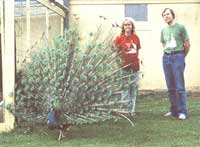
Peacocks aren’t just proud, they can be downright arrogant.
Perhaps they have the regal appearance to pull it off, but
nice garb shouldn’t grant the right to cast looks.
So who’d want one for a pet?
According to farmers Debra Buck and Dennis Fett, you might.
The married couple operates the largest peacock farm in the
nation, selling over 1,000 peafowl-hatching eggs a year.
They believe the peacock is the organic bug control of the
’90s. Peafowl will eat the bugs eating your vegetables and
the worms eating your apples. They’re also easy to care for
since they eat the same foods as most poultry (although
they should also be given a game-bird food containing 30
percent protein).
If you can see it all now-beautiful lawn ornaments dining
on unwanted pests hold up; there are still a few
considerations you should mull over. For one thing, peafowl
frequently snack on flowers and garden vegetables. Broccoli
and cabbage seem to top their list. In fact, Buck and Fett
suggest gardeners grow extra vegetables to compensate for
the inevitable loss. Peafowl also have a rather strange cry
that resembles the sound of someone screaming “help!” :
This maybe somewhat disconcerting for you and your family,
and down right traumatic for your neighbors.
Let’s take Rolling Hills Estates, California, for instance.
Last year, when bands of wild India blue peafowl suddenly
began roaming around community neighborhoods, residents
nearly went berserk. The ingrate peafowl took it upon
themselves to feast lavishly on vegetable gardens, relieve
themselves on residential properties, and scream wildly at
indecent hours of the night. Eventually community members
became so fed up with the birds that city officials phoned
Dennis Fett and offered him $200 plus expenses to figure
out a solution. Fett agreed, and spent several sleepless
nights determining ways to help out. He then flew to
California and spent four days outlining alternatives and
offering his suggestions to the town.
One of Fett’s ideas was to develop a foundation that would
organize the care and nurturing of the peafowl, using
homeowners’ associations to handle the peafowl problems and
protect community plants from hungry birds. He also threw
in some survival tips to make life more tolerable, such as:
1) avoid planting plants that peafowl like or put up a soft
mesh screen around those garden vegetables, 2) avoid
chemical pesticides, since peafowl also feed on bugs-the
more they eat bugs, the less they’ll eat gardens, and 3)
hide your kitty’s food bowl. Peafowl adore cat food.
As for the raucous noises, Fett told residents that they’d
better get used to it. There’s just no way to keep a
peacock from screaming. (Well, no humane way).
So, weigh all of your pros and cons, and if you decide to
buy one (females are peahens; males are peacocks; babies
are peachicks), check with your city or county codes to
ensure poultry may be kept, and then look for a good
breeder.
Some Cyanide in Your Soil?
Bad news for country dwellers. Big mining corporations are
blowing the tops off mountains from Iowa to Washington, and
it’s not coal they’re after. It’s gold. When they’re going
for coal, they at least have to clean up their mess-not so
with gold.
Here’s the real kicker: most companies use cyanide
to separate the gold from the ore it’s found in. Then, when
they’re finished mining they just, well …leave it there.
Unsuspecting animals fall victim to its nasty effects when
they drink from cyanide pools. It also seeps into the
ground, where sunlight can’t break it down, and then enters
the aquifer (underground water source). When ingested in
large amounts, cyanide can be fatal.
You can blame this fiasco on the mining law that Congress
passed in 1872-the same law that coaxed starry-eyed gold
diggers to stampede California, dynamite in hand. The law
basically says anyone can mine anywhere, anytime, for
anything, and never mind the mess. So mining companies are
buying up hundreds of acres of National Forest land.
And don’t think private land is exempt. Mining companies
make offers that many can’t refuse. They’ll pay Mr. Jones
for permission to search his land. So you’ll never know
when Mr. Jones’ tomato patch will be blown to bits. And
this could depreciate your property’s value.
Take for instance the small town of Chesaw, Washington,
where Battlemountain Gold is all set to blast nearby
Buckhorn Mountain. We’re talking about a 100-acre open pit
and 500 acres of dumped waste rock and tailings, soggy with
aresenic. Locals are scared silly. Not to mention the fact
that mines endanger bears, wolves, and lynx by poisoning
their drinking water.
Knowing full-well that they pose these threats, mining
companies sweet-talk opposition with the promise of new
jobs.
Over-zealous community residents often catch
building-fever, in anticipation of the mines bringing in
new business. “People start building with visions of a huge
windfall,” says Jim Goettler, member of the Washington
Commision for Responsible Mining.
Problem is, once all of the gold’s gone, the companies then
clear out, taking all the hands-on mining jobs and revenue
with them. All they leave behind are a bunch of tacky
mini-malls. Of course, these companies don’t contribute one
red cent towards the communities landfills, schools, or
fire departments.
All these negative side effects have rural residents down
in the mouth-but they are not powerless, Goettler says. You
can gather together, do some foot stomping, and attack the
1872 Mining Act. Then badger Congress to amend mining
legislation at the state level. After ripping up your land
and dousing it with cyanide, the very least miners can do
is clean up their mess.






