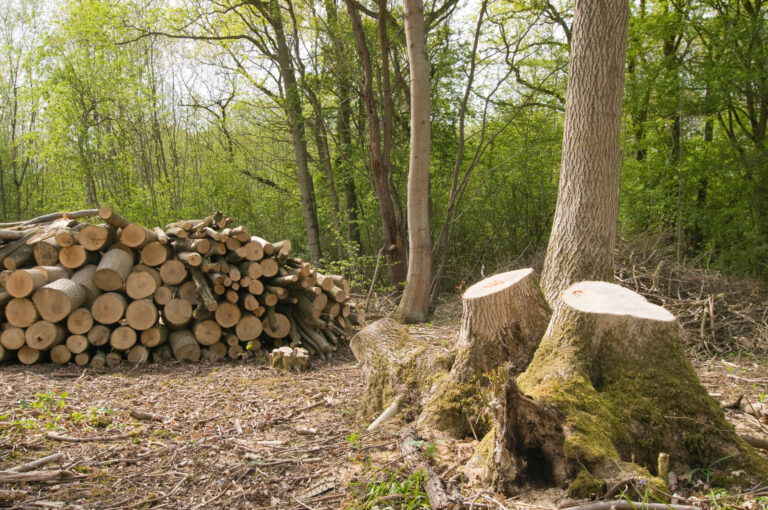
You can grow firewood by coppicing trees for firewood in a fraction of the time it takes to raise a tree from seed.
Of all the forestry techniques available to woodland owners, few methods are as underutilized as coppicing. Coppicing is a reproduction method wherein a tree is cut back periodically to stimulate new growth through dormant buds on the living stump, or “stool.” In turn, these buds develop into sprouts, also called “shoots,” capable of growing firewood in approximately half the time it would take to grow the same amount of wood from seed.
Coppicing as a management technique dates back to the Neolithic period, when people used coppice wood for a variety of purposes, ranging from beanpoles and lath to firewood and fence posts. Even into the 16th century, the economic importance of wood obtained through coppicing was so significant in England that King Henry VIII mandated the construction of fences around coppice forests throughout the country to protect them from browsing animals.
Tree Growth Variables

As a forester, I’m often asked how long it will take a tree to grow to a specific size. If I know something about the site, I can make an educated guess. However, more often than not, too many factors are at play to make any sort of reasonable estimate because both environmental and genetic factors influence growth rates. Environmental factors include climatic conditions as well as soil quality. Primary genetic attributes include vigor, disease resistance, photosynthetic efficiency, and species. Almost without exception, some species will grow faster than others, even in a less suitable environment. Willows, for example, will almost always outpace oaks in terms of growth rate, while beech trees in a northern hardwood forest are notorious for out-competing maples and birches, creating thick, single-species stands.
The Growth Benefits of Coppicing
Because of this natural variation, it’s important to avoid broad generalizations regarding yield. However, despite the many variables, coppice systems offer two clear benefits over trees grown from seed. The first benefit is reduced establishment time, meaning that you won’t need to wait for a seed to germinate, establish itself, and develop a full root system. The second benefit is that because coppice trees form multiple stems as opposed to a single trunk, you’ll have the opportunity to grow significantly more wood.

The following example illustrates how coppice firewood production stacks up against trees of seed origin. The two trees in this simple case study came from the same site to minimize variability.
First, I cut down a 40-year-old American beech tree with a single trunk, likely established from seed. The tree measured 8 inches in diameter at breast height (DBH) and yielded one face cord. I then harvested an 18-year-old, coppice-grown American beech tree that had four stems. The coppiced American beech also produced one face cord. In other words, coppicing encouraged equal wood production in less than half the time.
Growth Rate vs. Energy Potential
If you’re establishing a coppice woodlot for firewood production, you can expect an inverse relationship between the rate of growth and the energy potential of coppice species. If we were to rank four common species in terms of estimated growth rates and compare those growth rates to their energy potential, we’d see that, as a general rule, the wood from slower-growing trees contains more British thermal units (Btu) for the same volume of wood. (See the table “Growth Rate vs. Energy Potential of Tree Species,” below.) Be aware of this time and energy trade-off when you’re trying to decide which species to coppice, or when you’re purchasing firewood and are faced with the question of which species will yield the most heat per dollar.
Step-by-Step Guide to Coppicing Firewood
Select trees with poor form that have little value as saw logs or other forest products to coppice. You can coppice at any time of year, but you’ll achieve the best results by coppicing trees when they’re dormant and leafless.
Cut low stumps. A low stump encourages the establishment of new shoots at or below ground level. This promotes the development of roots and increases the tree’s stability. The ideal new coppice stool should be only 2 to 3 inches above the ground and should slope slightly to shed water (see left illustration below). If you’re harvesting a previously coppiced stool, cut along the same angle as your previous cut, just above the point at which the stool splits into multiple stems.
If you live in an area where animals are prone to browse, place branches around the stool as a deterrent. Another approach is to develop a coppice system that favors tree species that are less palatable to browsers. For example, animals are less likely to munch on beech and birch than on maple or oak.

Within 4 to 8 weeks, you’ll begin to see numerous sprouts emerging from the stump, forming J-shaped leaders (see middle illustration below). After leaf fall, clip off the smaller, less vigorous sprouts. On average, I leave 4 to 6 sprouts per stool (see illustration).
The amount of time it will take you to produce your first firewood crop will vary depending on species, site, stool size, and desired firewood diameter. I tend to harvest most of my coppice firewood on an 8- to 12-year cycle. For my more productive trees, this will yield firewood that’s 3 to 4 inches in diameter — small enough to avoid splitting!
The beauty of coppice firewood production is that coppiced trees maintained in a juvenile stage will never die of old age. The benefits of coppice systems also extend beyond simply providing firewood. The dense cluster of shoots around a stool provides vital habitat for birds and small mammals. And because coppice forests depend on healthy root systems, sound management of these forests also prevents erosion in the surrounding landscape, thanks largely to the stability afforded by a healthy rhizosphere capable of developing into a well-anchored mat of latticed roots. As for other uses, you can consider coppicing for animal fodder, basket splints, stakes, bentwood furniture, tool handles, and more.
Brett McLeod is the author of The Woodland Homestead and is an associate professor of Forestry and Natural Resources at Paul Smith’s College in upstate New York.