Besides
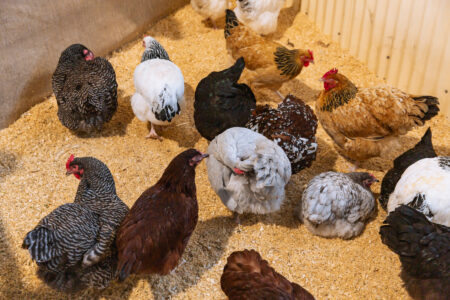
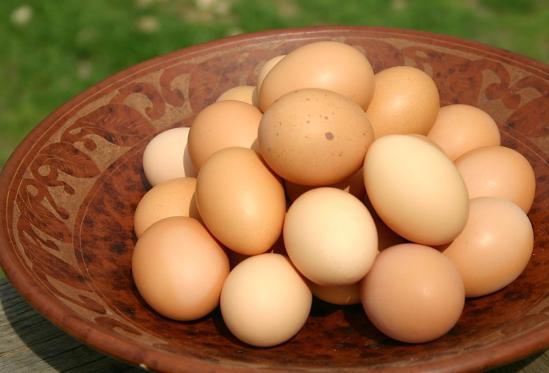
giving us four fresh, deeply flavorful, free-range eggs every day and providing
us with endless amusement, our hens are prodigiously productive fertilizer
factories.
We
have four laying hens. Each of them lays one beautiful brown egg every 24 hours.
By the end of each week, we’ve put 28 eggs in
the fridge. In a single year,
that’s 1,456, or 121 dozen eggs. Allowing for inevitable breakage and an
occasional off day for each hen, it’s still more than enough to feed Vicki and
me, and share the largess with friends and neighbors.
But
when it comes to pooping, the numbers dwarf the egg arithmetic.
First,
we have to add Larry the rogue rooster into the mix, for a total of five
chickens. At this point, it gets a little tricky to figure out their raw
fertilizer production in a year. I’ve found various estimates that come pretty
close to 45 pounds per chicken per year, for a total 225 pounds. In itself,
that’s a pretty impressive statistic. But my back tells me we’re talking about
a much bigger number.
Chickens,
of course, produce other waste – the urine that combines with their poop to
soak the bedding in their coop. (How funkily poetic.) We use well-dried straw,
and I’ve found that even with spreading a fresh layer over the soiled, it’s
still necessary to clean it all out and replace it about once a week. Until
yesterday, that went into a pile inside a rustic dog kennel that was left on
the property when we bought it. Left to it’s own devices, the pile would
eventually decompose into rich, loamy and valuable compost. But it’s an
inefficient way to produce finished fertilizer.

During
a recent trip to town to visit our local farm co-op for the fun of picking out
vegetable and flower seed for this season’s gardens, I noticed that the boys
were busy on the loading dock out back, shuttling around wood pallets stacked
high with new merchandise.
A
pallet is a wonderfully useful thing, even beyond its original purpose. One of
them makes a fine base for a rain barrel. Two neatly handle a rick of firewood.
Five can be nailed together to form an open-topped bin for storing potatoes.
I’ve seen them assembled into coops, used as the base for honeybee hives,
cobbled together for sub roofing on sheds, cleaned up and set on end as
farmhouse bedsteads, even stripped down and used as the raw material for chairs
and stools.
They
also happen to be just about perfect for compost bins. Set on one end and
connected at the edges, the double-layered pallets provide sturdy walls to hold
your compost pile neatly in place, while offering necessary ventilation to keep
decomposition moving at an efficient pace. Arranged in sequence, they allow you
to move the composting material from one bin to the next to continue its
transformation while making room for fresh stuff in the first bin, and so on to
a third bin. Et voilà, a homestead-sized composting facility.
So
I asked the boys on the loading dock what they do with their used pallets. We
burn them, one said. No, that’s changed, said another, they’re trying to sell
them now. I asked if they could spare seven. Why? I’m building a compost bin.
OK. Some people come
in asking for them and go off trying to sell them on their
own. Just wanted to make sure. You can have them. They fork-lifted a stack of
eight, tossing in a spare, helped me loaded them into my old pick-up, and I was
in business. If you’re reasonable, folks around here can be pretty generous.
Even to a Yankee.
Keep
one thing in mind. All sorts of stuff are moved around on pallets. In my urban
youth, when I worked nights moving freight on a Detroit-area loading dock to
supplement my subsistence wages as a new reporter, I occasionally had to handle
loads of toxic chemicals. Some had leaked, soaking into the pallets. This is
bad for dockworkers, and it’s bad for any use that can get poisons into the
food chain. Before making a compost bin, check with your source to be certain
your pallets are “clean.”
It
took only about an hour to assemble my three-section compost rig using heavy
nails to hold them in place and coated wire to strengthen the joints. It’s not
very refined, but on Shuddering Squirrel Acres refinement is secondary to
getting the job done. Next up, the hard work.
It
was past time to move my combination coop and chicken run to a new location to
give our chickens a fresh patch of weeds to peck at their leisure, and to
expose the old patch for mucking out the heavy layers of wet, packed,
nutrient-rich straw and waste.
The
only way to do it was by hand with a heavy garden fork, but being no fool, I
loaded it into the bucket of my tractor to save a couple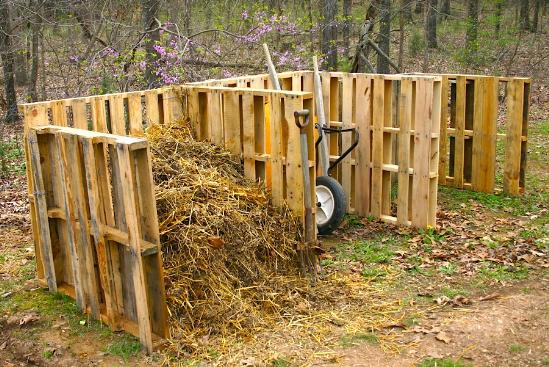
of dozen wheelbarrow
trips to the new composter. My back has been hard-used for several decades, and
I rationalize away the small additions to our carbon footprint to save further
wear and tear. Mea culpa, but a crippled spine cuts badly into the endless work
of running Shuddering Squirrel Acres.
Still,
cleaning up the old run and moving the pile from the dog kennel to the bin took
several hard hours on an 85-degree late-winter (!) day. It was both
exhilarating and exhausting.
There
seems to be general agreement among organic gardeners and veteran homesteaders
that chicken manure is just about the richest and best balanced natural
fertilizer you can use. But be aware that in its raw state, it’s especially
high in nitrogen, making it “hot” enough to burn your plants. It also contains
certain non-beneficial microbes that you don’t want on your vegetables. So it
must be composted, first to cook out the bad germs, then to cool out the
nitrogen.
Of
course, we supplement the pile with kitchen scraps – coffee grounds and tea
bags, banana peels, potato peels, other fruit and 
vegetable peelings, apple
cores – just about everything but meat, fish, grease and anything else that
could go rotten or rancid and attract vermin.
It’s
all too raw to use in this season’s garden beds – although we’re fixing to try
a little “compost tea” experiment – but next year? Ah, as they say in sports
and farming, wait till next year.
(If you’d like to read more about life on Shuddering Squirrel Acres, please check out my personal blog, I’m Mildly Concerned that One of My Hens is a Rooster…)
Photos by Ric Bohy