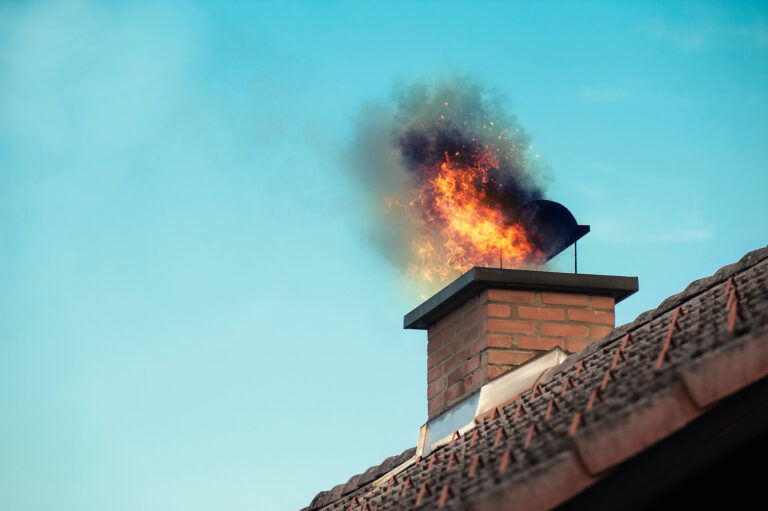
Learn how to prevent chimney fires using this detailed guide that will help any wood burner work more efficiently and safely. Once you know what causes chimney fires, you will be prepared to prevent one.
What Causes Chimney Fires?
Learn how to prevent chimney fires using this detailed guide that will help any wood burner work more efficiently and safely. Once you understand what causes chimney fires, you’ll be better prepared to prevent them and protect your home.
One of the most common questions people ask is what causes a chimney fire and how do chimney fires start in the first place. Many assume it’s just a random accident, but the truth is much more practical and preventable. When wood burns inside your stove or fireplace, it doesn’t burn completely. Instead, a significant portion turns into smoke and gases that rise through the chimney. As this smoke cools, it condenses into a sticky, tar-like substance that clings to the inner walls of the chimney.
This substance is called creosote, and understanding what causes creosote is key to understanding chimney fire causes. Over time, creosote builds up layer after layer, much like residue inside a pipe. If left untreated, this buildup becomes highly flammable. When exposed to high heat, oxygen, and sparks, it can ignite suddenly, leading to a dangerous chimney fire.
So, how does a chimney fire start? It typically begins when a spark or high temperature ignites the creosote lining. Once ignited, the fire can burn extremely hot and fast, sometimes producing loud cracking sounds, dense smoke, or even flames shooting from the chimney top. Many homeowners report smoke coming out of chimney but no fire, which can be an early warning sign of creosote buildup and restricted airflow.
A log burner chimney fire can be especially dangerous because modern stoves can generate high temperatures quickly. If creosote has accumulated, it can ignite rapidly, turning a normal burn into a hazardous situation. Understanding these causes of chimney fires is the first step toward prevention.
What Is It?
Creosote consists of particles and condensed vapors left over from the incomplete combustion of wood. It forms in several stages, ranging from flaky soot to thick, hardened glaze. Each stage presents its own level of risk, but all are combustible and contribute directly to what happens during a chimney fire.
In the early stages, creosote appears as a loose, dusty residue that can be brushed away easily. However, as buildup continues, it becomes sticky and tar-like, eventually hardening into a glaze that is extremely difficult to remove. This hardened creosote is one of the leading chimney fire causes because it burns hotter and longer once ignited.
Aside from fire risks, creosote also creates a messy and corrosive environment inside your chimney system. It stains pipes, connectors, and roofing materials while gradually weakening the structure. Some of its chemical components may even be carcinogenic, making it not just a fire hazard but also a health concern.
The best way to reduce creosote–and ultimately prevent what causes chimney fires–is to burn wood as completely and efficiently as possible. Modern, clean-burning stoves can significantly reduce creosote buildup. Look for certified appliances approved by environmental authorities, as these are designed to minimize smoke production and improve combustion efficiency.
Still, even the best stove cannot eliminate creosote entirely. Regular maintenance and proper chimney design are essential to reducing the causes of chimney fires and ensuring long-term safety.
Good Chimney Design
A properly designed and installed chimney will accumulate creosote more slowly than will an inadequate one, and it will be better able to withstand the ravages of a chimney fire, should one occur. If you’re considering installing a chimney, take comfort in the fact that it doesn’t cost a lot more to do it right; and if your present chimney doesn’t measure up, consider the potential costs of neglect.
The basics. Safety dictates that a chimney used to vent a woodstove should be made of either tile-lined masonry with an air gap between tile and brick or insulated stainless steel, and it should serve only the stove. All openings other than the stove’s connector and the cleanout (which should have a tightfitting cover) should be sealed. Air leaks make it impossible to control a chimney fire if one gets started.
Safe clearances. Even the most effective chimney requires a clear air space (without insulation) of at least 2 inches to the nearest combustible material. All wooden framing members and sheathing should be held back from the outer surface of the chimney. This may seem unnecessary when you lay a hand on a brick chimney and realize that it’s little more than warm to the touch, but the provision is meant to deal with the sorts of extremes that occur during a chimney fire.
Likewise, you should observe safe clearances for the stove and its connector. If these aren’t listed on the appliance, consult a book on wood heating.
Creosote accumulation. The creosote accumulation rate in a chimney is affected by five factors: the density of the smoke, the temperature of the smoke, the amount of time the smoke spends in the chimney, the turbulence (swirling) of the flow and the temperature of the chimney walls. The first two are mainly matters of operating technique, which we won’t discuss here, but the last three are directly affected by chimney design.
Chimneys should have about the same cross-sectional area as the stove’s outlet, a size which offers a good compromise between smoke residence time and turbulence. Creosote problems often occur when a woodstove is connected to a fireplace chimney, which may be three or four times too large. Such chimneys should be relined to reduce their size.
Of the three chimney design factors, wall temperature may have the largest influence on creosote deposition. What’s more, a warm chimney is a win-win situation. You’ll get less creosote and more draft. The temperature of the chimney’s inner wall is determined by the temperatures of the flue gases inside and the air outside and by the insulation value of the material between. Most important, an interior chimney — one that is wrapped in warm house air — stays clean much longer than one that runs up the side of the house.
Of the various types of chimney materials, insulated metal is most effective at retaining heat. The insulation may be either a special fiberglass and ceramic material or a sealed air space (avoid chimneys cooled by circulating air). Masonry is less effective, though some reliners use an insulating refractory that has a considerably higher R-value than either brick or block.
An indoor connector between a woodstove and chimney isn’t usually made with insulated pipe. This short section of single- wall material is a compromise between efficiency (since the pipe radiates heat that would otherwise go up the chimney) and creosote. As a general rule of thumb, keep uninsulated connectors to less than 6 feet in length. Use the minimum number of elbows with the most-gradual turns possible to allow smoke to flow smoothly up the chimney. And secure all joints with sheet metal screws.
Creosote-reducing devices. In MOTHER EARTH NEWS No.s 73 and 74, Jay Shelton and Claudia Lewis reported on their tests of several stove attachments that were designed to reduce the rate of creosote accumulation in chimneys. The most effective of these were catalytic converters and barometric draft controls. A properly designed and operated catalyst can cut creosote deposits by more than 90%. A catalyst is most effective when integrated with the stove’s design. A barometric draft control dilutes the smoke, allowing it to pass out of the chimney without leaving creosote behind. Shelton and Lewis found that the device can reduce creosote accumulation by up to 75% but noted two liabilities: It allows warm house air to escape up the chimney and will provide a chimney fire with air.
Chimney Cleaning
How often should you clean your chimney? About the most advice anyone can offer is to do so whenever deposits reach 1/4 inch in thickness. This may happen in a matter of days in a poorly designed chimney connected to a woodstove operated at very low output. Or it may take years in a well-designed system attached to a good catalytic stove. Check your chimney weekly until you learn how its installation and your operating techniques affect creosote.
What to Do When It Happens
When a chimney fire finally does get started — and for most wood burners, it’s a matter of when, not if — it will announce itself dramatically. The normal crackle will be overwhelmed by a roar often likened to a 747 taking off up your chimney. You’ll hear air being sucked through the draft control, and stovepipe sections may even shake. The connector may begin to glow cherry red.
Chimney fires most often occur when starting a fire, when refueling, or during an unusually hot blaze. Flames, allowed to burn intensely to ignite new fuel, lick into the chimney and, if there’s enough oxygen, ignite the creosote. Heat in the chimney drastically increases draft, inducing the flames to rise through the entire system. One thing leads to another, and in short order you’ve got a raging inferno that can destroy the chimney and even burn down your house.
As soon as you suspect you’ve got a chimney fire, close the stove door and draft control; if the heater is reasonably airtight, suffocation will subdue a chimney fire in its early stages. Next, alert everyone in the house so they’ll be prepared to leave if necessary. Then step outside and determine if any sparks are coming out the top of the chimney. These may ignite roofing materials or other nearby combustibles. A shower of sparks should send you straight for the telephone to call the fire department. In fact, the best course of action is to call firefighters as soon as you’ve closed the stove door and dampers and alerted your family. By the time you decide that you really need the pros, it may be too late.
Closing the damper may only reduce the intensity of a chimney fire. A blaze in a heavy creosote deposit can smolder for hours, despite having its oxygen supply cut off. Open the draft control to resume normal heating, and your jetport will be open again for takeoff.
To put a chimney fire out for good, you may need a fire extinguisher. There are two effective types: dry-chemical pressurized canisters and chimney fire extinguishers, which resemble highway flares. The standard household dry-chemical canister requires that you hold the stove door open while applying the chemical above the fire — a possible disadvantage. The flares simply require you to light one, toss it in and close the door. Other remedies, such as salt and baking soda, may be effective but are unproven. In any event, never try to put out a chimney fire by dousing the fire in the stove with water. You’ll be likely to crack the castings or pop a weld, which could be disastrous.
Dry-chemical extinguishers are available at just about any hardware store, but you might have to visit a woodstove dealer to find the specialized chimney extinguisher. It’s a good idea to have both, keep them where they’re readily accessible, and make sure that all the adults in the household know how to use them.
There are three main hazards during a chimney fire. First, combustible materials near the chimney could catch fire from the radiant heat of the chimney. If the system has proper clearances, this is unlikely. Second, pressure may build in the chimney to the point where fire is forced out through cracks. This shouldn’t be a problem in a chimney that’s in good condition. Third, sparks from the top of the chimney may ignite roofing materials or nearby vegetation. A spark arrester screen will stop larger solids from coming out the top of the chimney, but the screen will have to be cleaned frequently during the burning season.
The Aftermath
Once the chimney fire is dead and the chimney has cooled, the system should be thoroughly inspected for damage. The firefighters you called to put out the fire will probably be glad to do this post mortem for you and make recommendations.
At the least, replace any black-metal or galvanized connectors that became so hot they glowed. High temperatures initiate rapid deterioration in these non-stainless steel parts. Stainless steel insulated chimney comes in two grades, UL103 and UL103HT. The latter is rated to 2,100 degrees Fahrenheit and is better able to withstand the stress of a chimney fire. Either type should be inspected after any flare-up. Look for wrinkling of the inner jacket and looseness in the joints.
In masonry chimneys, search for exterior cracks, leaks in joints, chipping or cracks in tile liners and deterioration at the thimble (where the stove connector enters the chimney).
For most wood burners, chimney fires aren’t just possible; they’re inevitable. Neophytes are often caught quite by surprise the first time, and few shrug off the experience lightly. A full-scale chimney fire makes an unforgettable impression. Here’s hoping you’ll have the opportunity to avoid the second one.
Early Warning
Chimney fire alarms incorporate a flue-temperature sensor that activates a visible or audible alarm at a certain set point. Units with internal sensors can warn of the start of a chimney fire long before it reaches the stage where it gives other outward signs, and even external sensors may give several minutes of warning. Potentially, then, a chimney fire alarm can be a very important
saftey accessory for wood burners.
If you’d like to experiment with a do-it-yourself alarm, see “MOTHER’s Flue Alarm” in MOTHER EARTH NEWS NO. 73. This inexpensive project uses an external sensor that, while less sensitive to the onset of a chimney fire, is also less prone to sound a false alarm.
Originally published as “Chimney Fires” January/February 1988 MOTHER EARTH NEWS.
Frequently Asked Questions
What causes chimney fires most often?
The most common cause is creosote buildup inside the chimney. This flammable substance forms when wood burns incompletely, and once it accumulates, it can ignite easily under high temperatures, leading to dangerous chimney fires.
How do chimney fires start in a wood stove?
Chimney fires usually start when heat or sparks ignite creosote deposits lining the chimney walls. Poor airflow, burning wet wood, and lack of maintenance increase the likelihood of ignition.
What happens during a chimney fire?
During a chimney fire, temperatures can rise rapidly, producing loud cracking or roaring sounds. Flames may shoot from the chimney, and dense smoke can fill the area. These fires can damage the chimney structure and spread to the rest of the house.
Can smoke coming out of chimney but no fire be dangerous?
Yes, it can indicate poor airflow or heavy creosote buildup. This condition often signals that the chimney is not functioning properly and may be at risk of a fire if not addressed.
What causes creosote to build up quickly?
Burning unseasoned wood, low-temperature fires, and poor chimney design all contribute to rapid creosote accumulation. Proper burning techniques and regular cleaning can significantly reduce buildup.
How does a chimney fire start in a log burner?
In a log burner, high heat combined with accumulated creosote can ignite quickly. Restricted airflow or improper fuel use increases the chances of a chimney fire starting.
What are the main chimney fire causes homeowners overlook?
Many homeowners overlook the importance of regular cleaning, proper wood selection, and chimney inspections. Neglecting these factors allows creosote to build up and increases fire risk.
How can I prevent chimney fires effectively?
Prevention includes regular chimney cleaning, using dry seasoned wood, maintaining proper airflow, and ensuring your chimney is correctly designed and insulated. These steps reduce creosote buildup and lower fire risk.