


MOTHER EARTH READERS share observations about a recent calving article, discussing the problems with hip-lock, pulling the calf during delivery, and general information on bovine labor.
DARYL ANN KYLE:
Eleanor Wrigley’s “Report from Alberta, Canada” (MOTHER EARTH NEWS NO.
31) mentioned the problem of “hip-lock” in calving. May I
offer asuggestion gleaned from a dairy farmer for
whom I milked cows? He kept Holsteins and was breeding a
lot of the heifers to exotic beef sires. Now, granted, a
Holstein heifer is pretty big as heifers go, but the calves
were still large enough to cause trouble during birth . . .
mainly hip-lock.
One day my dairyman boss told me the following: The average
cow’s pelvis is not equally wide and deep, and many
hip-locked calves will slip out easily if their bodies can
be turned 90 degrees. This method also helps alleviate the
damage to the hips of the calf which is often caused by
forceful pulling . Although I didn’t deliver any
of the young myself, 1 often watched my employer as he used
the above procedure with good success.
Eleanor’s suggestion that a cow be bred for offspring of
the correct size is surely the safest way to an easy
delivery. Problems can, however, arise with any first-calf
heifer — including the homesteader’s cherished
milker-to-be — and the technique of turning the
hiplocked fetus is easy and safe for the beginner.
(Incidentally, readers who are raising their own cattle can
surely benefit by the use of artificial insemination. Sires
are of the highest quality, fees are reasonable, and
inseminators are readily available in rural areas. Ask your
county extension agent for help in locating this service.)
Once a calf is safely born, MOTHER’s children may wish to
preserve its mother’s beneficial colostrum (“first milk”)
for the young animal’s use instead of eating it themselves.
The colostrurn may be refrigerated for a week or more, or
frozen and kept for months . . . and it’s wise to have a
few quarts in the freezer in case your calf gets sick.
Small amounts of this vital food mixed with water will
often bring dramatic improvement. The same frozen supply is
equally handy for starting lambs that are orphaned at
birth.
Colostrum can also be pickled. Find a large plastic or
unchipped enamel container or crock, put what you don’t
feed of the first three milkings into the bowl, and let the
accumulation stand at room temperature. It will sour and
begin to smell like yeast dough (don’t use it until this
point is reached). The thickened fluid can then be stored
in a cool — not freezing — place. At feeding time,
mix one part pickled colostrum and one part hot water to
make warm milk.
By the way, my father has fed pigs skim milk clabbered with
yogurt starter and swears by it. He just sets out a barrel,
puts in milk and a bit of yogurt, and then adds fresh milk
daily. The bacteria change over the course of time with
this method, so every now and then he starts fresh with a
new yogurt culture (from store or home). We’re going to
prepare the same food for chickens with our extra skim milk
as soon as our beautiful cow Ida calves. (We admit to
hoping for twin heifers . . . nothing like optimism!)
Speaking of chickens . . . experience has taught me that
feeding them whey without additional water gives the poor
birds diarrhea. And if you use a heat lamp in the henhouse
to encourage laying in cold weather — as Eleanor
describes — try a red one. Our flock has a lengthened
day through a timed white light, but the red heat lamp
stays on all the time during chilly periods and egg
production has remained steady all winter.
RON SAWYER:
Eleanor Wrigley’s “Report from Alberta, Canada” (MOTHER EARTH NEWS NO.
31) is discouraging enough to deter even the most eager
homesteader front obtaining a cow, because of the “calving
problem”. This is all wrong, since in the vast majority of
cases human interference is not necessary or even wise.
Most often, when correct presentation is evidenced, the
worst thing one can do is intervene and probably botch up a
normal birth.
Modern methods of “assistance” during bovine labor are
analogous to hospital delivery of human babies by knocking
the mother cold and yanking out the child with forceps. If
you don’t concur with the latter, then why practice the
former on your innocent four-footed companion ?
Patience is a virtue in calving, just as it is in human
delivery. Precipitous action can only lead to tragedy.
The first stage of bovine labor (dilation of the cervix)
generally takes up to six hours or more, while the second
stage (expulsive) occupies up to another six hours. The
time span from the moment the feet appear at the vulva to
the emergence of the tongue and subsequently the nose will
seem interminable if you don’t know that it’s quite normal.
Give the cow a chance to deliver her own baby.
As for the calf-puller, it not only looks like something
left over from a medieval torture chamber . . . it is. It
should be banned from the face of the earth. Farmers have a
way of attaching the instrument to the calf the moment its
legs appear at the vulva and then literally ripping the
young out of the mother, doing irreparable damage to the
cow by tearing her cervix.
True cases of hip-lock are probably much rarer than is
imagined. Breeding a heifer to a Charolais or Friesian
(Holstein) bull is one of its causes.
When hip-lock does occur, force is completely
contraindicated. Simply rolling the cow onto her back and
over to her opposite side, and then offering gentle
assistance, will bring about delivery in around 50 percent
of such cases. Another form of aid consists of rotating the
calf on its own axis to effect its release. If nothing
works and a vet is available, he might have to cut up the
calf within the cow (embryotomy) to save the latter’s life.
The solution is never a matter of “just a little more
force”.
There is only one circumstance in which more than a single
strong person should pull on a calf to deliver it. That
exception is a posterior presentation . . . and even then
it’s not necessary to panic and start yanking immediately.
Not until full cervical dilation is effected should gentle
pulling, one leg at a time, be undertaken. When the entire
hind end of the calf is outside the vulva, get those strong
onlookers to help you . . . and quickly. The umbilical cord
will rupture at this point and you have 30 to 40 seconds to
deliver a live baby. You can’t hurt the mother because the
widest part of the fetus is already through the cervix and
pelvis.
In cases other than posterior presentation, the umbilical
cord rarely ruptures before the calf’s head is well outside
the vulva . . . provided that steady, brute, outside force
has not been used. Thus the best way to protect both
mother’s and offspring’s life is not by speed or strength,
but by an educated policy of non- or limited interference.
Within reason, there is no need to muddle in on bovine
labor.. . any more than you would deny a woman her right to
natural delivery. If you’re convinced by Lester D.
Hazzell’s Commonsense Childbirth, then you’ll find
equal satisfaction in Calvingthe Cow and Care
of the Calf by the TV Vet (this letter owes everything
to him). It’s the best book I’ve ever read on the subject
and includes hundreds of marvelous photographs: normal
calving, Caesarean section, etc. This work — by one of
England’s top vets — is available for about $7.50 from
Farming Press Ltd., Suffolk, England.
ALAN SMITH:
I’ve read the chapter from Farmingfor
Self-Sufficiency reprinted in MOTHER EARTH NEWS NO. 27, and would
like to add some important points to remember when a cow is
calving . . . a very beautiful occasion, but also very
serious.
One of the first signs that a cow is about to give birth is
a dropping in of the sides of the tail just above the
pelvis. Labor should then begin, and the water
bag — which lubricates and cushions mother and young
before and during delivery — should appear shortly
thereafter. (You’ll know what it is as soon as you see it.)
Should two hours pass after the early signs without the
appearance of the water bag or any indication of calving,
it’s time to find out what’s wrong. A cow which is let go
much longer than that becomes exhausted and also exhausts
the calf. If the mother is too worn out to continue with
the birth process, you may lose both her and her baby.
“Diving in” — as the Seymours describe — to correct
a wrong presentation is insane unless you know exactly what
to do and how to do it. If you happen to scratch or damage
the uterus with your hand or one of the calf’s feet, your
cow might not be able to calve anymore . . . and could
possibly die. A veterinarian should he called, if possible,
to straighten things out. Yes, that costs money, but it’s a
heck of a lot less expensive than a dead or injured animal.
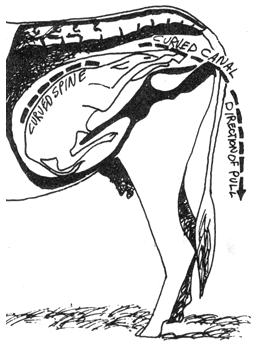
When pulling a calf, always apply the force more downward
than backward or straight out. The fetus must follow the
direction of the birth canal, or a broken back could
result. (The drawing will show you what I mean.) Remember
also to pull one foreleg ahead of the other so that the
shoulders move through the pelvis separately rather than
both at the same time.
Once the cow begins to calve with your assistance, keep
pulling constantly and firmly. If you stop, the calf’s hips
will sometimes (not always) become lodged in the pelvis…
and “hip-lock” is a difficult situation to remedy.
This may sound like a lot to remember, but all the things
I’ve mentioned are worth knowing if you have to use them
even once. Of course — as John and Sally say — if
you don’t breed a heifer too young or too small, and if
she’s properly fed and not fat, there should be no
difficulty in calving.
It’s also good to know that an injection of vitamins A, D,
and E (3 cc when the calf is one day old) gives the newborn
a real boost against infection and disease.
The above information was gained by watching 150 calves
being born and assisting in at least 50 births over a
period of three months. I hope it helps someone.






