

Man’s first wall was built as a stockade around his
village. Its function was to protect from intruders and to
contain livestock. In the evolution of house forms, herders
de-emphasized the importance of the hunter’s roof-tent in
favor of wall embellishments based on the village stockade.
First, he drove posts into the ground and wove wattle in
between. Later, he pressed stiff mud into the wattle
— a direct predecessor of our ever-popular suburban
“half-timber” style.’ Finally, a few thousand years before
Christ, the wall builders invented the brick, which
essentially brings us to the modern scene.
As contemporary man continues to place brick on brick to
form the wall — stockade around his “living” space,
he armors against life in much the same manner as his
pastoral ancestors. The function of walls for
protection persists even though the early pastoral
significance has been lost in our present non-pastoral
communities. Some self-conscious design reformers later
succeeded in disturbing these notions when they started the
bring-the-outdoors-in campaign. Result; the picture-window
became a stock item and indoor planters defied the
“outside” feeling as much as the concrete patio did the
“inside” feeling.
It’s about time we re-examine the wall in terms of purpose
and function. A house can be thought of as having many
purposes; but primarily it is a contrivance for regulating
(controlling) a segment of our environment. This
conditioned environment is enclosed with roof, floor and
walls so that weather factors such as air movement,
humidity, precipitation, temperature, and light may be
regulated. Walls are structural membranes separating the
indoor environment from the outdoor environment. On the
other hand, the greater the difference between the indoors
and the outdoors, the more elaborate must be the wall’s
inherent properties. The more important characteristics
which a wall must have include strength and durability,
flow-control (heat, moisture and air), and good design at
low cost. These are the more significant properties that
will concern us in this chapter.
Generally speaking, about one-half of the cost of a house
is the cost of the materials which go into it, the
remainder being labor costs. With this fact in mind one
would naturally assume that builders would have a thorough
knowledge of the nature and properties of all building
material possibilities. The functional performance of a
wall material is number one consideration, but at the same
time the most economic solution requires a selection of
components having the lowest combination of initial
cost and maintenance. This long-range cost is too
often overlooked by builders in their concern with how much
money must be raised in the beginning.
Among the many considerations for selection and evaluation
of wall materials, listed below in order of importance. I
would certainly include a seemingly far fetched salvage
value. Cheaper and easier demolition becomes
significant in this era when the average useful life of a
building is comparatively short. Plywood paneling and heavy
timber framing have high salvage values; brick and concrete
have low salvage values.
Check List for the Selection of Wall Materials
1. initial cost and subsequent maintenance cost.
2. compressive and traverse strength.
3. resistance to natural weathering, chemical attack and
atmospheric pollution.
4. combustibility.
5. ease of handling (size, weight, shape) and
erection.
6. resistance to scratching and impact.
7. dimensional changes with temperature and moisture
content changes.
8. susceptibility to insect attack.
9. appearance in color and texture.
10. moisture penetration resistance.
11. sound insulation and absorption.
12. adaptability to future changes of layout and salvage
value.
Wall materials must have the necessary strength in
compression, bending, shear and tension to carry applied
loads and to resist such external pressures as wind loads.
Accurate strength properties of the material must be known
before one can economically design a wall. In the design
analysis it is important to remember that the loads in
question apply only to the net width of the wall, excluding
door and window openings. From a design standpoint this
would suggest greater consolidation of openings and
adequately spaced, solid wall panels to provide bracing
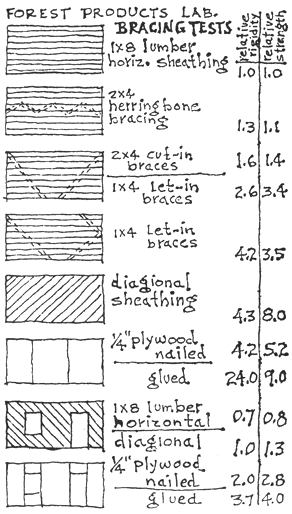
effect. Types of bracing and methods of fastening are the
main factors which influence the strength and rigidity of a
wall.
The durability of a wall is more dependent on heat flow
(temperature change) and moisture than any other factors.
Moisture deterioration can take place in all organic
building materials, as such materials are
hygroscopic-absorbing moisture from the air in proportion
to relative humidity. Dimensional change in a wall
primarily causes weakness and failure of fastening members.
Practically all wall materials change their dimensions
according to whether they are wet or dry. When a wet
material is dried, shrinkage occurs; when the material
becomes wet again, expansion takes place. But the
subsequent expansion is often less than the initial
contraction, leading to irreversible expansion. Swelling
and shrinking due to moisture-changes also causes a
breakdown of surface finishes. The pore structure of
organic wall materials easily permits capillary moisture
attraction from the atmosphere. As much as 40% of the dry
weight of a material can be taken up and held with water.
This is to say nothing of direct moisture contact from rain
or melting snow.
Wall moisture originating from within the building can be
an even more damaging factor than outside penetration. As
the inside temperature increases, inside water vapor is
transmitted into the wall and there condenses. This
condensation results in wetting of structural
materials and consequent loss of insulating qualities. It
also gives rise to such serious problems as chemical,
physical or biological deterioration of the materials
(corrosion of metal, spalling of brick, rotting of timber).
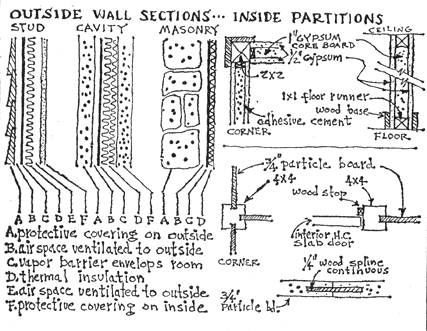
In wood-frame walls a vapor barrier will control
inside condensation. But in masonry walls the vapor barrier
prevents moisture from entering the room, and consequently,
moisture condenses behind the moisture barrier as the hot
summer sun follows a rain, driving moisture inside the
wall. Waterproofing the outside of a masonry wall will
prevent moisture migrations from the outside, but
this same waterproofing causes a build-up and damming of
water by condensation from the inside. In short, a wall
must be designed to limit this entry of water from the
outside via capillarity and at the same time permit the
flow of water vapor to the outside in winter. But the
outside wall should have a partial capacity for water
storage, separated capillarity-wise from the inside wall.
Furthermore, the transfer of vapor to the inside in summer
should be controlled by venting. Obviously, the best choice
for a masonry wall is one of the vented-cavity type. Where
insulation is used as well as a vapor barrier, a higher
indoor humidity is possible without the occurrence of
surface condensation. However, incorrect use of thermal
insulation can increase the danger of condensation. It can
increase temperatures on the warm side of the wall thereby
decreasing temperatures on the cold side and causing
condensation towards the cold side of the wall.
In the wall-material literature one finds ample reference
and speculation on the “wonder” material which satisfies
all the requirements of an inexpensive, durable, strong,
simply constructed wall. Realistically, this ideal material
should also exhibit no thermal expansion, no moisture
expansion, be impermeable to moisture, and resistant to
heat flow. Also there are summer moisture-heat-gain and
winter moisture-heat-loss factors to balance out, so it is
quite unlikely that such a miracle product exists or could
ever be inexpensively manufactured.
The more practical approach to wall building is for the
owner-builder first to plan his walls in relation to areas
for winter functions and summer functions, daytime use and
nighttime use, inside partitions and outside exposure,
bearing walls and curtain walls, storm sides and sunny
sides. Our practice of building all four walls of a house
of equal thickness and insulation is absolutely absurd. The
nighttime, sleeping areas certainly have opposite
requirements from daytime, living areas.
The thermal performance of a wall is determined by its (a)
degree of direct solar heat penetration through windows,
(b) absorptiveness of the exposed surface to solar
radiation, (c) heat-storing capacity, (d) insulation
characteristics, (e) ventilation rate. Heavyweight wall
materials like tamped earth are cool during the day and
warm during the night in regions where the daily
variation in outdoor air temperature and solar radiation
are great. But in regions where the daily outdoor
temperature variations are small but solar radiation
intensities high, such heavyweight wall materials do not
permit sufficient cooling off during the night for
comfortable sleeping. In such regions, lightweight
materials should be used.
Another gross extravagance in the home building industry is
the use of heavyweight materials in non-load-bearing
partitions. This is an example of a builder’s failure to
select a wall material from the point of view of purpose
and requirements as well as availability and other economic
considerations. An interior, non-load-bearing wall
certainly does not require even similar properties as does
an outside supporting wall.
Wall materials in a house should be as varied as window
sizes or roof coverings. The success or failure of a wall
design–and the completed house as well–is
determined by the degree to which the builder relates the
wall material to inside and outside environment. A wall is
a sort of transition between these two environments; it can
express this function with insensitivity or by a statement
of simple logic. When peppered with openings and
conflicting materials, a wall lacks clarity and
composition. Of all that man has created, simplicity of
structure is a constant characteristic of the finest. You
can get a unified design by reducing the number of
materials used, by consolidating the areas and spaces
within. You can simplify linear design by extending lines
both horizontally and vertically–resulting in a neat,
uncluttered silhouette. Simplicity means balance in form,
scale, texture and color. Simple structure also means
economy. All this is to tell the owner-builder that
structure is effective as it satisfies your human need. Set
your reasoning to get the simplest, most effective means
possible. Immerse yourself in this economy-of-means. After
a while you will not have to think effectiveness
and balance. It will become part of your nature, with your
actions taking place on a more intuitive, non-verbal,
non-intellectual level.






