

Aldo Leopold writes in “The Farmer as a Conservationist,” It
is the individual farmer who must weave the greater part of the rug on which America stands.
Shall he weave into it only the sober yarns which warm the feet, or also some
of the colors which warm the eye and the heart?
I must confess as a life-long farmer, this is an issue I grapple
with constantly. Sometimes I lose, but many times we all win. Such is the case
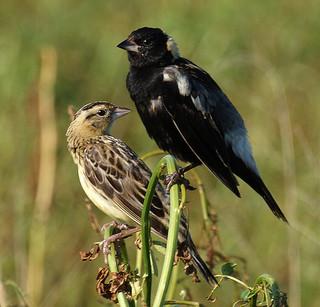
with the bobolink.
I grew up with bobolinks. All my life they have nested on
our farm and all my farming life I have listened to the males’ delightful
flight-song from the end of April through early summer.
Why the bobolinks nested on our farm and on very few
neighboring farms, I have never fully determined. One reason may be that,
although always a dairy farm, we never switched totally from growing red clover
to alfalfa, which was the conventional way of moving in the Midwest.
We stayed with clover because it was more forgiving than the
high pH-loving alfalfa and red clover fit a four-year rotation better. And for
its beauty. Few things are more attractive than a field of blooming red clover
being visited by thousands of butterflies and honeybees. Because clover is slower
maturing than alfalfa, the bobolinks benefited from the later-cut hay.
For years I wondered why the bobolinks arriving our farm
usually around April 28 (the males show up about a week before their mates) and
then delayed nesting until almost June. At the same time the red-winged
blackbirds, savannah sparrows, and the eastern meadowlark often had fledged
young by the time the bobolinks settled down to nesting, after weeks of chasing
each other.
Then I discovered the reason: A decade ago a friend gave me
two clumps of big bluestem and I planted them on each side of our mailbox where
I see the prairie grasses practically every day. I noticed that by the time our
cool season hayfield grasses such as orchard grass and timothy are already
heading out in early June, big bluestem had only reached the height where a
bobolink could hide its nest. Suddenly I had one of my increasingly rare light
blub moments–since the bobolinks were native to the prairies, they have it in
their DNA to wait for cover before nesting.
That waiting-for-cover conflicts with the bobolink in the
eastern United States
where all dairy farmers want dairy-quality hay and that means early cutting,
especially on an organic dairy where the prices of off-farm protein are
exorbitant. The bobolinks end up being the losers. Only rarely have I seen
bobolinks attempt a second nesting. If their nest and eggs or nestlings are
destroyed with the mowing machine, bobolinks just give it up.
The bobolinks are in serious trouble, especially in the
Northeast, largely on account of these changes in agricultural practices.
Studies have shown that since 1968, the year we started farming, bobolinks have
declined by over 65 percent. In early hay cropping 96 percent of the eggs and
nestlings are destroyed by the mower blades or killed by predators following the
mowing. I once attempted to save a nest by leaving a strip of uncut hay and the
first night a predator got the eggs, likely a skunk or an opossum.
For that reason for
most of my farming life I agonized over delaying the cutting of one twelve-acre
field of hay until July for the sake of the bobolinks. We farm with horses and
horses don’t need dairy quality hay, I could justify myself in a delayed
cutting. But I hated to explain to my neighbors when we had what we call a
perfect hay week–wind out of the northeast, 80 degrees, low humidity–in
mid-June and we weren’t cutting that field of hay.
Sometimes, as Emerson said, a man standing in his own field
is unable to see it. Sometimes we need younger and brighter minds to look at
the picture in order to get a different and better perspective. I needed my
son-in-law’s view.
Since we are a grass-based dairy with 50 Jerseys,
he suggested we graze the “bobolink field” early but not intensively. Use the
bison as a model, he said. We’re now beginning our third spring with that
method and it has worked way beyond our highest expectations.
Here is what we do: Beginning as soon as the first males
begin singing across the field, he will turn the herd into half of the 12-acre
field (the field is divided down the center) for 12-hours, then the other half
for 12 hours. Normal practice is to give the cows only about an acre for that
time period, which is then grazed fairly short. With that rotation the redwings
and sparrows can coexist, but not the bobolinks.
Perhaps three or four days later, depending on the growth
rate of the grasses and forbs, the same pattern is repeated. The bobolinks are
not disturbed by the cows because as the grasses begin to reach maturity the
cows tend to follow paths and only meander here and there to graze.
By the end of June the orchard grasses, the dominant forage,
is three feet tall and in seed and young bobolinks are flying. While there were
tall overripe grasses, there was also a cover of low new growth throughout the
field. This year, when I mowed the hay on June 26th, the bobolinks had finished
rearing their young and had left the field. The males were already congregating
into bachelor flocks several days prior to the mowing of the hay. My son-in-law
counted over 50 males in two groups.
The young and females hadn’t left the farm but moved to the
next field, which was oats, and switched from an insect diet to the tender
seeds of the ripening grain. They were fattening up for their 5000-mile flight
to Argentina.
I wished them well.
For too long I thought that the songs of our hayfield birds
was for their own purposes and our listening pleasure. In other words, the
songs were pretty but had no monetary value. Really, money was least of my
concerns. Then I found out that the stomata on leaves of the hayfield plants
open and close as ordered by the physiology of each species. The stomata open
to admit air in order to take in carbon dioxide and trace plant nutrients. Dan
Carlson, an innovative plant physiologist, has held and proved with experiments
that sound waves from the songs of birds give the plants an assist during the
hours of morning mist for which reason birds broadcast a veritable concerto
while the rising sun starts to wake up the rotating planet…and the process of
photosynthesis begins.
Not only have my eyes and heart been warmed many times by
the showy colors and pleasing songs of the bobolinks, when I heard that they
are an asset to the profitability of our farm I felt like the Prophet Ezra: “…I
plucked off the hair of my head and of my beard and sat down astonished.”
David Kline presented a workshop at the Seven Springs, Pa. MOTHER EARTH NEWS FAIR.
Please visit the FAIR website for more information about future FAIRs. Dates and locations to be announced. You can also get FAIR updates on our Facebook and Twitter pages.






