

“A cold wind blew across the prairie when the last
buffalo fell … a deathwind for my people,” said
Chief Sitting Bull. And, indeed, the buffalo’s near
extinction ranks as one of American history’s most shameful
tales.
Bison facts: There was a time when the powerful beasts ranged from
Virginia to California, from Canada to Florida,
and down into Mexico. Indeed, it’s been (conservatively)
estimated that when Europeans first arrived on these
shores there were over 60 million bison in existence, amounting to
probably the greatest aggregation of large animals ever
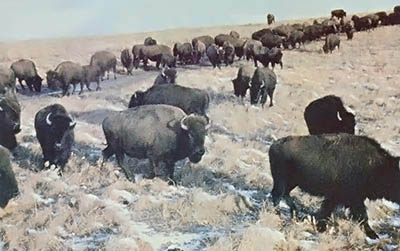
known to civilized Homo sapiens. Even as recently as the
last century a herd could contain a million individuals,
so that “the country was one robe” and “the plains were
black and appeared as if in motion.”
However, as men and women from the eastern cities moved
westward, the situation changed dramatically. The worst of
such people wantonly butchered the marvelous creatures,
taking just the hides–or sometimes only tongues–and
leaving the carcasses to rot until the
bone harvesters could collect their share. Few people
realize that this senseless slaughter caused much of the
hostility that the Plains Indians–many of whom relied
upon the bison for food, shelter, and more–came to feel
toward the settlers!
By 1890, only a few small herds remained. More recently,
however, as a result of the efforts of conservationists and
ranchers who recognized the animals’ value, buffaloes once
again began to dot the American countryside. Today, there
are an estimated 30,000 head–divided among about 400
herds–in the U.S. and Canada. (Although a couple of
the groups number over 1,000, most are much smaller.)
What’s more, bison are, when properly raised, proving to be
both enjoyable and highly profitable livestock animals!
A Hardy Breed
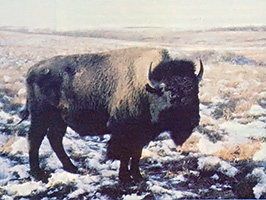
The buffalo has one distinct advantage over most domestic
cattle: its incredible hardiness. With a rough hide
and thick covering of wool-like hair, a bison (even when
very young) can easily tolerate the harsh, frigid winters
of the upper prairie states and can weather blizzards
that would likely kill entire herds of beef animals.
Thriving on grasses alone, the native livestock can range
and forage far and wide, and even root out food from
beneath deep snow. In fact, some commercial buffalo herds
are simply left to forage year ground, although most are
fed a little hay during the cold months. (Our Kansas Fish and Game Department’s herd is given 1 1/2 pounds of 18%
protein pellets, per animal, throughout the winter, as well as and supplemental hay when there’s a ground cover of snow.)
In addition to being thrifty to feed, the beasts are
relatively disease-free. A few cases of brucellosis,
however, have recently been reported in bison herds,
and–since the disease can affect humans and cattle,
as well as other domestic animals–it’s an illness
that every potential buffalo buyer needs to be wary of.
Some folks say that bison tend to develop their own
resistance to brucellosis, and in states where they’re
still considered wild animals, testing for the disease
isn’t required. But for your own safety and that of all
your barnyard critters, I’d recommend that, when purchasing
a buffalo, you buy only one that’s had a recent negative
brucellosis blood test performed.
For What They’re Worth
Since bison have thrived for thousands of years without
human help, it’s a pretty safe bet that the animals won’t
need much from you. In return for the little
care it will require, your herd will reward you in a
number of ways. Buffalo meat, for example, is delicious,
relatively fat-free, and highly marketable; the hides
can be used for anything from robes to tipis; bison
“wool” can be spun and woven into garments; the
creatures’ mounted heads are considered valuable by some
folks; and, if a bison rancher were to follow the
example set by the Plains Indians of 200 years ago, he or
she could probably learn how to utilize the sinews,
bladders, “buffalo chips,” and almost every other part of
the animals that were once known as “the Indians’
commissary.”
Buffalo meat is the major source of income from a
commercial bison herd. A mature cow will weigh about 800 to
1,200 pounds, while a large bull can tip the scales at more
than a ton and stand six feet tall at the shoulder. Of this
poundage, 40 to 50% will be usable meat (it works out to
about the same dressing percentage as a steer) and can
provide virtually the same cuts you expect of beefsteaks,
roasts, ground meat, etc.–or be made into summer
sausage and jerky. Bison tastes very similar to lean beef … and the key word here is lean! Buffalo steaks, you see,
average less than 10% fat (one study reports only 4% for
range-fed buffalo) as compared to beef, which will
contain from 20 to 40% fat. Bison burgers are, therefore,
valuable in weight- and cholesterol-watchers’
diets. For just that reason, a number of
hospital kitchens now serve buffalo instead of beef.
The animals’ hides are also valuable, since bison leather
is stronger and more pliable than that from cattle and is
in demand for any job where superior material is needed. A
tanned “prime” specimen will bring about $10 per square
foot, which works out to between $200 and $500 per skin.
“Prime” refers to the toughened, more durable pelts that
are harvested during January and February. After that, the
critters’ long hair begins to fall out and their coats
become “ratty” looking, but even summer hides will often
bring in from $100 to $400!
The shaggy wool-like hair itself can be collected and spun
into buffalo yarn. Unfortunately, it isn’t practical to
bring your buffalo “flock” together each spring for a
fun-filled, buffalo-shearing day … they’re far from
being as gentle as lambs!
Instead, you will have to collect the wool from places
where the animals have rubbed it off in their wallows
or on their scratching posts. Bison are avid scratchers, rubbing their skin blissfully on a chosen fencepost,
tree, or rock. In fact, many of our early western telegraph
poles were downed when over-enthusiastic buffaloes selected
them as backscratchers! And, in the summertime, bison will
roll in wet areas to give themselves mud coats for fly
protection.
The majestic good looks of a bull buffalo open up yet
another potential market for the bison herder. The mounted
head of a large bull with an impressive set of horns (cows
have horns, too, but those on a bull’s more massive head
are generally larger) will sometimes bring from $500 to
$1,000, although it will cost about $400 to $800 to have
the “trophy” processed by an experienced taxidermist.
And, as is the case with any animal enterprise, the sale of
good breeding stock can provide an important part of the
overall income from a buffalo herd. Bison for breeding are
sold by the head–not by the pound–and prices,
of course, vary greatly from area to area, and from animal
to animal, but a buyer can figure on paying $200 to
$700 for a calf or yearling, while a mature bull may run
several thousand dollars.
Buffalo “Hunts”
Yet another potential moneymaker is available to the bison
breeder. It may not appeal to many folks,
but when carefully controlled can provide a legitimate
source of income.
There are, you see, plenty of men and women out there who
seem to fancy themselves latter-day “Buffalo Bills.” Such
individuals are quite willing to pay a large fee for the
privilege of hunting down (read that as “walking into the
pasture”) and shooting a trophy bull.
Depending on your point of view, this idea may sound either
abhorrent or ludicrous, but using this method to replace
standard butchering practices can have some advantages:
[1] A well-placed bullet is as humane a way to butcher an
animal as any (it’s hard to be sure, though, that your
hunters-to-be are well-qualified marksmen who won’t make
poor, crippling shots).
[2] Large bulls can be nigh onto impossible to drive out of
the range or lure into a corral, and on-the-range
butchering is often the only practical thing to do.
[3] There’s nothing a buffalo likes less than a
fenced-in corral. A one- to two-ton bull will crash
through all but the sturdiest of holding pens, and if your
corral fence isn’t strong enough, you could find yourself
chasing a to-be-butchered bull and his harem all across the
prairie.
[4] Some folks believe that an animal’s fear or stress
reaction causes chemical changes that affect meat flavor
and possibly even make it less wholesome. And–in
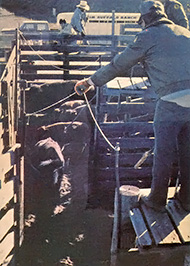
watching the buffalo roundup at the Kansas Fish and Game
Department’s annual sale–it seemed to me that the
adult bulls were much more easily spooked than were the
cows. Because of their intense fear of holding pens, you
might be able to produce better meat by butchering mature
bulls out on the range, thus avoiding the drive to a
corral and inevitable trauma.
Considering the foregoing points, some buffalo ranchers
argue that, if people are willing to pay to make the kill
for you, why not let them? (Of course, the price you charge
the “mighty hunters” will depend upon what parts of the
animal, if any, they may want to keep.)
Buffalo Husbandry
Bison are grazing ruminants that feed on natural prairie
grasses or planted pastures with equal enthusiasm. Some
folks claim that it’s possible to maintain three adult
buffaloes on the same range where two cows could be kept,
but most experienced herders will tell you to figure about
the same amount of pasture for each bison as you’d give a
cow of the same weight. (The size of the per-animal area,
of course, will depend entirely on how good your grassland
is. A buffalo cow and her calf might need only one acre of
lush pasture, while it’d take five to ten acres to support
the same animals in my part of Kansas. In
near-desert regions where the grass is very sparse, a cow
and calf–bovine or buffalo–would require as much as
20 to 40 acres.)
Bison breed in the late summer or early fall, and a
female’s gestation period–like that of a cow–is
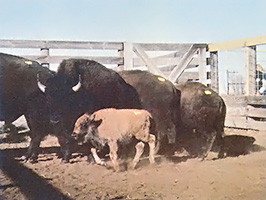
approximately 275 days (nine months). Most calves are born
between April 15 and June 15 (though some stragglers may
not arrive until September), and the whole herd will assume
the responsibility of protecting the babies. When the young
first appear, they have tawny red coats, which are lost in
about four months. The calves begin to graze very early,
although they may still nurse when they’re yearlings.
Both bison bulls and heifers reach sexual maturity in the
third or fourth summer. But bulls in herds that already
have established sires may not become effective breeders
until they’re six to eight years old, since the newcomers
will be unable to compete for mating privileges until
they’ve gained the strength and experience to earn
positions within the herd. Don’t let this working out of
the social order bother you, though. Such “battles of the
bulls” are short, and seldom result in serious harm to the
participants.
Though some buffalo breeders maintain a one-to-one ratio of
bulls to cows, most keep only one male for every ten
females. With a one-to-ten ratio, you can figure on an 80
to 90% calf crop each year. You can also expect your
buffalo to continue producing young for a long time, since
bison in captivity may live to be 30 to 40 years old. (You
can easily spot the old codgers, because–with
advancing age–their horns will become rough, increase
in curvature and diameter, begin to splinter, and generally
look worn.)
A Wonderful Wild Streak
Keeping bison “home on the range” can prove to be
difficult. Provided they have adequate room to roam,
buffaloes do tend to respect a fence more than cows do.
Rather than push against it or crane their necks through it
for that always greener grass beyond, the beasts will
contentedly munch on their own side of a barrier … but
this tolerance goes only so far: A frightened herd can
stampede through or over almost anything in its way.
Buffaloes can outrun most horses; jump a fence better
than deer; muscle their way through a barrier in
bulldozer fashion; and move so quickly that, when a
panicked animal begins to bounce from one side of a corral
to the other, it can look a lot like a monstrous handball
flying about a giant court.
A four- to five-foot barrier, with five strands of wire, is
considered minimum fencing by most owners. And a corral
needs to be built of 8- to 10-foot-high iron or 2 X 10
boards mounted inside 8 – to 10-inch-thick posts.
The fact is that bison haven’t changed much over the years,
no matter how hard folks have tried to “civilize” the
beasts. These proud animals always have been and still are
wild creatures. Domestication may seem to work for a while,
but eventually nature will reassert itself, and a ton
of “tame” buffalo that suddenly reverts to crazy-eyed
ferocity can wreak havoc on fences, other
critters, or the nearest human in a matter of seconds.
However, most buffalo herders admire the animals for their
permanent wildness. While such men and women never forget
the potentially destructive force that lurks beneath the
creatures’ usually placid behavior, they feel that raising
the once abused beasts combines the preservation of an
important part of the Old West with a modern approach to
earning an income.
If you agree–and if you have the necessary rangeland,
the fences, and the good sense to maintain a healthy
respect (and admiration) for the buffalo’s tremendous
strength–keeping a bison herd might be just the
livestock operation for you.
EDITOR’S NOTE: Further information about bison as livestock
may be obtained from the National Bison Association.






