


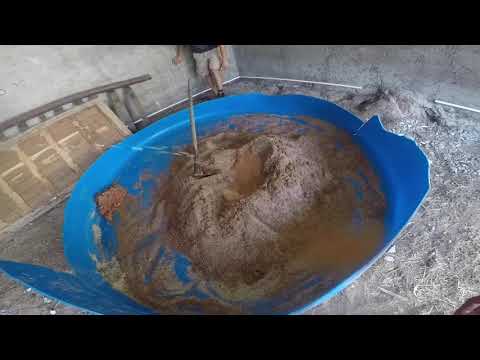
Spreading adobe
Photo by Tom Keeling
Once you have done your tests, reviewed them and decided which ratio of sand to clay to use then you are going to be ready to apply them to your wall. Try to make enough mixture to at least finish a wall at a time as it is a bit difficult to merge a dry section from a previous day into a new section the following day.
Make sure to fully mix all your ingredients dry. It is much easier to put in the time now mixing than try to separate clumps of clay later on.
In this video, we didn’t use a fiber but if you were going to you could now add thin straw, chopped into lengths no greater than your small finger. You could also use goat or other hair if you had access to that, or you could break up pieces of dry horse manure for an even finer fiber. Fibers reduce cracks and in the case of horse manure, when used as a final render it adds a beautiful mesh-like effect which you can only see if you look very closely.
Once you have a homogeneous mixture you can add water. Keep adding it slowly until you reach your desired consistency. You may notice that natural building guides usually dont show a quantity of water. This is because the ambient humidity and the humidity of you ingredients will dictate how much water you need to add. So it is always best just to keep adding water slowly whilst mixing well until you reach a workable consistency. For a render I would say a good consistency is one you can pick up in your hand but does still easily fall off, not holding its shape. If you can see water pooling on the surface it may be too wet in which case you will need to add more dry mixture.
Apply the Mixture to a Wall
Rendering adobe, photo by Tom Keeling
On very dry walls, wet them first with a mister, hose or wet brush. Wait ten minutes and then wet them again before application. If the wall is too dry then it will quickly try to suck all the moisture from the render and this can cause an air space between wall and render, causing the render to fail. Conversely, if the wall is too wet the mixture will just fall off and you will need to wait for that area to dry a bit first before trying again.
Once the wall is moist you can apply your clay slip. Clay slip is very fine filtered clay, mixed with water till it is a cream/paste. You paint this on your moist wall and can apply render directly on top whilst it is still wet.
Tips for Smooth Application
In this video, we applied render by hand, making sure to push hard into the cracks to make sure the render has a strong key inside the wall. Apply render with a movement from down to up catching falling mixture with your other hand if you like. It is also good practice to place a mat on the floor to catch any mix that falls, you can then add this to your bucket and reuse when you like.
In the end, we used a hawk to smooth the walls to make the next finer render easier to apply. The aim of this layer was to create a smooth even surface to work on to for the final renders and paints.
When working on to a clay wall I would follow these steps. When working on to other materials that are not as rough as the cement block wall make sure to do tests first which you can see in my previous video. When I posted about a clay paint I made a while ago all the questions I had were related to whether this could be done on different surfaces and my advice is always to do the tests first and then you will know for sure!
Tom Keelingis based in Portugal and has traveled throughout Brazil and Eastern Europe learning about natural building and farming. He’s working on a two-story stone barn renovation using clay and wood, and including a shower and toilet block built using rammed earth and adobe bricks. Connect with Tom at Fazenda Tomati and on Facebook and Instagram. Read all of his MOTHER EARTH NEWS posts here.
All MOTHER EARTH NEWS community bloggers have agreed to follow our Blogging Guidelines, and they are responsible for the accuracy of their posts.







