Come Rain or Shine
I’ve been farming my whole life. When I met my friend Richard about four years ago, we discovered that we’d both spent our entire lives on the same path to self-sufficiency, thanks to MOTHER EARTH NEWS. Over time, we explored different ways to improve our growing systems, including researching the best cold frames and experimenting with different types of cold frame covers for year-round protection.
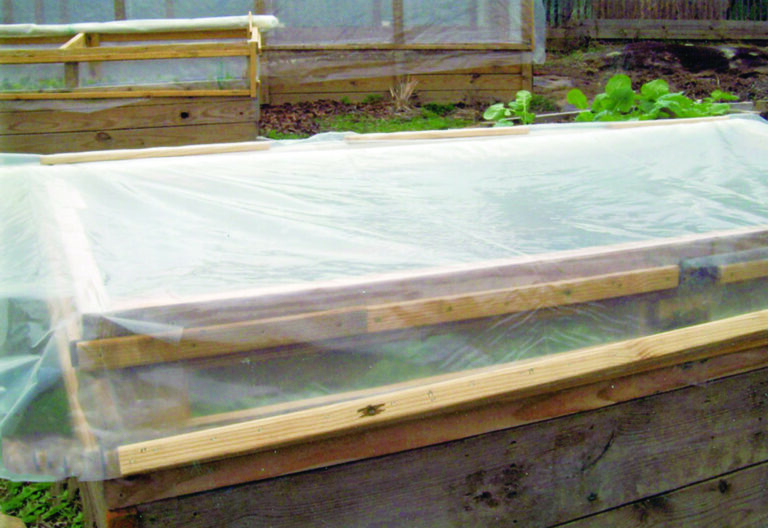
Together, we designed this roll-top solution for our cold frames. As a frost buffer for the plants inside, we built a wooden framework on top of the cold frame and then covered it with sheet plastic, creating a durable cold frame cover that works in all seasons. The framework’s front is 12 inches tall, angling up to 18 inches tall in the back. The cover of the framework is simply a piece of greenhouse plastic tacked down along the framework’s back side. The front edge of the plastic is sandwiched between two 1x2s. These 1x2s extend the length of the cold frame to keep the weight of the wood from ripping the plastic off. The weight of the 1x2s keeps the plastic in place when closed.
To open the cold frame, I simply roll the 1×2 toward the back edge, wrapping the plastic around it. This makes the system flexible compared to traditional cold frame covers that need to be removed entirely. To keep the rolled plastic in place at the back of the framework, I screwed one end of a short board inside both back corners. When I want to unroll the plastic, I just flip the boards down.

The great thing about the roll-top is that it’s usable year-round. When the cold frame is open, the roll-top is out of the way, which allows the rain to come in naturally. This makes it one of the best cold frames for gardeners who want both protection and flexibility. The roll-top works best on individual beds that aren’t too long. The longer the bed, the harder it is to neatly roll up the plastic. That said, I do use this technique on one of my 16-foot-long beds, with two 8-foot-long boards on the weighted end to span the length of the bed.
The wooden framework that supports the roll-top doesn’t interfere with summer crops, and it also provides young seedlings with some protection from wind. There’s no need to worry about storing windows, frost blankets, and hoops, and then dragging them out again every fall. It’s especially great to have the whole setup in place when a late frost threatens my crops after I’ve already put my other covers in storage. In colder setups, you can even modify this into a dark cold frame by using thicker or shaded plastic to retain more warmth overnight.
Martha Ann Burgard
Gadsden, Alabama
Sugar and Spice, and Everything Nice
The photo of six beautiful egg yolks curing on a bed of snowy white salt drew me in to “Egg-cellent Preserves” by Karen Solomon (April/May 2019). I didn’t even care how the cured yolks would taste; I just wanted to make something that looked as pretty as that photo. And the timing was perfect: I found myself with a glut of eggs from my productive hens this spring. So, I dry-cured yolks on a bed of sugar and salt, and they came out great!
But then I was left with this beautiful salt and sugar mixture that I couldn’t bear to discard, or even to compost. I mixed it with olive oil and some lime essential oil, and voilà! I ended up with salt and sugar scrub for my hands. I keep it in a jar next to my sink. It smells wonderful, and it makes my dry winter hands smooth and supple as could be.
Jen Dickinson
Stockton, New Jersey
Creating in the Caribbean
I’m a longtime reader of MOTHER EARTH NEWS, and I look forward to, and enjoy, every issue. I live in the Caribbean and have to apply MOTHER’s information inversely. We use the advice you provide for spring in fall. That’s our cooler season, when we plant most of our crops. (We can plant hot-weather crops, such as okra, bananas, squash, beans, and spices, year-round.) During our winter season, we usually plant lettuce, broccoli, onions, kale, spinach, carrots, and many others. Fruit trees, such as fig, lime, mango, and soursop, produce all year long. Other fruit trees are seasonal and harvested in winter, such as coffee, orange, and tangerine.
Our property is about 1⁄4 acre. We have to deal with both a rainy and a dry season, as well as termites and other insect pests. Interplanting and organic treatment methods control these pests in the garden, but the pests still destroy wood at a terrifying rate in our tropical climate. Because of this, wooden beams don’t work well for raised garden beds. Not only do they rot quickly, but they’re also more expensive than cement construction blocks.
Because of these conditions, we build our raised garden beds with cement blocks and top them with ornamental bricks. These beds look nice, they’re easy to put together, and they’re virtually indestructible and pest-proof. To install one, we measure out the garden space, dig up the grass and weeds to prevent their growth in the garden, use string to ensure straight edges, and then dig down several inches before placing the blocks. We use a level to make sure the tops of the blocks are even and the bricks look good.
Stella and Joe Cherry
Sustainable Seed Packets
You can reuse old calendars by turning them into seed packets! I make various sizes of packets depending on the dimensions of the calendar pages. If the calendar is light in color, I use a black marker to write the seed details. If the background is dark, I attach a piece of white paper with clear packaging tape to have something to write clearly on. These seed packet envelopes are great for personal use, or for giving seeds to others!
Holly Wolfe
Duluth, Minnesota
Puppy Port-a-Potty
Our dog, Olivia, has an irrational fear of getting wet, and I worried about how she’d make it through a hurricane that was approaching our property in September 2018. I came up with a simple solution. I had my husband fill a kiddie pool with sod from the yard. We then carried it to our front porch. It was raining the next time Olivia needed to go; she wouldn’t budge when we opened the back door and tried to get her to go outside. So we took her to the front porch and encouraged her to try out her port-a-potty. It took a treat to coax her in, but then she successfully relieved herself! This turned out to be the best idea I’ve had in a while. The fall and winter of 2018 was the wettest we’ve had since getting Olivia. She’s happily continued to use her special port-a-potty on every rainy day since. Something I thought would be a temporary fix has turned into a permanent fixture on our porch.
Dawn Meyer
Rock Hill, South Carolina
Combat Corn Earworms
My mother-in-law’s elderly neighbor gave us a great natural way to prevent, and even get rid of, corn earworms. Just apply a medicine dropper full of mineral oil to the corn silk. I’ve tried this many times, and it really works. This technique also gets rid of European corn borers for me.
Joan Johnson
Parrottsville, Tennessee
DIY Water Filtration System
This kind of water filtration system doesn’t require a substantial investment. It uses readily available materials, such as sand and gravel, to filter out mud and other sediments. Charcoal is perhaps the most crucial ingredient for removing any stuff you don’t want to drink, and most traditional water filters contain it. You can follow these steps to create your own filtration system:
- Begin by finding a food-grade plastic water bottle, such as a Gatorade container, and cut about 1⁄2 inch off the bottom of the bottle. As a point of reference, the neck of the bottle will be the bottom of the filter; the part with the opening you created will be the top. Keep the plastic cap on the bottle.
- Next, stuff a soft filter into the bottle, and push it toward the neck. A bandana works well as a filter, and it’s a readily found item. Alternatively, you could use several cotton balls or a coffee filter.
- Get another piece of cloth and use it to spread out your charcoal. Charcoal from a grill or fire pit is preferable. Make sure to break the charcoal into small chunks, using a large object, such as a rock, to crush it if needed. After working the charcoal into the desired size, wrap it up tightly in the cloth, and slide it into the bottle against the first piece of cloth.
- Before you start adding substances to the bottle that act as filters, rinse all of them thoroughly. This will help reduce the amount of debris in the first water that passes through the filter. Many water filtering methods you see today rely on special kinds of membranes made from polytetrafluoroethylene. However, for this project, you’ll want to use more natural materials, such as sand, gravel, and small rocks. Hence, rinsing off these materials is an important step in creating a clean water filter.
- From here, creating your water filtration system means adding more gravel to assist with the purification. You’ll start with the finest material and add layers of progressively coarser stuff. Put playground sand directly on top of the charcoal layer. You don’t need to wrap it in a cloth before pouring it into the bottle, but make sure to add enough to fully cover the cloth.
- Paver sand — also called “polymeric sand” — comprises the next layer. It’s likely to include small stones.
- The final two layers of this filter are fine gravel and coarser gravel. Depending on your area, you may find both of these materials in nature. Because of the modest diameter of the plastic bottle, you shouldn’t need more than a couple of handfuls, equaling an inch or two of coverage.
- You’ve now added everything to the filtration system. Get another piece of cloth and stretch it tightly over the bottom of the bottle (which is actually the top). Keep the soft material in place with a rubber band or a cable tie.
- You’re finally ready to witness the fruits of your labor. Hold your filter over an empty cup and take off the cap. Then, pour water into the top of the filter and wait for it to come through the neck of the bottle and into the cup.
These steps demonstrate that it’s not challenging to filter water at home, or wherever you are. Keep in mind, though, that you’ll still need to use water purification tablets to make this filtered water potable.
Kayla Matthews
Pittsburgh, Pennsylvania

Repurposed Planter
Here’s a way to be creative with recycled dish soap containers, adding small and large plants to create a unique and beautiful ecosystem. Share this idea with your children, friends, and the kids’ teachers for science projects. Happy planting!
Materials
- Empty dish soap container (don’t take off the cap; soak container overnight to remove the label before starting project)
- Scissors
- Small plant
- Rocks or shells
- Planting or potting soil
- Water
Steps
- Lay the dish soap container flat on a work surface, and then use your scissors to carefully cut an oval opening in the top.
- Add rocks or small shells to the bottom of the container to help provide air to the roots and drainage to prevent root rot.
- Add planting or potting soil to the container.
- Insert your plant into the soil, and push the soil around and over the roots to secure the plant in the container.
- Place the plant container under a grow light, outside, or near a sunny window to ensure growth success.
- To release water from the soil, open the cap on the container for drainage. Be sure to place something under the container to catch the water.
Sharon Ann Bradley
Hinesville, Georgia

Canning Conundrum
I enjoy canning fruits and vegetables because I love knowing what I’m eating. I also love the bursting flavors, the amazing color on my shelves, and having an abundance of summer to enjoy through winter. But I don’t love stuck jar rings. I’ve tried a variety of techniques over the years to remedy the problem, but this is my all-time favorite:
Heat a dish of water in the microwave for one minute. Invert the jar into the hot water for about one minute. Remove the jar from the water, and unscrew the jar ring. In most cases, it’ll come off easily.
Mary Martin
Rexburg, Idaho

No More Mucky Ducks
Ducks are messy, mostly because of water. To contain their mess, I came up with an easy DIY pen. Our egg-laying runner ducks are easy to maintain when contained in a deconstructed dog kennel. I took it apart and pushed the two halves together. One side contains water and the side with the wire door holds the ducklings during cleaning. The heat lamp is suspended from above. Runner ducks don’t fly and they lay great eggs year-round.
Melanie Goforth Hosch
Wirtz, Virginia

Duckingham Palace
I recently completed a project that converted an old Tuff Shed into a new home for my duck, chicken, and rabbits. I insulated the shed, and then divided it into two parts (one side for my duck and chicken and the other side for my rabbits). The shed is 8 feet by 8 feet. There’s a run attached to the shed (also divided), which is 10 feet by 16 feet. I’ve dubbed this shed “Duckingham Palace.”
Helen Kopy

Durable Raised Beds
I love all designs for raised garden beds, and have several of my own, but many instructions dwell on cost-effectiveness. I prefer to focus on longevity for my raised beds. I’ve made several from patio stones and decking materials. They cost more upfront, but I’m confident they’ll last for at least my lifetime, and possibly my grandchildren’s.
A few of my beds are made up of 16-by-16-inch patio bricks. My husband took some channel iron and cut pieces to secure the bricks together, and welded two pieces of channel iron for the corners. My other beds are made from weatherproof decking boards with aluminum corners. Albeit a bit pricey, these beds should last a very long time. Some are 10 years old and show no signs of wear. I have hardware cloth under each bed to shut out moles. Most of the beds also have old fence panels on top to keep cats from “using” them.
Bonnie Miller
Farmland, Indiana
We Pay for Top Tips
Do you have handy home, farm, or garden advice? We pay $25 for each tip we publish, plus another $25 if we use your photos. Send your tips to Letters@MotherEarthNews.com.
Frequently Asked Questions
1. What is the best cold frame for home gardening?
The best cold frames are those that provide insulation, durability, and easy access to plants. A roll-top design with flexible cold frame covers is highly effective because it allows ventilation, rain access, and protection from frost without removing the entire cover.
2. What are cold frame covers made of?
Cold frame covers are typically made from greenhouse plastic, polycarbonate panels, or glass. Many gardeners prefer plastic covers because they are lightweight, affordable, and easy to roll or adjust depending on weather conditions.
3. How to make a cold frame from plastic bottles?
To make a cold frame from plastic bottles, collect clear bottles, cut them, and assemble them over a wooden or metal frame. This DIY method creates insulation pockets that trap heat, making it a cost-effective and eco-friendly cold frame cover solution.
4. What is a dark cold frame and when should you use it?
A dark cold frame uses thicker or shaded materials to retain more heat and reduce light exposure. It’s useful in extremely cold climates where heat retention is more important than sunlight, especially for overwintering plants.
5. Are cold frames useful year-round?
Yes, the best cold frames can be used year-round. In winter, they protect plants from frost, and in spring or summer, adjustable cold frame covers allow airflow and rain exposure, making them versatile for all seasons.
6. How do you maintain cold frame covers?
Cold frame covers should be cleaned regularly to allow maximum sunlight through. Check for tears in plastic covers and ensure they are securely fastened to avoid wind damage.
7. Can cold frames replace greenhouses?
Cold frames are a simpler and more affordable alternative to greenhouses. While they are smaller and less controlled, the best cold frames can effectively extend the growing season and protect crops in most climates.