
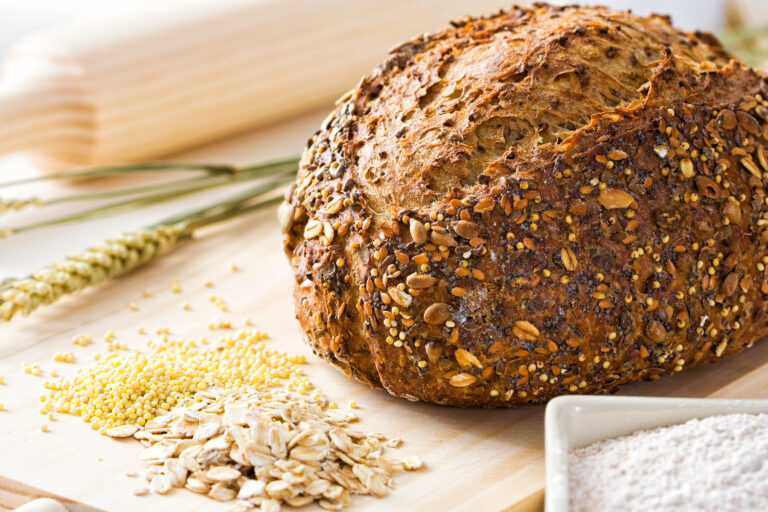
Learn how to find a quality home grain mill to grind your own flour. This article covers reviews on grain mills and the health benefits of fresh-ground grains.
Modern countertop grain mills make it easy for anyone to grind fresh, flavorful flours. There are dozens of flour mills from which to choose. Fortunately, the search for an ideal mill can begin with three basic decisions — what power source to use, the appropriate milling mechanism and the maximum flour temperature to tolerate. Many mills are appropriate for family use as well as in a home business. The decision comes down to price, quality, versatility, and convenience features.
Power Source
- Manual Mills. For the energetic, athletic, disciplined person, a manual mill (particularly the large flywheel type) can be a superb choice, with a low chance of nutrient-damaging heat buildup. But most manual mills require work, so be realistic — if there’s no flour, there can be no bread.
- Electric Mills. If the primary objective is getting the flour ground and the bread on the table without any fuss, frills or fanfare, then an electric mill’s primary drawback — loss of use during power outages — may be acceptably rare. The zippiest, cleanest, easiest mills in this category are relatively inexpensive, and they do one heck of a job, then go back in the cupboard.
- Convertible Mills. Many mill manufacturers have devised ways to make their mills convertible from manual to electric or vice versa, so grinding continues with or without power. It is important to select a convertible mill that works properly in either mode because some don’t.
Milling Mechanisms
Each grain mill has some mechanism for crushing, beating or grinding grain into meal, usually in a range of textures from coarse to fine. Some mechanisms are more versatile than others: They grind hard, soft, oily or wet items. Aside from the increasingly popular “oat roller,” two milling mechanisms dominate the home mill market: burr and impact.
- Burr mills are the most common. They have two grinding plates, one fixed and the other rotated by a power source. The grain is fed into a gap between the burrs, which are grooved to aid the shearing and crushing of the grain. Composite stone burrs are constructed by pressing natural or artificial stones (and sometimes metal cutting blades) in a bed of cement. Metal burrs/plates, some of which are flat and some cone-shaped, are constructed of hardened cast steel or other metal. Basically, stone burrs tend to crush the grain, and metal burrs tend to break and shear it.
- Impact mills employ two flat stainless steel heads with concentric rows of “teeth” that spin within each other at high speeds. Grain drops into the mechanism and is hammered, rather than ground, into flour. These very fast, efficient electric-only mills handle most dry, non-oily grains, but can only produce fine, not coarse, flours.
Heat Buildup
Heat is generated when grains are crushed between burrs or slammed around by metal pins. As milling time or speed increase, heat increases, which raises the risk of damage to nutrients and gluten. But when does heat buildup become a problem? Here’s what scientists either suspect or have documented:
- 112 to 115 degrees Fahrenheit. Heat-sensitive vitamins may begin to deteriorate, and the baking quality of gluten could be at risk of deterioration. This would be the upper limit for the super-safe miller.
- 122 degrees. Some enzymes are destroyed or become inactive, and some deterioration of gluten has been observed. (The baking performance of gluten declines progressively between 122 and 158 degrees with virtually all functionality lost by 167 degrees.)
- More than 140 degrees. Losses in bread quality are clearly apparent; enzymes, heat-sensitive vitamins and probably many other healthful components are destroyed.

Review of Selected Mills
Mockmill Simple and intuitive to operate and easy to clean. Stepless adjustment of the settings from very fine to coarse. Throughput of approximately 100 grams of soft wheat / minute. Sturdy industrial motor Grinding mechanism consisting of corundum-ceramic grinding stones Made in Germany 6-year warranty for non-commercial use.
All dry grains can be ground, including wheat (both hard and soft), oat groats (dehulled oats), rice, triticale, Kamut, spelt, buckwheat, barley, rye, millet, teff, quinoa, amaranth, sorghum and dent (field) corn. Sprouted grains can also be milled, provided they are thoroughly dried first. It will also grind spices, lentils, and dry beans (pinto, red, garbanzo, kidney, etc.) It isn’t suitable for herbs, oilseeds like flax or sesame, popcorn, or fibrous materials.

Nutrimill Medium-sized electric; impact type; not convertible to manual.
Compact, filtered, no-dust flour canister. Mills all dry grains, popcorn and most beans, but not seeds or nuts. Grain flow and texture control. The motor and milling chamber have a lifetime warranty, the other parts are warranted for ten years.
KoMo Grain Mills Medium-sized electric; burr type; not convertible to manual. Imported from Germany.
Highest quality, industrial motor, solid beechwood casing, stunning good looks. Grinds all dry grains, beans, corn. It comes with a 12-year warranty.
Family Grain Mill Small electric; burr type; convertible to manual. Imported from Germany.
Grinds small dry grains but corn and beans need precracking before milling; never overheats flour. Mill mechanism and attachments useable with separate manual base that starts at $70. Exceedingly versatile; widely available; very popular. Lifetime warranty (excluding replaceable burrs).
GrainMaker Mill Medium-sized manual. Made in USA.
Highest quality; heavy duty; hand-crafted; easy to use. Lifetime warranty including burrs. Grinds dry and wet items, including grains, beans, nuts and nut butters. Comes in red. Availble for purchase online (layaway option available).

Country Living Grain Mill Large manual; burr type; convertible to electric. Made in USA.
Highest quality, very attractive, work required but large flywheel and optional bar extender reduce grinding effort significantly. Mills all dry items; needs accessory auger for large items. 25-year track record; lifetime warranty in manuel operation. Widely available in catalogs and on the Internet. Occasionally models become available at a discounted price becuase they are dinged or have an imperfection but are still fully functional and fully guaranteed)
Diamant Large manual; burr type; convertible to electric with V-belt pulley. Imported from Poland.
Highest quality, easiest to operate of all manual mills, considered the “Cadillac” of manual mills since 1920; comes in green. Large flywheel significantly reduces grinding effort and milling time; grinds all dry or wet items, including nuts and nut butters, with a standard auger. Standard, extra-fine and extra- coarse burrs provide versatility; one-year warranty.
Mill-Rite Medium-sized electric; burr type; convertible to manual. Made in USA.
A reliable workhorse; heavy-duty motor features gear reduction so flour remains cool, quieter than many mills; exclusive feature disengages motor, so mill works easily manually. Mills all dry grains, corn, beans. Built to last; 10-year-warranty on parts and workmanship.
You can find more grain mills and flakers from Pleasant Hill Grain of Hampton, Neb. 866-467-6123
This article was written by Marleeta F. Basey who had been milling flour and making 100-percent whole meal bread for over 25 years by the time she wrote the book “Flour Power” that was published in 2004. In the beginning, her bread was heavy, earthy and toothsome. After many trials, many errors and much research (including a review of cook books from the early 1900s), she learned how a few “secret” ingredients could turn her whole meal bombs into fluffy, light, flavorful loaves without adding white flour or commercial gluten. The most secret of ingredients, it turned out, was the wheat that she milled into flour.
Fresh, Whole Grains Suppliers
- Sun Organic Farm of San Marcos, Calif. 888-269-9888
- Great River Organic Milling of Fountain City, Wis. 608-687-9580
- Eden Foods of Clinton, Mich. 888-424-EDEN
- Montana Milling of Great Falls, Mont. 800-548-8554
- Bob’s Red Mill of Milwaukie, Ore. 503-607-6455
Readers’ Grain Mill Reviews

A Spiritual Practice
I purchased a Nutrimill grain mill in January 2003, and I love it. It can grind 4 cups of wheat into fine flour for bread making in about five minutes.
The mill fits on the kitchen counter, underneath the upper cabinets. It holds 20 cups of grain at a time, and its impact grinding mechanism is self-cleaning. Even though it’s marketed as being the quietest mill there is, it’s still pretty loud.
I buy my organic, high-protein wheat in 50-pound bags from the local Mennonite bulk food store at a very good price, and store it in recycled bakery icing buckets.
The actual bread-making process has become almost a spiritual practice for me, from grinding to kneading to slicing the finished breads. I listen to old-time music on my little kitchen radio, and the day’s problems literally melt away. We rarely eat meat, so we depend on our ‘staff of life’ to provide the protein missing in our diets. I substitute a half cup each of ground flax seed, wheat germ, soy flour and oat bran for 2 cups of the flour in the recipe, so I know the bread is super healthy. Our bread is so much cheaper to make than it would cost to buy a similar multi-grain one, and certainly cheaper than meat! The investment in the Nutrimill is paying off in money saved and improved health.
Sam Jones
Jonesborough, Tennessee
Toddler Loves Mom’s Bread
I started grinding my own flour in early 2003 after purchasing a Whisper Mill. I had been baking all of my family’s bread using store-bought whole-wheat flour. I knew that the nutritional quality had deteriorated in the purchased flour I was using.
The Whisper Mill has proven itself to be a great buy. I have ground both hard and soft wheat, buckwheat groats and soybeans. Our everyday bread is oatmeal/whole wheat. This is what I have fed my 4-year-old since he started eating bread. It is remarkable how sweet a loaf of bread made with freshly ground wheat tastes. My family continues to encourage my baking by showing their appreciation for my wholesome, homemade goodies with big smiles. And nothing makes me feel more satisfied than watching my 4-year-old bite into a big piece of buttered bread that I made myself. I know what he is putting into his mouth — something I would never know with purchased commercially produced bread products.
Lori Fulton
Canonsburg, Pennsylvania
Maximum Nutritional Value
For about 25 years, my sole mill experience has been using a Bosch grain mill.
Although I may use it only a couple of times a month, at one point in time, I was making bread every week and needed to grind the grains. I have never had a moment’s problem with the mill. The set of earplugs is useful in blocking out the high-pitched motor sounds.
It is very satisfying to know I’m maximizing the nutritional value of the grain at mealtimes.
Judy Wahlers
Phoenix, Arizona
Trading Trout for Wheat
We live in Illinois, near St. Louis, and local wheat is not as rich in gluten as the hard, western red wheat. We camp out West regularly and bring back a few bushels of wheat every couple of years. Last time, on the way home after a fishing trip, I stopped at a grain elevator alongside of the railroad in western Colorado. The operator suggested his discharge chute would burst my plastic trash bags in which I had proposed to collect wheat from his elevator, so he directed me to Delmar Eichenberg, a local farmer. We visited Delmar, admired Native American artifacts he had collected, ended up trading fresh trout for a few bushels of his wheat, made a new friend and plan to repeat the visit soon.
I use a Vita-Mix to grind 2 cups at a time, which takes 1-1/2 minutes to turn wheat berries into fresh flour. I sometimes add dried cranberries, walnuts and raisins to the bread. We have five generations of our family here on the farm, and all enjoy it immensely. Warm, it’s irresistible; cold, it’s great with jelly, butter or plain; toasting even enhances the flavor. Ingredients are about 12 cents for a pound and a half loaf.
Richard P. Ellerbrake
Lebanon, Illinois
Evolution of The Loaf
It all started as a general interest in healthful eating. As vegetarians, bread is an important and exciting part of our diet. After our exposure to Zingerman’s bread (Ann Arbor, Mich.), we knew we would never find satisfaction with grocery store bread again. The excellent “chew” and hearty crust in these rustic, old-world and beautiful loaves is incomparable.
Several hundred hum-drum grocery loaves later, we began to put the pieces together:
1) The bread machine we got for Christmas one year,
2) The Laurel’s Kitchen Bread Book that lay dormant on a shelf,
3) The availability of whole wheat berries just a short drive away at an Amish bulk food store,
4) The purchase of a hand-crank mill called “Our Very Best Grain Mill.”
Our plan was to make Desem (Day’-zum) bread once a week as outlined in Laurel’s book. Desem is Flemish for “starter”and is a unique way to bring wholesome wheat bread into your life. Desem deserves recognition because the ingredients are so pure and simple: wheat, water and salt. It was glorious and a memorable homesteading experience.
I refer to it as a memory now … because it only lasted about three weeks. Yes, we soon realized this hand-grinding plan was too time-consuming. We exchanged the first mill for an electric model, The Grain Master Whisper Mill, with which we’ve been quite happy. It is fairly quiet (like a modest vacuum noise) and clean, but most importantly — it’s fast! It grinds in a few minutes what took 30 by hand.
Somewhere after the Grain Master purchase, our bread machine, which had become stationary on the kitchen countertop, broke down. Kneading the dough by hand was not an option due to the time and mess; after some research we bought a KitchenAid mixer. This machine saved even more time by cutting our kneading time down from 27 minutes in the bread machine to five.
So after quite a journey, we have our tools of choice: KitchenAid mixer and Grain Master Whisper Mill. These work well for our two-loaf-per-week Desem operation. We have not tired of this excellent loaf. Our process continues to evolve as does the quality of the bread, and our health with each week’s baking.
I urge you to reference these books in any article about whole-wheat bread, they have been incredibly helpful: The Laurel’s Kitchen Bread Book: A Guide to Whole-Grain Breadmaking, by Laurel Robertson, Carol Flinders, and Bronwen Godfrey–also The Bread Builders: Hearth Loaves & Masonry Ovens by Daniel Wing and Alan Scott, 1999.
Jodi Robison
Wooster, Ohio
Mill That Does Everything
We have the most basic hand Corona mill. It’s a great little mill that grinds anything — corn, oats, acorns, sunflower seeds, flax. We have used some of the higher-quality, more pricey mills, and they do a better job creating fine flour, but they also plug when grinding oily seeds or soft grains like oats. For a first mill that does everything, we would recommend the Corona. Ours was about $50, it’s five years old, and we have never had a problem.
Chris Knapp
Canaan, Maine
A Worthy Investment
I consider myself a junk food junkie and a health food nut all in one package. With such tendencies for food in these categories, I’m always looking for ways to balance my evil habits with providing healthy food for my family. A couple of years ago, we borrowed a small Corona mill. It ground nicely enough, but we had to pour the berries in at a snail’s pace — not practical for everyday use. We have been using a Diamant grain mill for a year and a half, and I am extremely pleased with it. True, it was a major financial investment — a basic model with all-purpose burrs costs $1,000. When we first got the mill, I had aspirations of “renting it out” to others to grind their own grain, but our lives have been busy so this never happened. It would be a great idea to own a mill in conjunction with others to offset the cost.
The Diamant is designed to be mounted to a table with four bolts, so it stays out all the time. If you don’t mind a 14-inch-high mill in the kitchen, this is a great model. I love looking at the mill on the counter. Its design is kind of old-fashioned with beautiful lines. I appreciate the fact that something designed for practical everyday use is lovely to look at. It is made of cast iron, so it should still be around for my great-grandchildren.
The Diamant mills easily. The more you tighten the burrs, the finer the flour, and the harder it is to turn. It mills easily, but does it mill fine? Yes! I am not sure if it can grind as fine as King Arthur whole-wheat flour, but I like mine a bit coarser. It also has a large-capacity hopper that can be full and still grind the grain effectively.
Joyce Hillman
Monroe, Maine
Frequently Asked Questions
What are the main power sources available for home grain mills?
Manual Mills: Operated by hand (often with a flywheel), these require physical effort but run a very low risk of nutrient-damaging heat buildup.
Electric Mills: Fast, clean, and convenient for quickly getting flour ready with zero fuss, though they cannot be used during a power outage.
Convertible Mills: Designed to operate in both manual and electric modes so you can grind flour with or without power.
What is the difference between burr mills and impact mills?
Burr Mills: The most common type. They use two grinding plates (either stone or metal) to crush, break, and shear grain in textures ranging from coarse to fine.
Impact Mills: Use two flat stainless steel heads with spinning rows of "teeth" to hammer dry, non-oily grains into fine flour at high speeds.
Why is heat buildup a concern when milling grain?
As a grain mill operates, friction generates heat. Excessive heat can degrade nutrients, active enzymes, and the baking quality of gluten:
112°F – 115°F: Heat-sensitive vitamins and gluten baking quality may begin to deteriorate.
122°F: Some enzymes are destroyed or become inactive, and gluten functionality begins to decline.
Above 140°F: Severe losses in bread quality occur, destroying enzymes and health-promoting components.
Can all grain mills handle oily seeds, nuts, or wet items?
No. Many electric and burr mills (such as the Mockmill) are strictly designed for dry grains, beans, and spices, and can clog or struggle with oily seeds (like flax or sesame), nuts, or wet items. However, heavy-duty manual options like the GrainMaker Mill, Diamant, or Corona are capable of handling wet items, nuts, and nut butters.
What are the health and financial benefits of grinding your own flour?
Grinding your own flour allows you to maximize the nutritional value and fiber content of whole grains while eliminating commercial preservatives or additives. Many home bakers also find that baking with fresh-ground flour produces superior flavor, results in a naturally sweet taste, and proves significantly cheaper over time than buying specialty multi-grain loaves or store-bought equivalents.






