

Our nationwide reader survey reveals the best organic pest control methods for managing garden pests. Use organic pest control methods that work on aphids, slugs, and so many more.
Several years ago, MOTHER EARTH NEWS launched our Organic Pest Control Survey to learn more about the best organic pest control methods — and the not-so-great methods — when it comes to limiting insect damage in organic vegetable gardens. About 1,300 gardeners from across North America responded, providing new, region-specific insight into vegetable garden pest control.
Our survey had strengths and weaknesses. It included opportunities for open comments, which became the source for the practical tips in this article. But, although we asked many questions about specific methods, we failed to always list chickens and ducks, which we learned many gardeners regard as essential players in controlling Japanese beetles and other garden pests.
We were surprised by some of the results. For example, we suspected gardeners would report that coping with various root maggots was a challenge, but 90 percent of respondents reported getting good control with crop rotation. Similarly, flea beetles didn’t make the list of worst pests because most gardeners achieve good control by using row covers and growing susceptible greens in fall rather than spring.
Ultimately, the survey revealed 12 widespread garden pests that give gardeners grief. Here are the nitty-gritty details, including down-in-the-dirt advice on how to manage each pest, plus details on which pests are the worst in each region and a reference list for the best organic pest control by pest.
1. Garden Slugs

Garden slugs took top honors as the most bothersome pest in home gardens, with 55 percent of respondents saying the slimy critters give them trouble year after year. Handpicking was highly rated as a slug control measure (87 percent success rate), followed by iron phosphate baits (86 percent) and diatomaceous earth (84 percent). Opinion was divided on eggshell barriers (crushed eggshells sprinkled around plants), with a 33 percent failure rate among gardeners who had tried that slug control method. An easy home remedy that received widespread support was beer traps (80 percent success rate).
Relying on bigger predators — such as chickens, garter snakes and ducks — appears to be the most dependable way to achieve long-term vegetable garden pest control for garden slugs, as well as several types of beetles, cutworms and many other pests. Ducks are reportedly sharp slug-spotters, whether you let them work over the garden in spring and fall, or enlist a pair to serve as your personal pest control assistants throughout the season.
“Hungry ducks follow me around the garden daily. They love slugs and turn them into eggs,” commented a Mid-Atlantic gardener with 10 to 20 years of experience. In the Pacific Northwest, several longtime veterans of slug wars said ducks are a gardener’s best (and most entertaining) way to end chronic problems with slugs.
2. Squash Bugs

Squash bugs had sabotaged summer and winter squash for 51 percent of respondents, and even ducks couldn’t solve a serious squash bug problem. Most gardeners reported using handpicking as their primary organic squash bug control method, along with cleaning up infested plants at season’s end to interrupt the squash bug life cycle. The value of companion planting for squash bug management was a point of disagreement for respondents, with 21 percent saying it’s the best control method and 34 percent saying it doesn’t help. Of the gardeners who had tried it, 79 percent said spraying neem on egg clusters and juvenile squash bugs is helpful. About 74 percent of row cover users found them useful in managing squash bugs.
Several respondents pointed out that delaying squash planting until early summer and growing the young plants under row covers results in far fewer problems with this pest. This makes sense because natural enemies of squash bugs become more numerous and active as summer progresses. Until then, keep scraping off those egg clusters, and handpick as best you can.
Three readers shared this tip: In the cool of the morning, place open pizza boxes beneath squash plants. Jostle the plants and let the adult and juvenile squash bugs fall into the boxes, and then slide your captives from the boxes into a pail of soapy water.
A creative idea from Editor-in-Chief Cheryl Long is to create a simple Squash Bug Squisher out of two thick boards and a hinge. Find out how to build the squisher, plus read comments from fellow readers who are battling squash bugs.
3. Aphids

Aphids were on the watch list of 50 percent of respondents, but the success rates of various control techniques were quite high. Active interventions, including pruning off the affected plant parts and applying insecticidal soap, were reported effective, but so were more passive methods, such as attracting beneficial insects by planting flowers and herbs. Several readers noted the ability of sweet alyssum and other flowers to attract hoverflies for organic aphid control. “We attract a lot of beneficials by planting carefree flowers in the vegetable garden, including calendula, borage, zinnias, cosmos and nasturtiums” (Midwest, more than 20 years of experience). Other respondents commented on the importance of having some aphids around to serve as food for ladybeetles, hoverflies and other well-known beneficial insects.
4. Imported Cabbageworms

Imported cabbageworms came in fourth, with a 47 percent “disapproval” rating. If you see these little white butterflies in your garden, take action to protect your brassicas before the cabbageworm moths lay eggs. Two widely accepted biological pesticides, Bt (Bacillus thuringiensis) and spinosad, received remarkably high effectiveness ratings: 95 percent for Bt and 79 percent for spinosad. Row covers had a reported success rate of 82 percent, while companion planting and garlic-pepper spray had disappointing failure rates in excess of 30 percent.
Several respondents said they rely on paper wasps as organic pest control for cabbageworms. “They’re friendly, docile and voracious eaters of cabbageworms. My garden is full of cabbage butterflies, but I’ve yet to see a single worm; the wasps beat me to it” (Mid-Atlantic, six to 10 years of experience). To attract paper wasps, place bottomless birdhouses in the garden to provide nesting sites. Gardeners in the South, Mid-Atlantic and Midwest noted that cabbageworm populations drop if yellow-jacket nests are nearby, which enhances the success of fall cabbage-family crops.
5. Squash Vine Borers

Squash vine borers had caused problems for 47 percent of the survey respondents. The best reported organic pest control methods were crop rotation and growing resistant varieties of Cucurbita moschata, which includes butternut squash and a few varieties of pumpkin. The C. moschata varieties are borer-resistant because they have solid stems. Interestingly, if you’re attempting organic squash vine borer control, lanky, long-vined, open-pollinated varieties of summer squash (zucchini and yellow crookneck, for example) may fare better than hybrids, because OP varieties are more likely to develop supplemental roots where the vines touch the ground. Many gardeners dump soil over these places, so if squash vine borers attack a plant’s main stem, the plant can keep on growing from its backup root system. Because borers attack stems, compact hybrids, which tend to grow from one or two main stems, are naturally more susceptible.
One tactic is to wait out the borer’s egg-laying season. “To avoid squash bugs and squash vine borers, planting vining crops late and covering them with row covers until the first female flowers has been effective for us” (Midwest, six to 10 years of experience).
6. Japanese Beetles

Japanese beetles slid in at No. 6, which is surprising because they don’t pose problems in extremely hot or cold climates. Forty-six percent of respondents reported working in the unwelcome company of Japanese beetles, with handpicking being the most popular control method. Some gardeners grow trap crops of raspberries or other fruits to keep Japanese beetles away from plants. Several commonly used interventions — garlic-pepper spray, milky spore disease, pheromone traps and row covers — had high failure rates.
Numerous respondents said chickens ended their problems with Japanese beetles, with guinea fowl and ducks also recommended for vegetable garden pest control by ridding areas of Japanese beetle grubs and adults. Even if you don’t let your chickens scratch in your garden, your handpicking may be more enjoyable because chickens learn to love Japanese beetles very quickly. In late spring, when Japanese beetle larvae are close to the soil surface, letting wild, bug-eating birds work over the area can have a lasting impact, too. Several readers shared that having nesting pairs of robins and bluebirds (which feed insects to their young) is the best way to keep Japanese beetles from getting out of hand.
7. Tomato Hornworms

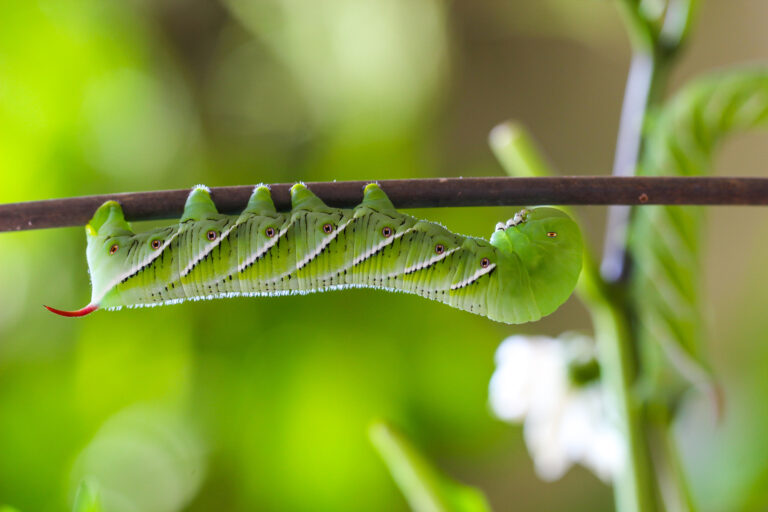
Tomato hornworms claimed the No. 7 spot, and were of concern to 42 percent of our survey respondents. Bt and handpicking were the preferred methods for how to fight hornworms, and several folks commented that tomato hornworms are among the easiest garden pests to handpick (probably because they’re large, easy to spot and produce a telltale, pebbly trail). Many gardeners reported seeing tomato hornworms often covered with rice-like cocoons of parasitic braconid wasps. “I had a lot of tomato hornworms this year, but the wasps took them out! Just like in the photos online and in bug books!” (Mid-Atlantic, more than 20 years of experience). Gardeners named zinnias and borage as good companion plants for reducing hornworm problems.
8. Cutworms

Cutworms were a concern for 41 percent of respondents, and effectiveness ratings for using rigid collars (made from plastic drinking cups or cardboard tissue rolls) to protect young seedlings from damage were amazingly high (93 percent effectiveness rating).
A common practice to reduce cutworm damage is to cultivate the soil’s surface once or twice before planting and hope robins and other bug-eating birds will swoop in to gather the juicy cutworms. Big, sturdy seedlings are naturally resistant to cutworms, so many gardeners said they set out seedlings a bit late to avoid cutworm damage.
9. Grasshoppers

Grasshoppers were a problem for 40 percent of respondents, and they seemed to be getting worse. We received many reports that increases in rainfall seemed to trigger an explosion in grasshopper populations. Chickens and guineas reportedly give good control by gobbling grasshoppers, but keep an eye on your poultry helpers to make sure they don’t harm crops. Gardeners described two interesting setups incorporating chickens for managing hoppers: a fenced garden with a fenced chicken “moat” around its perimeter, and a series of three small fenced gardens, each with a gate into the chicken yard for easy rotation of pecking services. (Sound cool? Check out our instructions on how to build your own chicken moat.) If grasshoppers are getting worse at your place, you may need chickens more than you think.
10. Cucumber Beetles

Cucumber beetles wouldn’t be so bad if they didn’t transmit deadly bacterial wilt to cucumbers and melons, but as it is, 39 percent of our respondents named them as serious garden pests.
For organic cucumber beetle control, neem, handpicking and good garden cleanup (removing all plant debris) were all rated as effective control measures, and once again poultry received many honorable mentions. Row covers earned more widespread use for the control of cucumber beetles than for any other pest, with more than 80 percent of people who had tried row covers reporting them to be effective.
Seventy percent of gardeners who’d tried companion planting said this method works for controlling cuke beetles, and 64 percent of people who’d tried yellow sticky traps reported these work.
11. Corn Earworms

Corn earworms were pegged as serious pests by 37 percent of respondents, many of whom get easy organic corn earworm control by using instruments ranging from oil cans to eyedroppers to add a few drops of canola or olive oil into the tips of ears, right when the silks start to show. Others reported using a standard solution of Bt in the same way, and several experienced gardeners pointed out the value of choosing varieties that have tight ear tips.
The corn earworm comments included several mentions of the ease with which earworm damage disappears if you pop off the end of the ear, thus making this pest not such a big deal. Raccoons, on the other hand, were reported to be a big deal, which was the main reason many gardeners gave for not growing corn. “If I plant sweet corn, the raccoons always eat it unless I fence them out” (Midwest, 25 years of experience).
12. Whitefly

Whitefly problems may be on the rise, because whitefly-plagued gardeners (36 percent reported a problem) often used exclamation points to emphasize their frustration with these tiny sucking pests. As for how to kill whitefiles, insecticidal soap earned a high effectiveness rating (90 percent), though many respondents said they use Dawn or other dishwashing liquids rather than regulation insecticidal soap. (Caution: Some research has found that repeated use of soap or detergent sprays can reduce yields.)
Broad-Stroke Pest Control
Along with working to improve your soil and thus grow healthier, more pest-resistant plants, several other common-sense approaches echoed through the comments sections of our survey. “The best way to beat the bugs is to plant more than you can use yourself. You can always give the surplus away” (North Central/Rockies, six to 10 years of experience). Others pointed out the advantage of setting the stage for beneficial insects and then simply standing back. From the Midwest: “I am willing to overlook some bug damage in order to provide good habitat for the beneficials reproducing all though the gardening season.” From the South: “A balance of insects is the goal, and ‘good’ and ‘bad’ insects both have to eat.”

Vegetable Garden Pest Control
Pest Control on the Wing
“Wild birds are a huge help, and gardeners should be encouraged to provide both nesting habitat and feeding stations for them. The bluebirds, flycatchers and other birds that live on my property spend a lot of time around my gardens catching bugs. The much-despised house sparrow is also a terrific boon to gardens, so urban gardeners would be well-advised to put out feeders even if that’s the only bird they will attract” (Maritime Canada, six to 10 years of experience).
Are Six-Legged Changes Afoot?
One of the questions we asked in our survey was this: During the past three seasons, have there been noticeable changes in the insect activity in your garden? Thirteen percent of gardeners reported they’d had many more pest problems, and 29 percent reported slightly more problems. Several respondents noted that increases in rainfall during the past few seasons seemed to be associated with more grasshoppers. Also, the appearance of a new, exotic insect, the marmorated stink bug, has brought new pest control challenges to gardeners in Pennsylvania and nearby states.
The Value of Beneficials
Seventy percent of survey respondents said they work to provide habitat for beneficial insects. Here’s what they said about whether this effort had helped to reduce pest problems:
- Seems like it has helped a great deal — 32 percent
- Seems it has been somewhat helpful — 49 percent
- Seems to have helped with some pests — 6 percent
- Doesn’t seem to make any difference — 13 percent
Worst Garden Pests by Region
Check out this table of the worst pests by region in 2011. A high score (scale is 0 to 100) indicates the insect was reported to always or often pose problems, while a lower score indicates rare problems with that pest. Pests are listed from most to least troublesome, and highlighted squares indicate the worst two pests for the region.
Best Organic Pest Control for Common Garden Pests
- Aphid: Insecticidal soap, attracting beneficials, horticultural oil
- Armyworm: Bt (Bacillus thuringiens), handpicking, row covers
- Asparagus beetle: Poultry predation, neem, handpicking
- Blister beetle: Poultry predation, neem, handpicking
- Cabbage root maggot: Crop rotation, beneficial nematodes, diatomaceous earth
- Cabbageworm: Bt, handpicking, row covers
- Carrot rust fly: Crop rotation, beneficial nematodes, diatomaceous earth
- Colorado potato beetle: Poultry predation, neem, handpicking
- Corn earworm: Bt, horticultural oil, beneficial nematodes
- Cucumber beetle: Poultry predation, neem, handpicking
- Cutworm: Rigid collars, Bt, diatomaceous earth
- Flea beetle: Insecticidal soap, garlic-pepper spray, row covers
- Harlequin bug: Handpicking, good garden sanitation, neem
- Japanese beetle: Handpicking, row covers, milky spore disease
- Mexican bean beetle: Poultry predation, neem, handpicking
- Onion root maggot: Crop rotation, beneficial nematodes, diatomaceous earth
- Slugs: Handpicking, iron phosphate slug bait, diatomaceous earth
- Snails: Handpicking, iron phosphate slug bait, diatomaceous earth
- Squash bug: Handpicking, good garden sanitation, neem
- Squash vine borer: Growing resistant varieties, crop rotation, beneficial nematodes
- Stink bug: Handpicking, good garden sanitation, neem
- Tarnished plant bug: Handpicking, good garden sanitation, neem
- Tomato hornworm: Bt, handpicking, row covers
- Whitefly: Insecticidal soap, attracting beneficials, horticultural oil





