With his husky build and soft, deep voice, John Jeavons seems at once strong and analytical. Crops and calculations are the mainsprings of this man’s work–and on both counts he’s been astoundingly successful. Jeavons has repeatedly demonstrated that deep, hand-dug, biointensive garden beds can produce yields two to six times higher than standard American agriculture, while using only a fraction of the water, fertilizer, and energy.
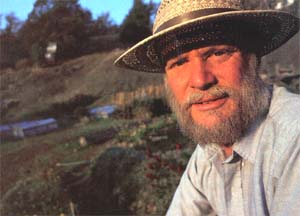
John has blue eyes, a trademark straw hat, and a gentle manner, but these fail to mute his overriding personal intensity. Not much for small talk, he jumps right into the latest gloomy estimates of our worldwide environmental crisis and points out ways his own work might help address the problem. Indeed, one of the most striking things about Jeavons is how he connects talk of global disaster with that of maximizing yields of a five-foot by 20-foot garden bed. “Think globally, act locally,” advised former British environmentalist E. F. Schumacher. “Think big, grow small” must be Jeavons’s personal version of that maxim.
For the better part of two decades, John’s been blazing the trail of biointensive agriculture. Step by step, with little more than garden fork, spade, and compost, he’s dug out an alternative that may, indeed, help answer the planetary problems our soil-mining agricultural systems have created. As former secretary of agriculture Bob Bergland once said, “John Jeavons is out of the mainstream of American agriculture–he’s 10 to 15 years ahead.”
Nowadays, though, the world is beginning to catch up–at least with where Jeavons was. His early books have been translated into five languages and used in over 100 countries. Biointensive projects have been started in Mexico, Kenya, Russia, India, China–the system is even taught in the Philippine public school system! But Jeavons isn’t standing still. He’s forging ahead, learning how to raise a complete diet in a minimal space, grow compost and “income” as well as food, live out a low-impact lifestyle, and more. (He refused to talk on record about some of his new directions, arguing that they would sound too radical for today–but would be more acceptable in as few as two years.)
In 1990, MOTHER intends to honor a number of people who’ve stuck to their environmental guns, who’ve kept their sights on helping us all mend our wounded planet, whether that ideal was in vogue or out. We’re proud to introduce this series by presenting the following discussion with John Jeavons (whom we first interviewed 10 years ago), a dedicated researcher who for 17 years has been steadfastly “keeping the faith.”
MOTHER: John, I’ve really been looking forward to the chance to meet and talk with you.
Jeavons: Me, too–there’s a lot to talk about. As you know, environmental problems have been hitting the front pages a lot lately. But the situation’s even worse than you might think. The earth’s lost three-quarters of its trees. As a result of this and other factors, by the year 2000, according to conservative estimates, 62% of the earth’s land surface will be desert–up from 43% in 1977. One-third of that is supposed to happen in the United States. California’s San Joaquin Valley, which produces approximately 30% of all the food in the U.S., is already in the early stages of salinization and desertification.
Mexico may become 60 to 80% desert. Indeed, during the last 12 months, Mexican crop production has dropped 20%. The country is in a stress situation (it already imports $5 billion worth of food annually). Russia’s crop yields are down even more: 40%. One of Gorbachev’s top economic advisers has said there’s a good likelihood of famine in the Soviet Union within two years. There’re indications that China, Bulgaria, and Poland are not much better off.
To top all this, according to Robert Muller, former undersecretary for the United Nations, some Russian scientists recently estimated the earth may become uninhabitable in as little as 16 years. An English scientist who was doing a similar evaluation disagreed: He thought it might be 20 years. Then the UN Environmental Program officers were presented this information, and they said, “Oh, no, no, this is way too pessimistic. It’s 50 years.”
MOTHER: The earth may become uninhabitable in 16, 20, or 50 years? That’s a pretty solemn way to start a conversation, John.
Jeavons: We don’t have much time. As Lester Brown of the Worldwatch Institute has said, “We have years, not decades, to turn the situation around.” We have to find ways to make positive changes, and soon.
And we can do it. The Chinese had too many houseflies in the 1950s. Their solution? They asked everybody to kill a few flies each day, and they asked some people to spend all day killing flies. In two to three years, they virtually eradicated the problem. Some households even reported having no flies at all. The solution is really that simple and that difficult.
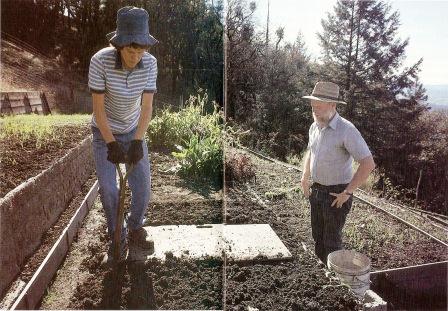
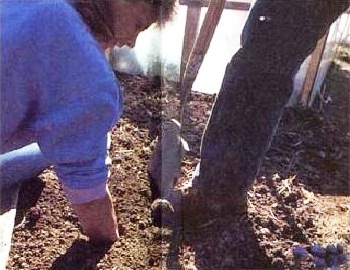
MOTHER: Let’s back away from global problems for a moment and talk about your system of biointensive agriculture. Almost everybody who’s heard of it knows that it involves double-digging: removing the top foot of soil in a growing bed–one trench at a time–loosening the second foot of depth, then replacing the original soil. That way the ground is loose and friable two feet down. What else is special about this method?
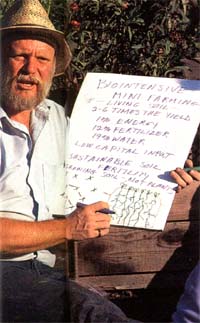
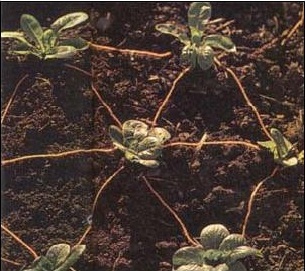
Jeavons: Biointensive minifarming uses water, soil, fertilizer, seeds, and sunlight–like any other method–but it puts them together in a different way. It preps the soil differently. It uses close, precise plant spacing. The microclimate created by that helps the soil hold water and produces an envelope of CO2 under the leaves that stimulates growth. The system also uses lots of compost to build up a living soil. The compost also holds six times its weight in water and will keep soil nutrients from leaching away. It uses light daily watering to keep an even supply of moisture in the soil.
As a result, this method consumes from one-third to one-eighth, to even as little as one thirty-second, the water per pound of food produced as commercial agriculture does. It consumes a maximum of one-half the purchased nitrogen fertilizer, and often needs none at all. And it requires only one one-hundredth the energy. All this, while producing two to six times the yields.
This method can be one way to help turn global scarcity into abundance. In California, agriculture uses 86% of the state’s water, and in the mid-’70s, there was a three-year drought. If everyone had been using biointensive agriculture, there wouldn’t have been a drought: One year’s worth of water would have lasted three to eight years.
MOTHER: But don’t we often hear that U.S. farming practices are the most efficient and effective in the world, that they’re counted on to feed a hungry world?
Jeavons: If you check the statistics, you’ll find that, most years, we import more calories, calcium, and protein from the Third World than we export to it.
And this “very efficient and productive” agriculture has many hidden costs. U.S. commercial farming practices deplete the soil eight times faster than it builds up naturally; in California, 80 times faster. In the last 200 years, we’ve lost half of our soil base, and that half took 1,500 years to build.
Look at energy. To put one calorie of food energy on our table, modern farmers require six to 20 calories of energy, both in human and mechanical, petroleum-based forms. How long would you stay with a bank if you gave them $20 and then at the end of the year they gave you one dollar back and said the rest of the money was gone? Compare that with Chinese wet rice agriculture, which requires only one-fiftieth of a calorie per calorie of food energy produced. That’s 300 to 1,000 times more energy effective.
And money? It generally takes about $500,000 to capitalize the average 500-acre farm in the U.S. The return on investment is about $8,600 a year, or 1.7%. Any normal business run that “efficiently” would go bankrupt. And many farmers are having just that problem.
MOTHER: What about the current trend toward organic farming? Isn’t that an improvement?
Jeavons: Generally, to grow food organically, you have to do just two things: Don’t use chemical fertilizers, and don’t use pesticides. You may be depleting the soil just as fast as a chemical farmer would. Consequently, the food may not always be very nutritious. After all, if you’re not building nutrients in the soil, they won’t be in your crops.
Organic food, in some instances, may even be toxic. An organic farmer may add a beneficial amendment like manure. But if that manure isn’t fully composted, it can contain excessive nitrates–in a form that’s easily picked up by a leaf crop like lettuce. So some organic lettuce could possibly give you nitrate poisoning.
Lastly, let’s say you’re an organic farmer who uses properly cured compost and manure, but imports those materials from off-site. Maybe the manure’s the residue of grain grown in North Dakota. Then using that manure actually helps deplete the soil in North Dakota.
We need to find out how to grow our food sustainably–without draining any area’s resources–over the long haul. It’s possible to do that on a closed-system basis; that’s what’s so exciting. It requires diligence and dedication, but in the long run there’s not really any other choice.
To accomplish this, the first thing we have to do is stop growing crops.
MOTHER: I beg your pardon?
Jeavons: We have to start growing soil. To do that, we will have to grow crops, but we have to get our priorities the right way around, because the goal is a living soil. Likewise, when we water, we shouldn’t water the crops–but water the soil. One dime-sized amount of living soil contains billions of microbes and other miniature life-forms. It can store nutrients and water better than almost anything else. That’s what we need to invest in.
To do so, we’re going to have to grow compost crops; not just nitrogenous ones, like vetch and fava beans, but others as well, such as wheat and rye, which produce a lot of carbon. If you want to have sustainable soil fertility, approximately three-quarters of your farm needs to be in compost crops all the time. Better yet, rotate crops and have all of your farm in compost three-quarters of the time. You also have to recycle all wastes. And you can probably export for income only about 10% of the crops you grow.
MOTHER: In other words, you grow your food and income crops on one-quarter of the land and your soil crops on the other three-quarters. That would have the advantage of being sustainable, but wouldn’t it end up taking as much space as conventional agriculture?
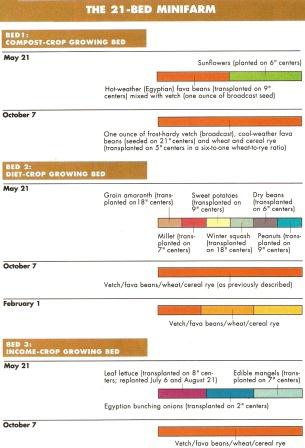
Jeavons: We think it eventually will be possible to grow all of a single individual’s food, money, and compost crops in as little as 21 beds: 2,100 square feet plus path space. That’s based on test yields. It may be a little optimistic; perhaps it will take 4,200 square feet. Since, however, commercial farms currently produce the average American’s diet–without growing compost or income–on from 45,000 to 85,000 square feet, we’re definitely talking about the miniaturization of agriculture. We’ve been miniaturizing electronics in the San Francisco Bay area nearby, so it’s not unreasonable to expect that as we all become more sophisticated in our understanding of biological principles, we can do the same to agriculture. Of course, we didn’t invent these techniques. They were used by the ancient Chinese, Mayans, Greeks, and some North Africans thousands of years ago.
Many people say there will not be enough land in the world to grow food for everyone. But if biointensive yields work out over time (that’s an important qualifier; it’s not going to happen right away) you could grow all the food for the United States on just its 19 million acres of lawns, golf courses, and cemeteries!
MOTHER: What biointensive projects are under way now?
Jeavons: Individuals are using our more than two dozen publications to teach themselves how to biointensively microfarm in over 100 countries. There are also several formalized teaching projects. In Mexico, the Family Planning Department is teaching biointensive techniques in 19 states under the auspices of its Menos y Mejores [Less and More] program. In Kitale, Kenya, the Manor House Agricultural Centre has a two-year apprentice-training program. In the Philippines, the Department of Education has committed to spread the method through the public school system–as a result of the work of Julian Gonsalves and the International Institute of Rural Reconstruction. There are also teaching and research programs in India, China, Togo, and Benin.
In the USSR, the 2,000 members of the Soviet Experimental Youth Gardening Complex [EMSK] voted to include biointensive practices as a major part of their program throughout their 116 acres of gardens around Moscow. At Ohio University, Steve Rioch, our East Coast Mini-Farm director, has helped obtain approval of the first four-year university-degree program, under the auspices of the botany department, with a major emphasis on biointensive minifarming.
And, of course, there are our own research gardens in Willits, California. When we first arrived, our steep-hillside soil was rated, at best, intermediate for grazing–you could hardly dent it with a spade. After our eight years here, you can sink your arm almost up to the elbow in a freshly dug bed.
MOTHER: You mentioned growing one’s own crops, compost, and income. Is anyone doing that?
Jeavons: Not yet. There are a few people living out the economic part. For instance, Kona Kai Farms in Berkeley, California, used biointensive practices to set up a minifarm that grossed $276,000 from a half acre in 1988 selling high-priced crops to restaurants. They’re not yet farming in a sustainable manner, however.
Generally, our research is five to 10 years ahead of public acceptance. For example, during our first project in 1973, we realized we were using half the normal amount of water per pound of food produced. At the time, no one believed us. About five years later, though, the result was widely accepted. In 1985, we published David Duhon and Cindy Gebhart’s One Circle, the book with the concepts for growing all your nutrition in the smallest area, and I think it’ll be as late as 1995 before a number of people are implementing it on a routine basis.
It was just two years ago that, based on field tests and bookwork, we developed a detailed understanding of the sustainable soil-fertility concept–how you could grow all your compost on a closed-system basis. It’ll probably be 1997 before that will begin to be used regularly in a significant way.
We’ve spent 17 years trying to develop agricultural models for obtaining the highest yields using the least resources in a manner that sustains soil fertility on a closed-system basis. Now, I think, we have most of the initial biointensive road maps needed.
MOTHER: So what’s the next step?
Jeavons: One of our main emphases in the next five years will be to begin to live what we’ve been researching–to grow more of our food, compost, and money. Right now, we spend 75 to 80% of our people-hours on site-researching, teaching, writing, fund-raising, and corresponding with people around the world. I’m hoping that by using some new 100-square-foot growing-bed training models we’re developing and by having other staff handle some of the mail and outreach, we can free up enough time to completely practice what we preach.
MOTHER: That sounds great. But do you think many other people will do something similar?
Jeavons: For that to happen, we have to change the image of farmers. Right now, farmers farm so they can afford to send their children away to college or technical school so they won’t have to farm. This is true in the Third World as well as here. In the U.S., two-tenths of 1% of the population will soon be raising 70% of the food–that’s one person in 500. The average U.S. farmer is 57 years old and generally knows how to grow only one or two crops while using resource-inefficient techniques.
We need to increase this skill base. We need to realize that farming is one of the most nourishing, important, sacred occupations anyone could have. Cities are wonderful places, full of ideas, music, culture, and education. But you can’t be safe in cities if your farmland’s being depleted.
MOTHER: Even if most people would be willing to say they thought farming was wonderful, I don’t know that they’d want to tackle the physical work involved–especially using your hand-tool techniques.
Jeavons: Well, starving isn’t easy, either.
That answer may sound harsh to you, but millions of people are starving right now. And it’s likely to get worse. I mentioned the drops in Mexican and Russian food production; U.S. food production is dropping too: We had an 89-day grain reserve in 1987, a 68-day grain reserve in ’88, and a 63-day reserve in ’89. Some analysts expect crop losses for 1990 and ’91 as well. Other scientific estimates indicate that due to the global-warming greenhouse effect, the average U.S. temperature may be 9°F higher in 2030 than it is now–and that such a rise could cut our crop production in half.
Still, I know that the most controversial issue of my work is labor. Most of us aren’t used to physical labor. We don’t want to farm, much less farm manually. And when we have those kinds of feelings, we set up mental blocks and decide, emotionally and understandably, that it can’t be done, at least not without overworking or stressing out. The question we need to ask is how can we easily raise our food with manual techniques. This question will bring the insights necessary to simplify the process to where it is humanly effective as well as resource effective.
Double-digging a bed–especially the first time–is work. But consider the fact that the Irish call double-dug beds “lazy beds.” After all, if you get four times the yields, you have to double-dig only one-quarter the area you’d otherwise single-dig. You have to water, fertilize, and weed only one-quarter the area. And the soil’s so loose the roots come out with the weeds, so you usually don’t have to reweed.
However, I think the best motivation for biointensive farming is that working with these life forces, even though it is physical work, is really rewarding and exciting. Even if there weren’t world environmental, food, and soil problems, I would want to live this way. At our Willits site, we may eventually have 400 terraced beds, with cascading strawberries, wheat, pumpkins, flowers, and herbs–a beautiful living tapestry full of fragrance and good food.
MOTHER: How much time does biointensive minifarming require?
Jeavons: From everything I’ve seen over 17 years, and I don’t expect anyone to believe this–I wouldn’t if were hearing it for the first time–as refinements occur, it’s going to be possible to grow as much food, income, and nutrition per hour by hand as it is with machines, and without detrimental environmental effects.
It’s already possible for a person to grow all of his or her vegetables, and I think, eventually, you’ll be able to raise all your food and compost with less than two hours of labor a day. Initially, that goal would probably require eight to 16 hours a day. But you shouldn’t try to do it all at once; you’d stretch your resources and yourself too thin. Instead, set yourself goals, like getting 10% of the way there the first year, 25% the next, and so on. Don’t try to raise a complete 21-bed unit the first year. Do a scaled-down three-bed version. Or, maybe better, do just one bed and go from there.
MOTHER: In other words, be patient.
Jeavons: Yes. It takes five to 10 years to build up the soil and about that long to build one’s skill. Also, since we’ve depleted our country’s soils about 1,500 years’ worth in 200 years, it’s not unreasonable to expect it to take 200 to 1,500 years to fully rebuild them. For example, at our Willits site we have a poor, sandy, porous soil with excesses of magnesium and sodium. Initially, it had very low levels of most beneficial nutrients. In addition, our nighttime temperatures are generally too low, and our daytime temperatures often too high, for the microbial life in the soil and crops to thrive. Consequently, our first alfalfa plantings grew only an inch or so high and gave only two cuttings a year. Eventually, as we built up and balanced out our soil nutrients, the alfalfa cuttings produced yields as high as two to six times the U.S. average.
We still have a lot of crop failures as we try to improve our soil and our skills and as we learn to work with the climate, but each problem usually shows us the way to the next improvement. Because we’ve grown up in a world of instant results, the patience required to build up soils and to learn to work in harmony with living biological systems continually stretches our limits! We need a long-haul perspective. And making the changes within ourselves to get that kind of perspective is perhaps going to be even more difficult.
MOTHER: You seem to be in for the long haul yourself.
Jeavons: Years ago when I began this work, one of my intentions was to set up constructive agricultural alternatives so that when the environmental pressures built up and people awoke to the crisis, we’d have a sustainable agricultural model ready to implement. There’d be positive models for people to put their energy into rather than simply feeling overwhelmed.
I think that time has come.
MOTHER: John, you’re keenly aware of a host of ever-worsening environmental problems, but you keep plugging away at solutions. How do you find the strength to keep going?
Jeavons: Well, the first step is to face the problem. We have to realize just how vulnerable and threatened we are–that humanity’s existence depends on preserving a six-inch layer of healthy topsoil. Then if we will actually look the problem full in the face, we’ll work right through it and come up with a solution, because problems always contain the seeds for their solutions.
MOTHER: Still, if you personally work hard on the solution and live an efficient lifestyle, but everybody else keeps wasting resources like they’ll last forever, then your individual acts will have very little larger effect. What good is that?
Jeavons: It’s not easy. I sometimes get discouraged because people don’t seem to care about themselves and the planet, especially if they know what the problems are but don’t act on solutions. But because the problems seem insurmountable, I don’t act on many of the solutions I know about–and I’m certainly not perfect, either.
I may not change the world, but I want to vote for life with my life. If I wasn’t acting positively about these problems–Good grief!–then I’d really be depressed.
MOTHER: Do you get personal strength from any spiritual beliefs?
Jeavons: [his eyes start to tear] Yes, I’m a Christian. And I feel this is what I’m supposed to do.
MOTHER: I’m sorry. I didn’t mean to upset you.
Jeavons: That’s all right. My faith is a very personal thing; I never mention it unless someone asks me. I’m not embarrassed about being a Christian, but people use the term in such funny ways, so I’m very careful about talking about it. Still, I’m sure it’s the only thing that’s allowed me to continue going through all the hard work and hard times: I almost went bankrupt twice about three years ago.
We have also worked with Buddhists and people of many other spiritual paths. I feel having a spiritual dimension to one’s work is important, but I don’t preach religion. I don’t even preach biointensive minifarming. I’m just trying to describe one solution. I do think one of the best solutions to raising enough food is for more individuals to raise their food locally and on a small-scale basis. But I’m sure there are lots of other good potential solutions, and people should take the ones that make most sense to them. Some that hold a lot of promise if practiced sustainably are wet rice-paddy agriculture, Asian aquaculture, biodynamic farming, agroforestry, Fukuoka culture, and biointensive minifarming. If someone came up with another good method for growing food that fulfilled the functional, environmental, human, and soil needs we’re talking about, I’d farm that way tomorrow.
People often cast me into the mold of believing I’ve got the single-recipe answer. Biointensive’s no panacea. Since it gets four times the yields, it can also deplete the soil four times faster–if you don’t recycle wastes and grow compost crops. Tree culture’s not a panacea. Instead of strip-mining the soil one, two, or three feet deep, trees can strip-mine the soil 50 to 150 feet deep and more–unless they’re grown the right way.
We’re the panacea.
MOTHER: What do you mean?
Jeavons: Walt Kelly’s cartoon character Pogo was talking about the environment once and said, “We have found the enemy, and the enemy is us.” Well, now we have to discover our allies. That is us, too.
We don’t have to continue what we’ve been doing. We can be pioneers in an opening field of miniaturization of agriculture, of a sophisticatedly effective use of resources, of building up a fantastically abundant ecosystem on this planet.
It’s difficult to see how one person can be part of a solution to the environmental resource depletion and human hunger problems so rampant in the world today. And, true, these problems taken as a whole are insurmountable to one person, but broken up into individual-sized portions, we can each easily become part of the solution. The portions all added together can be a whole solution. The earth is a large garden, and each of us needs only to begin to care for our own part of it for life to be breathed back into the planet, into the soil, and into ourselves.
The choice is ours. The individual becomes important again. And the work begins now.
Further Reading for Biointensive Farming
- How to Grow More Vegetables: The classic explanation of the biointensive gardening method. A detailed primer that covers compost, fruit, and tree crops as well as vegetables.
- The Backyard Homestead, Minifarm & Garden Log Book: This sequel to the above book covers small livestock, grains, minifarming for income, crop testing, herbal lawns, basic biointensive tools, garden record keeping, and more.
- One Circle: Subtitled How to Grow a Complete Diet in Less Than 1,000 Square Feet, this unique guide enables you to analyze both the nutritional and space effectiveness of crops.
- Man of the Trees: Selected writings of the renowned British ecologist-forester Richard St. Barbe Baker.
- Booklet 14: The Complete 21-Bed Biointensive Mini-Farm: A preliminary model for exploring how to produce all your compost, a complete diet, and a small income in as little as 2,100 square feet.