
Image by Alexas_Fotos from Pixabay
And what has happened to the dollar—as if you didn’t know—is that it doesn’t buy much any more. Or, to turn the situation around the other way, it now takes a great many more dollars to purchase what only a few of the pieces of green paper used to bring home.
Just how. many more dollars was emphasized with stark clarity by a recent Gallup Report. It seems that pollster George Gallup’s organization has been asking U.S. consumers an interesting question for the past 51 years: What is the smallest amount of money a family of four (husband, wife, and two children) needs each week to get along in this community?
In 1937—when that question was first asked—the median answer was $30. By 1947, the figure had risen to $43. In 1957, it was $72. Ten years after that, $101. In 1977, the answer was $199 … and this year it’s $201.
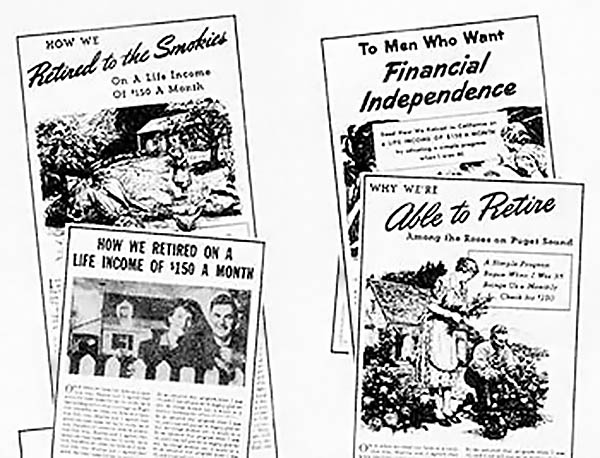
Which, of course, explains why the folks you see over there in the ads accompanying this column seem so smug … yet so ridiculous. Back in 1943—just 35 years ago, when those advertisements appeared in several of this country’s leading magazines$150 a month was, indeed, a comfortable amount of money for two people to retire on. Today, those two retirees would need $750 to enjoy the same standard of living. And 10 or 20 or Lord save us—35 years from now? Don’t even ask.
Well, of course, we’ve all been told that Stage II of Little Jimmy Carter’s “fight” against inflation is going to change all that. (Just as Richard Nixon’s Phase 1, Phase 11, Phase 111, etc. “fight” against inflation was going to change all that back in ’74 and ’75.)
Isn’t it interesting, though, that all these politicians’ “fights” against inflation always seem to concentrate so heavily on the belt tightening and sacrificing that we (never the politicians who create inflation in the first place with their printing—press money “giveaways”) must do?
And isn’t it interesting the way the progressive income tax has been set up so that the typical citizen (that’s you and me) already gets mugged twice even before we’re asked to sacrifice:
Once when the cost of everything we buy goes up. And the second time when, if we’re lucky, we get a raise in pay that’s big enough to keep us abreast of those rising costs. (Martin Feldstein, president of the National Bureau of Economic Research, has stated that a 7% increase in personal income increases federal tax collections about 10.5% as everyone is pushed into more confiscatory tax brackets. So, even if your paycheck expands fast enough to match inflation, you still lose because the government takes ever—bigger bites from those ever—increasingly worthless dollars you bring home.)
It’s little wonder that, as Guy Wright observed in the San Francisco Sunday Examiner & Chronicle back on January 15th of this year, “If there is any wisdom in the land today it’s the growing realization that government can’t solve our basic problems.”
Of course not, Guy. Not when government—whether staffed by Democrats or Republicans—is our most basic problem.
It has been the government—staffed by Democrats and Republicans alike—that has removed the gold and silver backing from our paper money . . . authorized grandiose social schemes and the “policing” of the world and studies of the flight characteristics of the Frisbee and Lord knows what all … annually raised the limits on the national debt … promised everybody everything except hard work . . . and otherwise mortgaged the future of every living American and every American who will be born for the next 100 years (at least). . . all just since World War II.
It has been the government which has “paid” for these flights of fancy by steadily raising your and my taxes . . . by printing increasingly gargantuan quantities of paper money (which, of course, makes that paper money increasingly “cheap”, so that it takes steadily increasing amounts of those dollars to buy the same amount of goods and services, which is the definition of “inflation”) . . . and which now solemnly tells us that we’re all going to have to “tighten our belts” to make everything right once again.
It has been the government, in short, which has fritzed everything up and which now expects us to “sacrifice equally” to make everything OK again.
Little wonder the prevailing wisdom is that government can’t solve our basic problems. Little wonder that we now have a “tax revolt” raging from the Atlantic to the Pacific. Little wonder that most of us now just wish the government would go away and leave us alone. Little wonder that so many of the decent, hard—working people of this country now regard Washington as “the enemy” and want as little as possible to do with the miscreants and poltroons along the Potomac (the ones who piously prescribe “sacrifice” for everyone but themselves) as possible.
But you, of course, already know all about that. What you want is some help in preserving what you have against the taxes and inflation that Washington continues to heap upon you … and the “sacrifices” that one politician after another asks you to make. This column will be back next Issue with some concrete suggestions that should help you withstand the onslaught.