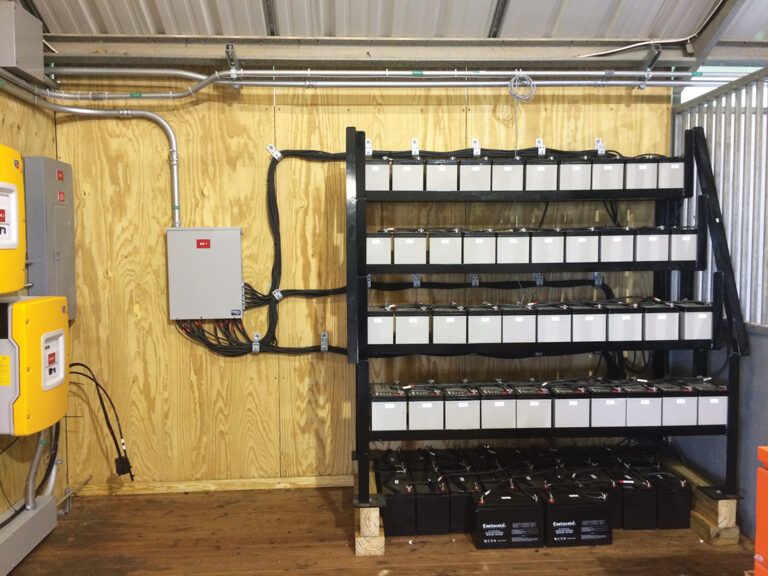
Discover small solar home battery options, including flooded lead-acid, deep-discharge, and lithium-iron phosphate batteries.
Welcome to our series answering reader questions and concerns about how to cut the utility-company cord.
Which home batteries can be recharged with small solar systems – and what other specifications should I be aware of when comparing small systems with those large enough to power an entire homestead?
Mike, via email
Let’s start with a few general comments about systems with batteries. The type of battery you choose isn’t specific to a small or large home system. Battery types only change in huge commercial and utility-scale systems, where battery voltages can run in the hundreds of volts; for a home system, you’ll generally use 12-, 24-, or 48-volt varieties.
Regardless of size, the first step to take when designing a solar-plus-storage system is choosing the right inverter. You’ll want an inverter that works with both solar panels and batteries and is big enough to handle the amount of energy you need. If you have a typical grid-tied system without batteries, you’ll choose an inverter that doesn’t draw its electricity from batteries. But if you’re hoping to upgrade to a battery-backed system, you can sometimes add a battery-ready inverter to your existing system. In some systems, you can upgrade to the newer hybrid, all-in-one inverters that connect to your solar panels and batteries in a single unit. The inverter manufacturer you decide to go with should be able to specify which types are compatible with your system (and the number you’ll need).
Now, let’s talk about the types of batteries available for homes. Three main types are available.
Flooded lead-acid batteries, also known as “wet-cell” – and their variations, including absorbent glass mat (AGM) and sealed-gel – are of the same chemistry as your run-of-the-mill car batteries. However, lead-acid batteries for home energy are designed to release their charge slowly to keep the lights on longer, whereas car batteries release their energy quickly. If you’ll cycle the batteries often (meaning you’ll charge, discharge, and recharge them frequently), you might be lucky to get five years of life from the lead-acid batteries. One advantage of newer AGM and gel-sealed batteries is their low maintenance requirements. Flooded lead-acid batteries require you to add water, sometimes daily. They also give off explosive gases that are corrosive, so they can’t be mounted in unventilated areas or below equipment made of metal.
Deep-discharge batteries, also known as “deep-cycle,” are the same kind you find in golf carts and electric forklifts. However, deep-discharge batteries for home use are more expensive than a cart battery, and a system becomes pricey when you need several to get the right voltage. Voltage and inverter are considerations you take together: If your inverter requires 48 volts to operate, you’d need four 12-volt batteries daisy-chained in a series (or two 24-volt units).
Lithium-iron phosphate batteries, sometimes called “LiFeP04,” are an improvement over lead-acid batteries, because they’re safer. LiFeP04 batteries can burn in a fire but aren’t known to self-combust to actually cause a fire. Although lithium batteries are more expensive upfront, they’ll last up to 15 years, require no maintenance, don’t give off explosive gases or corrode metal, and some can drain to zero without experiencing any damage. I particularly like the Briggs and Stratton AmpliPHI, because you can get them in 24- or 48-volt units, eliminating the need for a complicated daisy-chain that takes up a lot of space.
Finally, let’s tackle your second question about changes between small- and large-scale home systems. For starters, I’d use lithium-iron phosphate batteries for any kind of home system, small or large. The primary differences between a system powering a small home and one for a large homestead are the size of the inverter and the capacity of the battery bank. To get into the nitty-gritty details, I recommend you get a copy of my book, Aggie ‘n Arkie OTG Energy Guide, available from the Mother Earth News Store.
Send Us Your Power-Full Questions
We’ll do our best to answer your questions on energy in upcoming issues. Email them to Letters@MotherEarthNews.com with “Energy Q&A” in the subject line. May all your days be filled with sunshine – even when it rains!
Hoss Boyd is founder, president, and CEO of TeraVolt Energy and a recognized solar and energy-storage expert. Learn more about TeraVolt Energy.