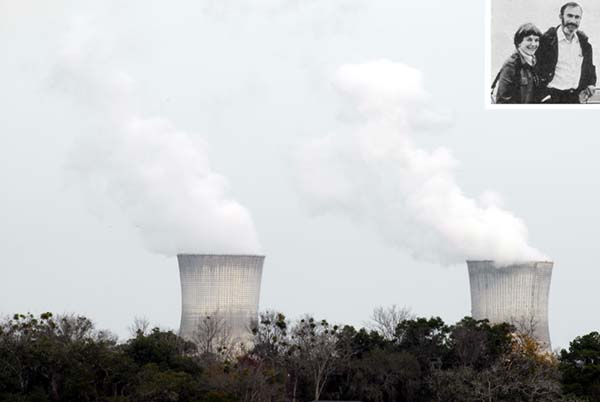
Paul Ehrlich (Bing Professor of Population Studies and
Professor of Biological Sciences, Stanford University) and Anne
Ehrlich (Senior Research Associate, Department of Biological
Sciences, Stanford) are familiar names to ecologists and
environmentalists everywhere. As well they should be. Because it
was Paul and Anne who — through their writing and research
— gave special meaning to the words “population,”
“resources,” and “environment” in the late 1960’s. (They also
coined the term coevolution, and did a lot to make ecology the
household word it is today.) But while most folks are aware of
the Ehrlichs’ popular writing in the areas of ecology and
overpopulation (most of us — for instance — have read
Paul’s book The Population Bomb ) . . . far too few
people have any idea of how deeply the Ehrlichs are involved in
ecological research (research of the type that tends to be
published only in technical journals and college textbooks).
In this installment of their regular Ecoscience column they discuss the Three Mile Island nuclear accident and what it revealed about the nuclear power industry.
Now that the dust and radioactivity have settled, and the laborious and dangerous cleanup
is underway, it’s time to take a look at
the lessons that can be learned from the near disaster at Three
Mile Island.
A Frightening Story
While the details of the complex accident are still not
entirely understood, its basic outline is fairly clear. A section
of the auxiliary system that was designed to supply cooling water
to the reactor core in case of failure
of the primary pumping system had been
removed from service by the closing of valves so that repairs
could be made. However, through human error the valves weren’t
reopened after the repairs were completed, leaving the
backup system cut off from the main system. Before this mistake
was discovered, an unrelated breakdown of the primary pump (which
is a fairly common occurrence) cut off the flow of cooling water
to the reactor core.
The pump of the auxiliary system started up as programmed but
could not supply water to the primary system because of the
closed valves. Sensors detected the problem and “scrammed” the
reactor (in other words, the neutron-absorbing control rods were
immediately inserted all the way to stop the chain reaction).
This action, however, did nothing to solve the problem of
disposing of the residual heat of radioactivity in the reactor
core . . . the problem on which the whole subject of emergency
core cooling systems (ECCS) is focused.
You may recall from previous columns in MOTHER EARTH NEWS that the heat present in a scrammed
reactor core is, under most circumstances, capable of building in
less than a minute to the point where the core starts to melt . .
. after which a complete meltdown is probably inevitable. The
mass of molten fuel then would melt through the floor of the
containment building and could, under some conditions, release an
enormous inventory of radioactivity above ground. The result
would be the kind of accident that, under the worst conditions,
is potentially capable of killing thousands of people immediately
and hundreds of thousands more by delayed cancers, while making
state-sized areas uninhabitable.
After the TMI reactor scrammed, mechanical failures
exacerbated the problem initiated by the original human error
(the failure to reopen the valves on the secondary system . . .
which was not corrected until a full eight minutes after the
start of the accident): A pressure-release valve stuck open, and
a gauge that was supposed to register the level of water around
the core malfunctioned. . . showing more water than was actually
present (a condition astonishingly similar to that portrayed in
the movie The China Syndrome ).
Such mechanical problems, however, need not concern us. The
crucial fact is that the reactor operators fixated on the single
malfunctioning instrument and repeatedly switched the emergency
core-cooling systems on and off —
attempting to control a water level that was being erroneously
reported to them by the faulty gauge —
while they simultaneously ignored numerous other instruments that
were reporting an overheating core.
In actuality, the operators were permitting the water level to
drop repeatedly (thus exposing part of the core) and then turning
the ECCS back on (partially reflooding the core). Through pure
dumb luck, there was sufficient steam around the core to cool it
enough to prevent a meltdown. A further crucial bit of luck was
the discovery that the auxiliary feed water system had been
valved off. If this realization had been delayed by only a few
minutes, the chance of a meltdown occurring would have been even
more probable.
Even with all that good fortune, the zirconium alloy cladding
on some of the fuel rods melted, split, and reacted with the
water to produce hydrogen. Some 10 hours after the initial pump
failure, a hydrogen explosion occurred, stressing the containment
building to about half its tolerance.
The whole affair was a very close call indeed, according to
Robert Budnitz (Deputy Director of the Office of Nuclear
Regulatory Research of the Nuclear Regulatory Commission) when he
spoke at the Lawrence Berkeley Laboratory on October 19, 1979.
After about 15 hours of mishandling of the accident, analysts
from the NRC, the utility, and the reactor manufacturer finally
realized what was being done wrong. They then instructed
operators to turn the ECCS on permanently . . . and started the
sequence of events that ultimately brought the reactor under
control.
Even that sequence was not without its thrills, though . . .
as operators tried to determine whether there was sufficient
hydrogen in the system to cause another explosion that would
breach containment and release the lethal load of
radioactivity.
Justifiable Fears
Perhaps Three Mile Island’s first lesson is that the concerns
which many of us have expressed about the safety of nuclear
reactors are fully justified. A disaster that could have made
much of eastern Pennsylvania (possibly including Philadelphia)
uninhabitable and killed great numbers of Americans was
prevented, largely by luck. Only a moron would be reassured by
the fact that it didn’t happen, and the nuclear establishment’s propaganda is clearly falling mostly on deaf ears. The second
lesson that’s been learned is that our concern about the
competence of utilities to run plants as complex and dangerous as
light-water power reactors is also fully justified.
The reactor operators, as the report of the President’s Kemeny
Commission detailed, were not remotely qualified to deal with the
problems confronting them. The conditions of reactor operator
training, it turns out, were more primitive than even the most
cynical critics Imagined. With millions of lives and billions of
dollars’ worth of equipment in their hands, the operators are
paid a maximum of $35,000 per year (about half the salary of a
senior jet captain) and receive infinitely less training than,
say, a pilot of a top-of-the-line jetliner who’s entrusted with
“only” a hundred or so lives and an apparatus worth a few million
dollars.
The operators do not, for example, get recurrent simulator
training such as an airline pilot receives. Every six months a
pilot is thoroughly checked out, either in a real airplane or an
extremely effective simulator, for his or her ability to handle a
wide variety of emergency situations: engine failures on takeoff,
for example . . . complicated by simultaneous fires, instrument
malfunctions, and so on. The pilot is expected to handle the
entire sequence of such emergencies flawlessly.
It’s integral to the training of all pilots, from private
through holders of air transport ratings, who operate under
instrument flight conditions that they learn never to depend on
the reading of a single instrument . . . or even of
two-instruments. Such pilots are intensively trained to evaluate
the condition of the aircraft and its position by continuously
cross-checking a variety of instruments which operate on
different principles. Learning to expect and detect instrument
failure is part and parcel of pilot training.
Had the nuclear reactor operators been trained to even
one-tenth the competence of a 727 pilot, Three Mile Island would
have been just one more incident in the thousands that occur
annually in the reactor industry, rather than a close brush with
calamity.
Inadequate Monitors and Civil Defense
Another lesson learned from the near-disaster is that the
instrumentation and procedures for monitoring releases of
radioactivity from nuclear power plants are wholly inadequate. It
has proven impossible to ascertain the scale of radioactive
releases in the course of the Three Mile Island accident or the
geographic pattern of the resultant fallout. Therefore, the
dosage received by the surrounding population can only be guessed
at. (Fortunately, all the estimates are quite low.)
In addition, the TMI accident demonstrated the hopeless
inadequacy of the civil defense apparatus that’s depended upon to
evacuate people from the vicinity of nuclear plants in case of a
large release of radioactivity (as would follow a full-scale
meltdown). The plans for evacuation made during the crisis were
sketchy at best, and the apparatus for implementing them was
wholly incapable of carrying out the task rapidly enough to
reduce significantly the expected loss of life.
But perhaps most frightening of all was the attitude of the
Commissioners of the NRC during the course of the drawn-out
emergency. Roger Mattson (Director of the Division of Systems
Safety, Office of Nuclear Reactor Regulation, and one of the top
NRC people on the scene of the accident) urgently recommended
that evacuation be initiated immediately, as evidenced by taped
excerpts from his phone reports to the Commission:
“It’s a failure mode that has never been studied. It is just
unbelievable . . . . My principle concern is that we have got an
accident that we have never been designed to accommodate, and
[the situation] is — in the best estimate
— deteriorating slowly . . . the most
pessimistic estimate is [that it’s] on the threshold of turning
bad. And I don’t have any reason for not moving people …. I
don’t know what you’re protecting by not moving people . . . . I
think we ought to be moving people.”
Yet the reaction of the Commissioners was clearly to worry
about what an evacuation would do to the “credibility” of the
nuclear industry. They should, of course, have been
— purely and simply
— concerned with the balance between
social disruption (including the probably small, if any, loss of
life that would accompany an evacuation) and the potentially
catastrophic loss of life had the reactor melted down.
It seems clear that, considering the information available at
the scene, the proper move would have been to evacuate . . . even
though luck prevented a total meltdown. The position of those who
claim otherwise is equivalent to that of a school bus driver who
knowingly coasts down a long, winding hill without any brakes,
battering the children as he or she careens around curves, and
then at the bottom says, “See, it was all right. None of them got
killed, so there was certainly no reason to let them out at the
top of the hill.”
A Beneficial Nightmare
Overall, though, the long-range effects of the Three Mile
Island accident should prove to be beneficial. Although the exact
degree of injury to the general public is unknown, it almost
certainly was small, especially in comparison to what it could
have been. Attempts will now be made to upgrade the
qualifications, training, pay, and prestige of people who become
nuclear reactor operators . . . as well as to improve the means
of monitoring their performances.
Reactor control room simulators do exist, and could be easily
integrated into a program of recurrent training similar to that
now required of airline pilots. Indeed, there are many
similarities between the two jobs . . . not the least of which is
pointed out by a description of flying —
commonly quoted by pilots — as “many hours
of boredom punctuated by moments of sheer terror”. Both pilots
and reactor operators earn their pay in those moments of sheer
terror . . . and the next time, we hope, the latter group will be
up to their task.
Similarly, there’s some sign that other aspects of reactor
safety will be tightened up, emergency evacuation plans
developed, and the NRC restructured so that there’s an
improvement in its overseeing functions. (However, it seems
unlikely that political pressures will be eased enough to let the
NRC do its job really well.) Indeed, even the Kemeny Commission
report made every attempt to soft-pedal the numerous mechanical
flaws in the power plant, while emphasizing the fumbling actions
of the operators and the bungling of the NRC.
Many experts, for example, insist that all TMI-type Babcock
and Wilcox reactors should be taken off line immediately until
their steam generators can be replaced with those of a design
less sensitive to the kinds of events that took place at Three
Mile Island. It would be an enormously expensive modification and
would undoubtedly involve considerable discomfort to the public
in some areas where the supply of electricity would be reduced .
. . but the alternative, in the opinion of some experts in the
field, is an unacceptably high risk of meltdown. Yet at this
writing it appears that such plants will be allowed to continue
to function without modification.
Perhaps the greatest benefit from the Three Mile Island
accident, though, will be a general weakening of the public’s
confidence in nuclear power and the development of more healthy
cynicism about the statements of members of the nuclear
establishment.
Although a barrage of misstatements and lies are now being
circulated to the effect that the accident proved how safe the
reactors are, it’s clear that most of the general public is no
longer fooled. Realization is spreading that, at present, the
safety of light-water power reactor technology is hopelessly
inadequate and that the most prudent course of action would be to
phase out such reactors as rapidly as is consistent with public
safety and welfare.
Reactor safety is, of course, only one of the reasons for
moving away from fission as a major source of energy. The others
include the waste problems and — much more important — the problems of nuclear
proliferation (the ways in which such power plants contribute to
the spread of atomic weapons to countries and sub-national
terrorist groups), plus the problem of overcentralization of
energy technology . . . issues that we’ll discuss in future
columns.
But as it stands now, it would seem that Three Mile Island was
a colossal disaster for those who would promote nuclear power
without any long-term view of human needs and a considerable
bonanza for the rest of us who would like to see a sustainable
society established on this planet.
More details on the Three Mile Island accident can be
found in “Kemeny Report: Abolish the NRC”, Science, vol. 206,
November 19, 1979, page 796. A nice summary of the problem of
inadequate operators can be found in the Wall Street Journal,
October 22, 1979.
For a description of the design of nuclear reactors and an
overview of nuclear power, see Ecoscience: Population, Resources,
Environment by Paul R. Ehrlich, Anne H. Ehrlich, and John P.
Holdren (W.H. Freeman and Co.).
We would like to thank Professor John Holdren of the
Energy and Resources Group, University of California, Berkeley,
for once again lending us his expert judgment on issues related
to nuclear power.