

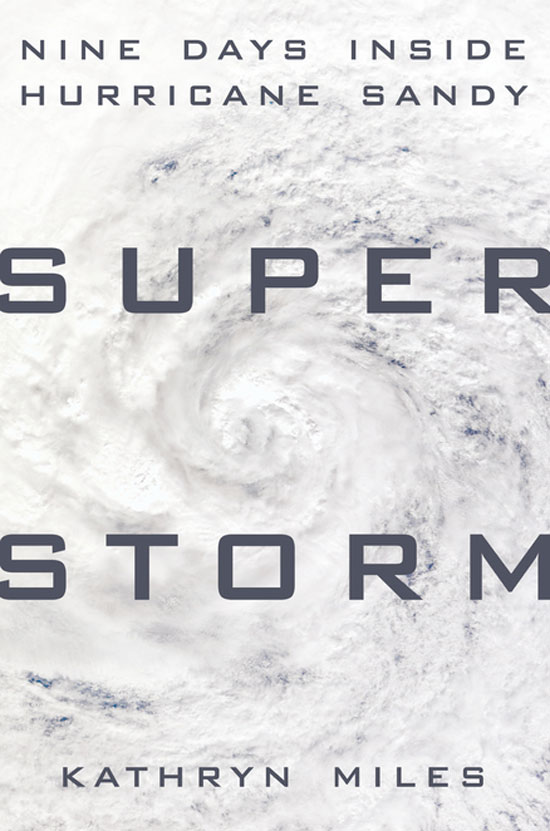
In Super Storm (Penguin Group, 2014), acclaimed journalist Kathryn Miles takes readers inside Hurricane Sandy—which became the largest Atlantic hurricane on record when it hit in October 2012—to delve into the physical damage of a highly destructive storm, and to get a glimpse into some internal weaknesses that left many American cities unprepared and in danger.
Our weather satellites are crumbling. Funding for staff and technology has been diverted. The computer systems that predict storms are vulnerable to hackers. And “horrific hurricanes,” as Newsweek wrote, are “the new normal.” Nine out of 10 of the costliest U. S. Atlantic hurricanes in the last century have occurred within the past 15 years. Property damage from those storms has been valued at $294.5 billion. Hurricane Sandy alone cost $65 billion in damage.
Superstorm Sandy showed us that everything we thought we knew about seasonal weather and storms was wrong. Miles takes readers inside the maelstrom to tell this epic story of nature’s power as it played out, hour by hour, over nine days, eventually affecting nine countries and twenty-four U. S. states. Based on extensive interviews, Miles details the anguish of dedicated professionals at the National Weather Service—along with the science they live by—as the drama unfolded.
Landfall
The sky was lit by a full moon that night, but no one could see it. Everything—the enormous harvest moon, the stars, the horizon—had been consumed by cloud. The storm was so immense it caught the attention of scientists on the International Space Station, who stopped what they were doing and peered out their windows. From there, the cloud cover seemed almost limitless: 1.8 million square feet of tightly coiled bands so huge they filled the windows of the station, so thick they showed only the briefest insinuation of an eye. It was the largest storm the planet had ever seen—a storm big enough to consume the entire Eastern Seaboard and beyond.
It had already wreaked devastation in the Caribbean, taking lives and destroying families. Now the storm was marching up the Atlantic, turning the ocean into unimaginable chaos. Waves the size of a two-story house collided against one another, exploding in foam and fury and blocking everything else from view as millions of pounds of water rose and crashed and fell, only to rise again. Those same waves fueled the machine that created them, sending more and more moisture into the storm’s core, where energy exploded with the force of a nuclear bomb. Gale-force winds rose and then spread out for 870 nautical miles, threatening everything in their path. The system was growing.
Nightfall came by imperceptible degrees. The wind and rain did not. They were soon punctuated by an omnipresent moaning: a kind of dark, low hum that made it seem as if the entire world was haunted. Within minutes, that moan became a constant, pervasive shriek as gusts of 90 miles per hour were recorded everywhere from Washington, D.C., to New York City. Barometers plummeted to unseen lows, heralding the force of the storm. So, too, did the apocalyptic precipitation that began to follow: almost thirteen inches of rain in Bellevue, Maryland; nearly six in Cleveland, Ohio. Twenty inches of snow fell in places like Kentucky and Newfound Gap, a low pass in the Great Smoky Mountains that divides North Carolina and Tennessee. In West Virginia, more than three feet of snow fell near the town of Richwood, collapsing roofs and collecting into barricade-like drifts six feet tall.
At the National Zoo in Washington, D.C., keepers scrambled to corral their charges inside, wrangling elephants and clouded leopards, the facility’s iconic pandas, and even a spindly, two-week-old dama gazelle. As they did, the storm turned inland, fixing a bead on the mid-Atlantic coast. Heralded by hurricane-force winds, the storm announced its arrival long before it made landfall, knocking down power lines and exploding transformers. A woman in Toronto was killed when a large illuminated sign pulled from its supports, then plummeted thirty feet to the ground. An eight-year-old Pennsylvania boy died when a tree fell in his Franklin Township yard. Not long after, an enormous oak fell through a home in North Salem, New York, crushing two best friends, ages eleven and thirteen, but leaving the rest of the home’s occupants unharmed.
And still the storm continued its relentless beat to shore, charging across three hundred miles of open ocean, picking up strength with every step. Meteorologists and scientists, officials and emergency managers stood baffled: What was this thing? By the time many of them decided, it was too late to issue warnings, too late to persuade millions of people their lives were in danger.
Gusts rose to 83 knots, building the waves higher, blowing off their tops and sending cataracts of salt water through the air for miles. Across Manhattan, those residents who resisted the call to evacuate struggled to walk down rain-swept streets, where litter tornadoed around telephone poles and newspaper kiosks. Awnings sheared off of storefronts and took flight. Flags stood straight and solid; trees rippled as if suddenly liquefied. Nearly a thousand miles away, spray from twenty-foot surf on Lake Michigan crashed onto Chicago museum- goers and commuters. At the international airport in Gary, Indiana, 50-mile-per-hour winds grounded planes. Hundreds of stranded passengers sat packed in terminals from Baltimore to Oklahoma City—and beyond.
By 6:00 p.m. that evening, three million people were without power, most of them in Manhattan and the surrounding boroughs. The lights went out on Broadway. Wall Street ground to a standstill and would remain closed for two days—the first time weather had shut down stock markets for consecutive days since the Great Blizzard of 1888. Out on Ellis Island, the Statue of Liberty—whose newly renovated crown had reopened to visitors just one day before—lost her torchlight and went dark.
At New York University’s Langone Medical Center, hospital officials were certain their patients would be safe, despite the deteriorating conditions outside. But the facility’s backup power system soon failed, shrouding the eighteen-story complex in blackness and requiring the evacuation of three hundred patients into a caravan of ambulances that extended blocks down rain-torn streets. The first to emerge from the darkened hospital were twenty infants from the neonatal intensive care unit, each one cocooned in blankets and heating pads and carried down nine flights of stairs by nurses, administrators, and maintenance workers. They worked by flashlight and feel, delivering first the babies and then the most critical patients, some of whom weighed well over two hundred pounds. They moved silently, synchronized, and often arm in arm, working together in teams of five or ten and stopping frequently to check breathing tubes and vitals. The only audible sound, some would report later, was that of the growing wind and surf. Waves so big they hardly seemed real rolled through streets. It was like being in a movie, said the staff, only much, much scarier.
That same surge swamped beaches and shoreline from Florida to Nova Scotia. It sank boats in Bar Harbor, Maine, and swept as far inland as Albany, New York—nearly 150 miles from the coast.
And then the storm itself arrived.
It hit land like . . . what? Like a freight train or an atomic explosion or an alien invasion? People tried to find a comparison, but everything fell short. It was a hurricane that wasn’t a hurricane. A superstorm. And as it hit like whatever it was, the storm sheared away sections of Atlantic City’s iconic boardwalk before inundating the streets with a wall of wave eight feet high. Within minutes, more than 75 percent of the city was underwater. Sixty miles away, in Seaside Heights, the storm ripped the Jet Star Roller Coaster—a massive structure with seventeen hundred feet of steel track and fifty-foot drops—from its pier and relocated it in the ocean shallows. It swept entire houses from their foundations and pulled cars into the surf. In Fall River, Massachusetts, the storm peeled away roofs and flooded Battleship Cove. In New London, Connecticut, it pulled the town’s iconic bathhouse from its pilings and left in its place a household stove, along with cords of splintered timber. The weather station atop New Hampshire’s Mount Washington registered gusts of 139 miles per hour.
Back in Manhattan, seawater poured down stairs and vents into subway stations, filling tunnels from track to ceiling. At the NYU medical center, the most critical patients had been safely evacuated, but thousands of animals used for medical testing had not. More than ten thousand mice and rats, many of which had been genetically altered for cancer and mental illness research, drowned in their basement cages. Seven thousand trees fell in New York City parks. More than sixty-five thousand boats were destroyed in New York alone. The city, one meteorologist said, was living its own worst-case scenario.
The force of the wind and sea exploded electrical transformers and caused massive fires that destroyed both fin de siècle mansions in Old Greenwich, Connecticut, and more than one hundred working-class homes in Queens. Other damage created a kind of cruel carnivàle: As the storm marched across the region, it neatly piled sailboats at the end of a dry pier and left floating taxicabs in their slips. It relocated a fishing vessel onto railroad tracks and pushed pickup trucks into backyard pools. Dining rooms filled with sand. Flood waters plucked the New York Aquarium’s resident three-foot American eel from its tank and deposited it, unharmed, in a staff shower stall.
But those were the easy stories. Most were far more grim.
More than ten feet of salt water flooded the low-lying areas of Staten Island. There, neighbors banded together and decided to make a last-minute run for it. They set out down their street, but were soon stopped by a wave of dark water bearing down on them. They turned and raced the opposite way, only to stop dead in their tracks. An angry wall of water was coming from that direction, too. It snaked, leapt, spun and crashed, picking up bits and pieces of people’s lives: toilets and kitchen sinks, pianos and sewing machines, lawn mowers and bicycles, porches and chimneys. Jack-o’-lanterns bobbed their way through the storm-churned water by the hundreds, a parade of ghoulish faces amid the chaos.
There was no escape.
The waves continued to grow, cannoning through windows and doors and deluging homes. Within minutes, that water was lapping at attic floors.
In the Oakwood neighborhood, two men sought shelter on the second story of a home after their car stalled on the street below.
Within minutes, floodwater was above their chests. They jimmied open the attic window and looked into the surge of water, now at eye level. A car floated by, then a Dumpster. And then—what was that? The roof of an entire house. Still attached to the house. The whole damn thing was floating on the angry tide. They agreed to take a chance. On three, they leapt out the window and onto the floating roof. There, they dug their nails into the shingles, trying not to get dizzy as the building spun its way through the crashing water.
Not everyone was so lucky.
The same rising sea caught several elderly people unawares and trapped them in their homes. The residents screamed for help, but neighbors couldn’t reach them: The waters were just too high, too fast. The bodies of the trapped would be found floating in living rooms and bedrooms days later. So, too, would the body of an off-duty police officer who relocated his family, including his fifteen-month-old son, to their attic before retreating back downstairs to secure the rest of the house. The family waited for hours, but he never returned. Another father and son were found in their basement, their bodies locked in a tight embrace, the dead father’s arms still shielding his son’s head.
In Tottenville, Staten Island, a family of three who had been robbed during Hurricane Irene also chose to remain in their home, despite the evacuation orders. As they finished dinner, the waters began flooding their house, lifting the dining room from its foundation and eventually shearing it away. They ran to their second-story master bedroom, but within minutes the water began pouring in through the windows and doors there as well. They retreated to the bathroom, where the mother and her thirteen-year-old daughter clung to the sink faucet as storm water lapped at their chins. And then the entire wall of their house gave way, pouring them out into the churning surge. Waves tore them from each other. The mother called—no, shrieked—her daughter’s name, but the plea evaporated in the roar of water. She kept calling, clinging to the sink, flinching each time another house slid into the waves. Hours later, she was deposited on a pile of debris. She was severely hypothermic but otherwise unharmed. It would be days before the bodies of the father and daughter were found.
As news of the rising water began to intensify, another mother bundled her two boys, ages two and four, and tucked them into their car seats, then set out for a family member’s house in Brooklyn. She thought she was doing the right thing—keeping her boys safe. But their SUV was soon overtaken by swell. The car stalled. Water began to pour in. She struggled with her seat belt, slipped into the back and wrestled both boys out of their car seats, took a deep breath, and crashed into the surge. The waves were unrelenting. They crashed upon her, pulling the mother and boys down. She clung more tightly. The waves kept coming. And then the biggest one of all struck. It tore the boys from her arms before sweeping her away, too. She clung, first to a tree, and then to the hope that someone would help. But no one would answer their door—no one would take that risk, no matter how much she begged and cried. Exhausted, she collapsed on a stranger’s porch and waited until daybreak, then walked the flooded streets until she found a police officer. Days later, the bodies of the boys were found less than twenty feet from each other, tangled in reeds and debris in a marsh at the end of a dead-end street.
. . .
On average, about six hurricanes develop each year. Fewer than two of them strike the United States. Major storms—storms with winds greater than 110 miles per hour—occur even less frequently: one every eighteen months, give or take. The chance that one of those storms will strike New York City is 3.2 percent. None of these statistics mattered at all with Superstorm Sandy. There was no precedent, no authoritative model or soothing data to help make sense of what was happening. The world had simply never witnessed a storm like this one.
Barometric pressures that day, October 29, 2012, were the lowest ever recorded north of the Carolinas. Surge levels were their highest. And the damage wrought by this storm was immense. Sandy damaged or destroyed a million homes. More than half of those were in the United States, located in a damage area roughly the size of all of Europe. Nearly nine million households were without power from South Carolina to Maine. Rain from the storm reached as far west as the Dakotas and as far south as Texas. Thousands of acres of shoreline were severely eroded. By the time Sandy dissipated somewhere over western Pennsylvania, at least 147 people had lost their lives in places as far-ranging as Jamaica and Canada.
This storm—this superstorm—wasn’t supposed to be that deadly. And it certainly wasn’t supposed to make landfall in the most populated region of North America. Nor was it supposed to morph into a monstrous hybrid the likes of which our oceans had never born. And that’s what was so terrifying about this storm. Hurricane Sandy broke all the rules.
Its story began just more than a week before it made landfall.
Reprinted with permission from Super Storm: Nine Days inside Hurricane Sandy by Kathryn Miles, and published by the Penguin Group (Dutton), 2014.






