

The Seasonal Almanac shares astronomical events in April and May 1996. Brilliant Venus will actually cast shadows in May.
The Seasonal Almanac: Events for May 1996
Venus is the brightest point of light in
the heavens. But this spectacular planet is fairly close to
the Sun in space and therefore always appears fairly close
to the Sun in our sky. We are lucky when Venus is visible
for more than an hour or two before sunrise or more than an
hour or two after sunset. And this spring we are luckiest
of all: in its eight-year cycle of recurring appearances,
this is the spring that Venus soars to its highest in the
evening sky. As April begins, the brilliant “evening star”
hangs halfway up the southwest sky at sunset and does not
itself sink below the horizon until about four hours later.
A bonus for Venus watchers occurs at the start of April. On
April 2 and 3, Venus is skimming right along the edge of
the loveliest of all star clusters, the Pleiades, or “Seven
Sisters,” cluster. Although the cluster is usually easy to
see with the naked eye, the brilliance of Venus may so
overwhelm its stars that we’ll need binoculars to spot them
plainly. The next few nights, no optical aid should be
required to view the wonderful little grouping of
sapphire-like stars being left behind by the peerless
diamond of Venus.
Venus is noticeably lower at sunset by early May, but to
make up for this, the planet gets even brighter. The
maximum brilliance of Venus is almost unbelievable,
especially as seen from a rural site, where Venus is even
capable of casting shadows in a very dark location. Try to
see how soon before sunset each day you can first glimpse
Venus. On days of deep-blue sky, the planet can even be
found in the middle of the day with the unaided eye!
The final weeks of May bring us the drama of Venus
appearing appreciably lower with each passing night. At the
start of May, Venus sets over three and a half hours after
the Sun, but by the end of the month, only about one hour
after. And if you have a small telescope or even a pair of
binoculars you can hold steady, there is another wonder of
Venus to behold: the changing phase of the planet. Venus is
a planet closer to the Sun than Earth is, and it displays
to us phases like the moon does (fully lit globe of Venus,
half-Venus, crescent Venus … ) Of course, normally you
need a fairly good telescope to detect these phases. But in
May, Venus is approaching unusually close to Earth (not
dangerously close, don’t worry!). So even binoculars may
show it as more of a long, skinny crescent than as the
simple point of light it looks like to the naked eye.
A Total Lunar Eclipse for the Eastern U.S.
Not since 1993 has the Earth experienced a total eclipse of
the Moon. On April 3, 1996, however, the Moon rises just in
time for the northeastern United States to see the start of
the total part of such an eclipse. In the southeastern
United States and across the Midwest, the Moon comes up
with the Earth’s “umbra,” or central shadow, already
completely covering the Moon. From the Rockies, viewers see
the umbra already moving off the Moon, and Pacific Coast
observers are left with only the slight stain of Earth’s
outer shadow, the “penumbra,” on the Moon when it rises.
The rising Moon often looks dimmer and more orange due to
haze down near the horizon. But as people in the eastern
half of the country see this Full Moon of Wednesday April
3, get higher, they will know that the Moon is more
unusually darkened and colored. No one can predict exactly
how dark the Earth’s shadow is in the different parts the
Moon goes through during an eclipse, or what colors are in
various parts of that shadow. But this eclipse will prob
ably be a moderately dark one, especially near the Moon’s
northern edge around mid-eclipse–7:10 P.M. EST. The
sky won’t be fully dark by then even in New England. But
the total portion of the eclipse doesn’t end until 7:53
P.M. EST, and the last bit of umbra slides off the Moon at
8:59 P.M. EST.
Fortunately, all of the United States will be suitably
positioned to see the entire total eclipse of the Moon we
will get on the evening of September 26, 1996. That eclipse
occurs at Harvest Moon and the planet Saturn will shine
beautifully at its brightest very near the dimmed and
reddened lunar disk.
Azaleas and Rhododendrons
While lunar eclipses bring added color to the night sky, we
don’t have to look far to find hues of all kinds in the
birds and the flowers of April and May. Even regions whose
soil does not support many kinds of plant life still may
support a few unusual plants. For instance, if your soil is
naturally very acidic, perhaps because you live in or near
pine forests, then you should have little trouble growing
the fascinating flowering plants called azaleas and
rhododendrons.
The yellow blossomed forsythia also likes acidic soil, and
if you live in the northern United States you may see their
blooms linger through much of April. But May is the
greatest month of flowers in most of the United States and
it is then that many of the azaleas and rhododendrons reach
their peak.
The flowers on azalea bushes are trumpet-shaped and as such
a favorite feeding-place of hummingbirds. (Watch your
May-blooming azaleas for ruby-throated hummingbirds hovering
and inserting their long tubelike beaks into the flowers
for nectar to help sustain them on their northward
migration.) The most common azalea colors are pink, purple,
and white, but further breeding has produced red, gold, and
orange. The blossom sizes range from small thimbles to
palm-filling bells.
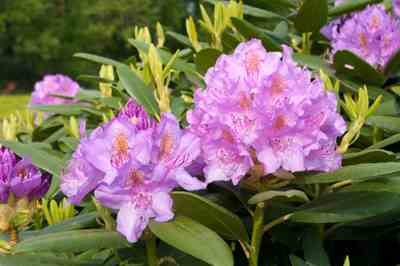
The rhododendron is perhaps even more interesting, if no
more beautiful, than azaleas. Some “rhodies” blossom in
summer. Their most common colors are white and purple,
though again special breeding has produced other lovely
hues. The rhododendrons are clearly related to the
wild-growing mountain laurel, itself beautiful enough to be
honored as a state flower. But the most fascinating feature
of rhododendrons is the temperature behavior of their
leaves, which enables us to use them as natural
thermometers. The greater the angle of uplift in the
rhododendron leaves, the higher the temperature.
The leaves stay on the plant all year and it is quite
remarkable on the coldest winter days to see their long
forms closed up (looking almost like bean pods) and
pointing straight down. In winter, when you wake up in a
warm house, you can glance at the rhododendrons and
estimate whether the air outside is 30 degrees Fahrenheit or 10 degrees Fahrenheit.
In May and June, the lovely widespread flower clusters may
distract, but you can still notice just how chilly the dawn
is or see if the day is one of those throwbacks to early
spring which still creep in even when summer is at the
doorstep.
When Do We Hold Easter?
For the past 10 years, most Americans have made the clock
change from Standard to Daylight Saving Time on the first
Sunday in April–which this year happens to be Easter.
But what is the rule for when Easter occurs? Ideally, the
system for determining the date of Easter is as follows.
Take the date of the spring equinox (the start of spring).
Then find the first full moon either on or after that date.
Easter is the first Sunday after the day of that full moon.
(Easter can never occur on the day of a full moon.)
However, there can be departures from this ideal system.
For instance, church authorities decided to accept the date
of spring equinox as March 21. But, as astronomers tell us,
the equinox can actually fall on March 19, 20, or 21 in our
era of history, depending upon slight variations of Earth
in its orbit and upon leap years (for instance, this year
having a leap day at the end of February made the spring
equinox fall in the opening hours of March 20 for the
continental United States, and not on March 21 anywhere.).
In practice, therefore, the date of Easter is actually
determined by special formulas, such as the table of Golden
Numbers in the prayer book. When all is said and done, the
earliest that Easter can occur is March 22 (if the full
moon occurs on March 21 and March 21 is a Saturday) and the
latest Easter can occur is April 25 (if the full moon is on
March 20 and April 18 is a Sunday).
The last time Easter occurred on March 22 was in 1818; the
next time will not be until 2285! In the year 2009, Easter
will take place as early as March 23 for the first time
since 1913. The last time Easter occurred on April 25 was
1943, and the next time will be in 2038.






