


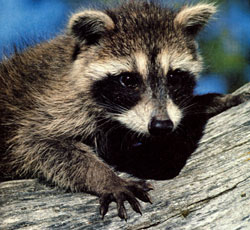
The ever-adaptable raccoon is comfortable in rural or urban settings. Raccoons are spreading to the east and with them comes the threat of rabies.
Raccoons and Rabies: An Eastern Urban Threat
Most people think of dogs, skunks, and bats as the primary
carriers of rabies (once commonly known as hydrophobia because of its victims’
apparent fear of water), but this dreaded viral disease can infect most any
mammal and, if untreated, guarantees a slow, painful, very messy death.
The good news is that the traumatic series of 13 injections
in the stomach required for persons bitten by animals suspected of being rabid
has been relegated to history along with other medieval tortures. Instead,
medical science has recently given us a prophylaxis that’s 100% effective when
administered promptly, and, best of all, requires only five injections (plus
one or more injections of serum globulin) in the arm rather than the stomach.
The not-so-good news is that, with the recent and drastic
increase in the population of raccoons in Washington and other eastern cities,
the threat of raccoons and rabies has increased dramatically throughout the mid-Atlantic
area.
One researcher who is closely monitoring this epizootic (an
epidemic among animals) of raccoons and rabies is Dr. Suzanne Jenkins, assistant
state epidemiologist for Virginia and a veterinarian epidemiologist with the
Centers for Disease Control in Atlanta. Dr. Jenkins points out that rabies is
always with us, generally dozing but rousing from time to time to cause a
ruckus. The current outbreak among urban raccoons began with a single case in
West Virginia in 1977 and spread rapidly to Virginia, Maryland, Pennsylvania,
and the District of Columbia. During the past decade, the numbers of rabid
raccoons found in the mid-Atlantic region are increasing (see the chart in the image gallery).
As the numbers in the chart show, the epizootic peaked in 1983 and has
been gradually decreasing since. Still, 665 verified cases of raccoon rabies
during the first six months of the past year are nothing to sneeze at, and
suggest that the total for 1986 will exceed that for 1985, reversing the
decline. The outbreak appears to be rolling like a wave northward, and even as
the mid-Atlantic epizootic ebbs somewhat in its southern extreme, the incidence
of raccoon rabies in Pennsylvania and other north-eastern states is on the
rise. Meanwhile, Florida is the center of a separate mini-epizootic that’s more
tenacious (it’s been around for a quarter of a century or so) and less urban.
In spite of their numbers, rabid raccoons rarely pose a
direct threat to humans. Dr. Jenkins and her associates worry most about cats
and dogs that haven’t been inoculated against rabies contracting the disease
from infected raccoons and passing it on to their owners. “It’s a real
problem for health professionals and animal control agencies,” says
Jenkins. “We can’t reassure the public that we have things under control,
because we don’t. As yet there’s no direct control method for raccoon rabies.
Research teams in several areas are working to find a way to protect wildlife
with an oral rabies vaccine placed in bait, but–though preliminary results are
encouraging–this approach doesn’t promise to provide a remedy in the near
future.”
What can people living in high-risk areas do to protect
themselves, their families, and their pets from the threat of rabies? “Our
current thrust,” Dr. Jenkins says, “is to convince people to have
their pets vaccinated against rabies and to leave wild animals alone–to avoid
feeding raccoons or allowing them to get into garbage containers, and to
discourage the animals from nesting in residential areas. But even with all the
publicity we’ve generated concerning this problem, people still find and adopt
baby raccoons, or pick up what they think is an injured animal and get bitten
and possibly infected with rabies.”
If you or a member of your family should be bitten by any
animal, wash the wound thoroughly and contact a doctor immediately. If the
animal is still lurking about, ask your local animal control authorities to
pick it up and examine it for rabies–which just might spare you a lot of worry
and needle holes.






