

This February won’t provide us with a
full moon, though the sky will compensate us in March with
the rare (and long-fabled) “blue moon.”
The time between
one full moon and the next averages (with very slight
variation) about 29 1/2 days. So there can never be two
truly full moons in February not even in leap year, when
February is still a half day too short. Our longer months,
on the other hand, can have two full moons. In fact, this
happens once every few years. When it does, the second full
moon of the month is called a “blue moon.” However, I
suspect that this definition of a blue moon came into being
in recent years or decades. The very much older phrase
“once in a blue moon” probably originated with an event
much more rare than a two full-moon month: initially, it
probably referred to those rare instances when the moon
literally looks blue.
What causes the moon and sometimes
the sun to look blue (or green or bronze) is a pall
containing particles of just the right size to
preferentially scatter the blue wavelength of moonlight or
sunlight. Such a cloud may be produced by widespread forest
fires or by vast volcanic eruptions. The only really
widespread and striking case of blue moon (and sun) in the
U.S. during this century was the one in September 1950,
which was visible across New York, New England, and part of
the Mid-Atlantic states. It was caused by Canadian forest
fires.
If you want rare, however, the pattern of a
two-full-moons-January, no-full-moon February, and
two-full-moons March is pretty rare. Instances of it can
never occur less than 19 years apart, but it doesn’t always
occur that often. This year’s instance is only the fourth
of the 20th century, and the last time it happened was in
1961. It won’t happen again until 19 years from now, in
2018.
Actually, I do need to qualify the above statements.
They are the correct years if you figure the exact times of
full moons in the astronomers’ worldwide time system,
universal or Greenwich time. This year’s episode of two
fulls, no full, two fulls happens in both universal time
and in American time zones. But that is not always true.
Nevertheless, whatever time zone you calculate these events
for, they average about one per generation.
Thrilling Months for the Planets
The two full moons of March will look more or less like any other
full moons. But in the west, at dusk, during this February
and March, there are sights not just of great intellectual
interest but also of great visual beauty. There is one of
the finest arrangements of moon and planets in years and
what is arguably the closest really visible conjunction
(meeting) of the two brightest planets in decades.
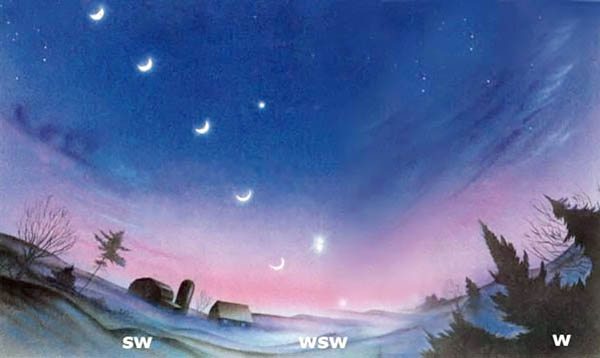
February
begins with the two most brilliant planets, Venus and
Jupiter, still about 22° apart. When we talk about
degrees in the sky, we mean fractions of the 180° of
the half circle or dome that we perceive the sky to be.
Thus, from horizon to overhead — halfway across the sky — is
half of 180°, which is 90°. You can measure these
“angular distances” in the sky by using your hand: your
fist held out at full arm’s length is, from your viewpoint,
about 10° wide.
Venus and Jupiter may start the month
over 20° (two fist widths at arm’s length) apart, but
the gap between them closes rapidly. Each night, they are
about a degree closer together, the brighter and lower of
the two, Venus, appearing notably higher and Jupiter
notably lower. Thus, at nightfall on February 17, they are
only 6° apart when a lovely crescent moon shows up
about 5.2° below Venus. The night after this line of
Jupiter-Venus moon, we see the moon leap up to the upper
left of Jupiter: the three great lights now form a
triangle, with Venus and Jupiter 5° apart, Jupiter and
the moon 4° apart, and the moon and Venus about 8 1/2°
apart. The additions of Saturn far to the upper left and
Mercury to the lower right make this scene even lovelier.
Each night thereafter, the moon moves higher and farther
left (east). But Jupiter and Venus keep getting closer
together. Each night, they are beautiful, but if your sky
is clear on February 23, you will see the two 0.15°
apart-almost close enough for their rays to be touching.
In
the final days of February and first of March, Venus keeps
getting higher, Jupiter lower, and Jupiter pulls fairly
near a new planet below and to the right of it, Mercury. On March 8, four of the five bright
planets are within 27 1/2° of each other in the west at
dusk (though Mercury has just about faded from view). In
the next two weeks, Venus nears Saturn and has a fairly
lovely conjunction with it. But there are two more planets
you should hear about for February and March.
One planet is
Mars. It rises in the late evening in February, a little
earlier in March. Mars will be unmistakable because it will
be brightening each week and its color (golden-orange)
becomes increasingly noticeable.
There is one more planet
to mention, the dimmest of them all. That planet is Pluto. For the past 20 years schoolchildren have had to learn
that formerly farthest Pluto was actually now slightly
closer to the sun than Neptune. Well, this 20-year period
ends on February 10, 1999. Pluto will once again be farther
from the sun than Neptune or any other now-known planet of
our solar system …for about the next 230 years!
Centennial of Cold
Maybe no American cold wave has been more shiver-inducing than the one that
occurred 100 years ago this February. When it entered the
lower 48 on February 11, it dropped temperatures to as low
as – 61°F in Montana. By the next morning, the Arctic
blast had rushed over the eastern plains and Texas,
bringing a low of -22°F to Kansas City and -8°F to
El Paso!
Twelve different states recorded their lowest
temperatures ever for any date in this cold wave (some of
the records set still stand). The third morning, February
13, brought the coldest weather ever recorded along the
Gulf Coast and parts of Florida: 6.8°F at New Orleans,
-1°F at Mobile, 7°F at Pensacola, and the all-time
Florida low of -2°F at Tallahassee. On the morning of
February 12, 1899, Washington, D.C., saw a low of
-15°F. But the great problem for the East was the
blizzard that was about to hit in the wake of the cold
wave. The “Great Eastern Blizzard of ’99” dumped 34 inches
of snow on Washington, D.C. — 20.5 inches of those on
Valentine’s Day. It also left buried beneath 41 inches of
snow the Victorian town of Cape in May, located at the
southern-most tip of New Jersey — setting a snow-depth record
that remains an all-time high for the Garden State.
Today
we are familiar with the undulatory nature of the jet
stream’s position and how its dips are typically just wide
enough to bring extremely frigid winter weather to most of
the U.S., while the rest of the country basks in unusual
warmth. The existence of the jet stream was not even
suspected back in 1899. Today, we can nod knowingly when we
hear that on February 18, 1899, the mercury in San
Francisco soared to 80°F.
You know a cold wave is
powerful when its icy touch reaches the southernmost United
States. Perhaps even more astonishing is when snow falls
and gathers in these parts of the country. Note especially
the storm that America’s greatest weather historian, the
late David M. Ludlum, called “probably the greatest
deep-snow anomaly in the recorded climate history of the
United States.” It occurred on February 14 and 15, 1895,
and dropped amounts the likes of which have yet to be seen
again in our southeastern states. Places in southwestern
Louisiana got up to 24 inches of snow; Galveston had 15
inches, New Orleans, eight. It even snowed at the very
mouth of the Mississippi River.
The King of Storms
Jupiter’s most recognizable characteristic
is its “Great Red Spot,” a massive (twice the diameter of
the earth) anticyclonic storm system that has persisted in
the atmosphere for over 100 years. Winds at the outer edges
of the storm reach 250 mph, while the center is very nearly
calm. The storm is massive enough to spawn temporary white
oval storms, which are 2000 miles or more in diameter and
rage for approximately 40 years. Despite close passes by
the Voyager and Galileo spacecraft,
scientists have no idea how the storm formed or why it
refuses to resolve itself.
What About the Wind Chill?
The lowest temperature ever recorded was
-128.6°F on July 21,1983, in Vostok, Antarctica. The
lowest average annual temperature is in Plateau Station,
Antarctica: a balmy -70°F.






