

Paul Ehrlich (Bing Professor of Population Studies and Professor
of Biological Sciences, Stanford University) and Anne
Ehrlich (Senior Research Associate, Department of
Biological Sciences, Stanford) are familiar names to
ecologists and environmentalists everywhere. As well they
should be. Because it was Paul and Anne who through their
writing and research gave special meaning to the words
“population,” “resources,” and “environment” in the late
1960’s. (They also coined the term co-evolution, and did a
lot to make ecology the household word it is today.) But
while most folks are aware of the Ehrlichs’ popular writing
in the areas of ecology and overpopulation (most of
us, for instance, have read Paul’s book The
Population Bomb) . . . far too few people have any idea of
how deeply the Ehrlichs are involved in ecological research
(research of the type that tends to be published only in
technical journals and college textbooks). That’s why it
pleases us to be able to present–on a regular
basis–the following semi-technical column on the immigration debate by
authors/ecologists/educators Anne and Paul Ehrlich.
Immigration in the Future
In our last column, we described the growing alarm that
many Americans feel over the ongoing “invasion” of this
country by illegal immigrants . . . mostly from Mexico.
During the mid-1970’s, reports carried in the popular media
claimed that as many as 12 million illegal aliens were
residing in the United States, with thousands more pouring
in daily. However, recent–and more carefully
compiled–estimates have put the number of such unlawful
residents at about four million . . . and indicate that the
flow–the actual volume of which remains undetermined–is
heavy in both directions.
Most illegals apparently come to
this country for temporary work, sending the money to
families left behind. They move back and forth across the
border, working here and returning home frequently to see
their kin. The underlying causes of the migration are the
poverty and lack of jobs in Mexico (roughly half of that
nation’s work force is unemployed or grossly underemployed)
and the availability of work at high pay (by Mexican
standards) in the United States.
A Danger to Human Rights
People who are strongly opposed to Mexican
immigration claim that illegals are taking jobs away from
American workers and that they are a huge burden on our
welfare system. But our studies, as well as those of other
students of the problem, indicate that neither of these
claims has much basis in fact. Still, although the nature
and size of this unauthorized influx have been distorted
and vastly overblown, a real problem does exist.
One central issue is that of human rights. People who come
to this country illicitly are particularly vulnerable to
exploitation and abuse. Because they fear exposure,
illegals can’t protest when an employer fails to pay them
or when someone robs or cheats them. They rarely apply for
welfare or unemployment benefits–even though they have
often earned them–for the same reason.
Furthermore, when
they cross the border into the U.S., many migrants are
preyed upon by border bandits. Robbery is almost usual . .
. and rape and murder aren’t rare. Not uncommonly, the very
smuggler who was hired to bring the men and women into the
U.S. will rob and abandon his charges.
What’s more, when
Mexican illegals are caught by the Immigration and
Naturalization Service (INS) either when crossing the
border or while within this country, they’re detained in
substandard facilities, then sent back to Mexico after only
the most rudimentary of proceedings. Until recently, the
INS frequently conducted raids on firms suspected of hiring
illegals and rounded up and sent to Mexico all employees
who couldn’t prove they were U.S. citizens or legal
residents! Indeed, the INS has sweeping powers to detain
and deport people, which–if abused–could pose a threat to
many American citizens, as well as to illegal aliens. So
far, for the most part, the INS has conducted itself with
restraint . . . but if public hysteria pushes the agency
into a witch hunt, the situation could change.
Power to the Powerless
In fact, the situation along our southern border is already
changing. Some illegals are beginning to assert their
rights before being returned to Mexico . . . by demanding
proper deportation proceedings, for instance. It used to be
almost unheard of for a captured alien to resist arrest,
but now such struggles are no longer unusual. (There have
even been gunfights between the Border Patrol officers and
smugglers.)
Worse yet, the tightened surveillance–signaled by the erection of the highly publicized fence in
the San Diego/Tijuana border area–has resulted in the
diversion of migrant traffic to desert areas farther east .
… and some men and women don’t survive the crossing. As
a result of such tragedies, the U.s.-Mexican border has
become an area often characterized by violence . . . and
the possibility of a serious international incident
occurring there is very real.
The changes in the border
situation have led to a change in attitudes in Mexico, as
well as in the U.S. Mexican people have, for years, deeply
resented the gringos’ penchant for exploiting Mexicans on
both sides of the border: either in the form of U.S.
companies which “invest” in Mexican factories in order to
produce commodities for the American market with
inexpensive Mexican labor, or in the form of other firms
that employ low-cost Mexican labor (legal or illegal) in
the U.S. Mexico is a relatively poor country alongside of a
very rich one, but the nation is no longer powerless . . .
and its government knows it: The land’s newly discovered
endowment of oil and natural gas alone gives its leaders
great leverage . . . which is already being used in dealing
with their wealthy and powerful northern neighbor.
Until
recently, most Mexicans regarded the temporary northward
migration of hundreds of thousands of workers as generally
beneficial to their country, particularly since it helped
relieve the nation’s acute unemployment problem. As long as
the workers seemed to be needed by American employers and
were willing to go–and as long as the American public
remained unconcerned–there seemed to be no reason for the
Mexican government to worry. But now the migration has
become a public issue in the U.S…. the Border Patrol has
been urged to “crack down” . . . and there has even been
federal legislation proposed that would outlaw the hiring
of illegals.
California, in fact, already has such a law,
but the legislation has been difficult to implement. The
burden of enforcement doesn’t fall (as it properly should)
on the INS or the police, but is the responsibility of the
employers . . . even though it’s virtually
impossible for them to determine whether a prospective
employee is a citizen, an illegal, or a legally admitted
alien entitled to a job here.
Clearly such laws, if
enforced, would soon lead to discrimination against all
Hispanics, unless some sort of forgery-proof work permit
were issued by the government to everyone eligible to work
in the United States. And many people–including
ourselves–believe that requiring work permits for any
Americans could be a first step toward repression.
Should We “Slam the Door?”
As a result of
the growing fuss over this whole situation, the Mexican
government is showing concern about the treatment of its
citizens in the United States . . . as it did during the
era of the braceros: farm laborers legally recruited for
seasonal work in American fields. Mexican leaders are
worried about the escalation of border violence, the
exploitation of migrants, and the potential consequences of
any serious attempt by the United States to “slam the door”
in the face of Mexicans seeking work.
Such a radical
“solution” to the immigration problem has actually been
proposed, of course . . . but mainly by people far from the
scene who haven’t considered the logistic problems posed by
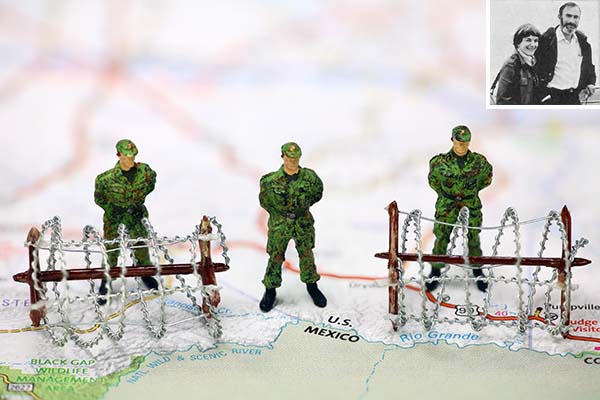
any attempt to seal a nearly 2,000 mile border. The effort
would be doomed to failure, and–at the very least–it would
undoubtedly result in an escalation of violence. A closed
border would also encourage illegals to bring their
families and stay longer, since reentry into Mexico would
be more difficult and hazardous than it now is.
Then, too,
slamming the door would likely lead to a great increase in
violations of the civil rights of U.S. citizens (especially
those of Mexican descent), as well as the rights of legal
immigrants near the border or anywhere that illegals might
be found . . . which is now almost everywhere. (A recent
report indicated an influx of Mexican illegals in New York
and Boston. Such immigrants go where the jobs are . . . and
employers like them because they’re willing to work long,
hard hours for low pay and few benefits in jobs that most
Americans–even those who are chronically unemployed–shun.)
Sealing the border is clearly not a sensible solution. The
illegal migration can only be dealt with successfully by
attacking its roots. Thus, much of the problem must be
solved in Mexico. If that land’s poverty were reduced and
its people were able to make a living at home, they
wouldn’t go to a strange country (where they’re generally
treated badly) to earn enough to keep their families alive.
And if the population explosion in Mexico could be curbed,
the growth in the work force in coming decades would not
completely swamp the rate of job creation.
At the Root of Things
The Mexican government is aware of
its necessary role in easing the migration problem. In the
last few years, Mexico has established one of the world’s
strongest family planning programs.
However, eradicating
poverty in any rapidly growing, less-developed country has
proven to be an extremely thorny problem . . . and Mexico
is no exception. That nation’s leaders hope that their
land’s new-found oil wealth will help bail them out. Of
course, whether the supply of “black gold” will really help
solve the problems or will only exacerbate the rich/poor
division within the country remains to be seen . . . but
the opportunity for economic improvement does exist, and so
does the Mexican government’s desire to end the nation’s
underemployment and poverty.
Still, some of the problem’s
roots lie north of the border, too . . . principally in the
lure of available jobs for migrants. What, then, should the
United States do? Keeping the illegals out–an all but
impossible and enormously costly task–would cause economic
problems in the U.S. (by removing workers from their jobs
with no replacements available under the existing
conditions of those jobs) . . . offend Mexico . . . erode
our civil rights . . . and be inhumane to boot. Thus, it
seems to us that the best approach would be to legalize the
migrants in some way . . . and thereby achieve some degree
of regulation and control over who’s here and what they’re
doing. This approach would, in addition, make it easier to
eliminate the worst abuses and exploitation.
Earlier this
year, Senator S.I. Hayakawa of California came up with a
proposal for legalization that strikes us as one of the
most practical so far. He suggested that each migrant
deposit $250 (which is less than the going price for being
smuggled into the U.S.) with the Mexican government, to be
held in interest-bearing bonds. In exchange, the migrant
would be issued a travel document entitling him or her to a
six-month visa. The deposit would be returned only if
reclaimed within the six-month period, and the worker would
then be eligible for another visa the following year.
A
system of this sort would be beneficial to both countries.
It would offer temporary employment to Mexicans, thus
relieving their nation’s unemployment pressures while–at
the same time–encouraging the return of many laborers who
would have acquired the kind of skills needed in a
developing country. It would not encourage workers to stay
in the U.S. and bring their families, as–ironically–closing
the border would do. It would provide American employers
with the low-cost, hard-working labor they want . . . and
help prevent the abuse of those workers. It would also
avoid the need for the police-state enforcement of
immigration laws. And, by satisfying needs on both sides of
the border, the plan would help improve relations between
the United States and Mexico.
A Humane Policy
While Hayakawa’s proposed system would
solve many aspects of the illegal immigrant problem, the
plan still wouldn’t necessarily decrease the contribution
of immigration to population growth in the United States.
Even if most of the Mexican workers were legally
admitted only on a temporary basis, some proportion would
come to stay, regardless of the law.
Meanwhile, many
Americans are purposely having small families out of the
wish to end U.S. population growth and thus ensure a
brighter future for their children. Who can blame such men
and women for wanting to close the border if they see our
land’s population still growing because of a high rate of
immigration?
There are two important prerequisites to the
establishment of a sensible and humane national immigration
policy. The first is to gather dependable statistics on
both the inflow and the outflow of aliens. The second, of
course, is to establish an explicit national population
policy . . . of which immigration must be an important
component.
In a finite world, one can no more reasonably
plan a nation to accommodate an ever-growing number of
citizens than one can design an airplane to handle an
ever-growing passenger list. It’s crucial that this country
not only end its population growth as soon as possible, but
that it then institute a gradual decline toward a
population size that can be maintained permanently at a
high standard of living. For this goal to be achieved, the
birth rate must be established slightly below the death
rate . . . but just how far below will depend on the level
of net immigration (the number of immigrants minus
emigrants) that a national consensus deems desirable.
It
seems unlikely that there would be a consensus in favor of
total cessation of immigration. Most Americans apparently
agree that some categories of immigrants must be admitted:
for example, close relatives of people already resident or
naturalized, and refugees from oppression . . . especially
those who’ve become refugees as a result of American
foreign policy. Emigration of Americans to other lands, of
course, would balance at least some of such
admissions.
One of the toughest and most persistent
problems that we’ll face in the future will be the pressure
for entry into rich countries from citizens of poor
countries who are simply seeking a chance for a better life
. . . a dilemma that the United States already shares with
other industrialized nations around the world.
A problem as
complex as this one, however, cannot be solved with simple
measures or police action. It will persist in some form as
long as great differences in wealth and opportunity exist
between nations like Mexico and the United States, and as
long as population growth hinders the poor countries’
efforts to develop. But until such inequities can be
reduced, Americans can try to deal with the situation
wisely and humanely . . . rather than reacting to the
migration phenomenon with fear and hostility.
A detailed discussion of the movements of people between
nations-with special emphasis on Mexican-American
relations-can be found in
The Golden Door: International Migration, Mexico and the
United States by Paul R. Ehrlich, Loy Silver-back, and Anne
H. Ehrlich (Ballantine, 1979).






