


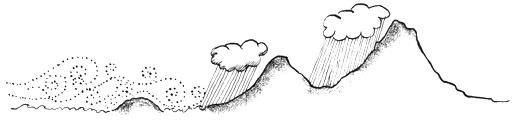
Here’s why the Pacific Northwest has such a wide divergence of climate:
Warm, moist ocean air moving inland cools, turns to fog and releases
moisture as it rises over the obstructing mountains. The dry air then
has very little precipitation to deposit on the mountains’ eastern
slopes, leaving that region semi-arid.Thus, within only a few miles, the
character of the land changes rapidly from a forested, mild coast to
sub-artic plains and bush, making homesteading in Canada an ideal situation.
Another Garden
Long before Europeans came to spoil and pillage this North
American Continent, Nootka, Salish, Kwakuitl, Haisla,
Tsimshian, Makah, Bella Coola, and Skokomish “Indians” led
a rich, full life among the bountiful nature of the
Northwest Coast. Their elaborate tribal societies
flourished in the abundance of natural game, berries and
fishes. Their “status structure” was based on giving. The
more generous a man, the more costly his gifts, the more
bountiful his feast table . . . the higher his status in
the community. In this land of plenty, of gentle rain and
mild climate, civilization had reached a pinnacle of
generosity.
Of course this was not a mythical idyllic paradise. There
were frequent wars among tribes, but these were usually
wars of acquisition, not annihilation. The chieftal powers
were very weak, and when the social structure was
threatened–by the arrival of aggressive, mercenary
colonists–it rapidly collapsed. Little is left of
those original inhabitants, or their culture, and most of
what remains is generally misinterpreted and totally
misunderstood. (For a totally empathetic and realistic view
of this fantastic culture and others of the North and
Central Americas I suggest reading Man’s Rise to Civilization, Peter Farb, the source of
the preceding material.)
Much of the natural abundance of the great West Coast has
changed too, of course, with the growing of great
industrial ports and the gross exploitation (such as lumber
and fishing) of the natural resources. Technology and
pollution have decreed that salmon will no longer cram the
rivers so thickly that “you could step across their backs
to the other side (of the river) without getting your feet
wet.” But all is certainly not lost. We have abused the
land but vast areas along the beautiful coast have never
yet felt the foot of man or the scars of super-highways.
The Northern Jungle
If you were asked to identify a photo taken of the forests
along the west coast of British Columbia, Canada, you would
probably first associate the lush, green, fern-infested
jungle with a tropical rain forest.
It seems unbelievable that the combination of high moisture
and mild temperatures could produce a treble-layered forest
at latitude of 60°-40° north. Only a bright green
light filters through the first layers of giant conifers
and the middle layers of broad-leafed trees to the bushes
and ferns that blanket the floor. Although the forest teems
with life–deer, squirrels, birds, bears, etc.–catching the animals is practically impossible due
to the extreme density of the vegetation. Visibility is
limited to a few feet. The rain forest also contains a
“false floor” composed of dead and rotting trees. This
floor is often 10 feet above the real ground and it’s
possible to fall through the layer of downed trees and
become trapped below.
There are few roads to interrupt the splendor of these
coastal mountain forests: Most of the traffic is handled by
boats running along the coast. Isolated fishing villages
and lumber camps dot the sheltered coves and exotic fjords
along the rugged coast.
The coast itself is structured of fantastic wave-sculptured
cliffs and sandy, rocky coves. These cliffs were “recently”
carved by the receding glaciers and their faces are
constantly being reshaped by the erosive and powerful
Pacific surf. In spite of the tremendous pounding surf
along the base of the cliff, the rocks swarm with a
brilliant profusion of starfish, and the hardy abalone–a large, edible sea-snail.
Offshore you can see the rugged islands that were at one
time mountain peaks. The thousand-mile waterway that runs
around these hundreds of rocky fortresses was called “The
Road that Walks” by the Indians. The entire area was
literally carved out by the actions of the last great
glacial period; mountains sunk and rivers submerged and now
it is possible to sail among the peaks of these once mighty
mountains.
In the sandy coves you can dig for steamer clams, search
out Dungeness crab from their hiding places around rocks
and pick up Pacific oysters in shallow water during low
tide.
This is famous salmon and sturgeon country as well. Even
though the numbers of these huge fish (sturgeons average
200 lbs.) have been greatly diminished by commercial
fisheries, the shortage is hardly noticeable to individual
fishermen. The Indians prepare fresh salmon by cleaning and
splitting the fish and lacing each side (skin down) against
a driftwood plank. The salmon is then smoked slowly over a
low fire. The row, or eggs of the female sturgeon (and
salmon) are used for making caviar.
This area has become known for the growing of consistently
high quality fruits, berries and vegetables. The Fraser
River Valley, east of Vancouver, is especially rich
agriculturally. The rich soil, mild temperatures and
plentiful water insure maximum crop yields. Surprisingly,
the valley is so temperate, wine grapes have been grown
successfully.
Temperature extremes are rare. The average summer
temperature near Vancouver is 59.8°, winter 38.2°.
You can expect frost from November to mid-February and snow
cover during this period is negligible.
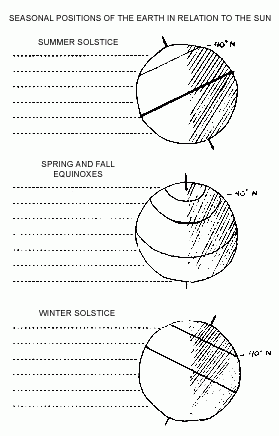
Because of the northern position of the region
(approximately 50° latitude) the sunlight received in the
summer varies from 2 to 4 hours more than most parts of the
United States. In other words the growing season for most
crops is lengthened (over, say, Ohio) about 180 hours
during the summer months. This often produces “monster”
vegetables and fruits that mature several weeks earlier in
the season, conversely, the winter days are shorter than
lower latitudes, averaging about 8 1/2 hours of daylight.
The coast of British Columbia receives over 100 inches of
rainfall a year. The average is even higher on the western
mountain slopes. Most rain falls in the fall and winter.
Though there is usually sufficient moisture through the
summer, some eastern portions of the Fraser River Valley
require irrigation which is easily furnished by the many
clear mountain streams and rivers. The precipitation
generally takes the form of heavy fogs and light drizzle as
opposed to torrential downpours.
This region is considered safe from most natural disasters
such as hurricanes, tropical storms, tornadoes and
thunderstorms that damage so many parts of the world.
Unlike the San Francisco Bay area, which is plagued by
frequent earthquakes and unstable faulting, only two quakes
have been recorded in the last 100 years in the Pacific
northwest. Both in Puget Sound, Washington.
The “Natural” City: Vancouver
Vancouver has to be one of the most nature-loving cities in
the world! Within the city limits there are 128 parks.
Included is famous Stanley Park with 1,000 acres, much of
which is pure virgin forest. Conservation groups are very
active and have recently purchased 400 acres 25 miles out
of the city limits for use as a bird sanctuary. Many
controls (on fishing and lumber industries) are being
instituted to preserve the beauty and resources of the
area.
Vancouver is a very active art and poetry center, too.
There are several major art galleries in the city and some
really great poetry, etc., is coming out of the Vancouver’s
underground. Art and science museums, plus a huge marina
featuring killer whales and many rare Pacific fish, are
also major attractions in this coastal hub.
There is a district of large, old houses called the “West
End” adjacent to Stanley Park in Vancouver. These old
buildings have been converted to inexpensive boarding
houses and apartments. Partially because the city is fairly
new, crowded urban slum areas are virtually unknown. The
beautiful University of British Columbia campus overlooks
the sea in the extreme western part of the city.
The economy of Vancouver is based on trade or
transportation (30%), with manufacturing, the lumber
industry, fishing and publishing contributing most of the
other 70%.
Vancouver is a perfect place to reap the benefits of
civilization in a natural environment. It may be one of the
least stifling places to settle while exploring the area
for cheap land possibilities. With the variety of parks,
inexpensive natural foods, clean housing and flourishing
artistic awareness, Vancouver could make an important focal
point for a wide variety of life styles.






