

Conservationists across America were shocked, recently, to
learn that Secretary of the Interior James Watt sees little
reason to worry about preserving the land and resources of
the United States for our descendants. As he explained to
the Interior Committee of the House of Representatives, “I
do not know how many future generations we can count on
before the Lord returns.”
James Watt is a brand new kind of Interior Department
head, one with no apparent interest in environmental economics. He seems to believe that God has given
him marching orders to turn over as much of our public land
as possible to private exploitation. This calling, however,
is not merely a result of his appointment. For four years
before taking office, Watt was president of a gang
of environmental rapists, centered in Denver, called the
Mountain States Legal Foundation. In that role, he crusaded
in favor of unregulated strip mining and other policies
that would contribute to the spread of overgrazing and air
pollution.
Watt’s viewpoint (one that’s apparently shared by many
other wealthy and powerful westerners) appears to be that
God originally gave the lands of the United States to an
assortment of large corporations, the Indians then
stole that territory from big business, after which
the federal government stole it from the Indians. The goal
of Watt and other so-called “sagebrush rebels,” then, is to
return the land to its “rightful” owners.
Bureaucratic Exploitation
To anyone familiar with the present state of western lands,
Watt’s crusade would be funny if it weren’t so dangerous.
One must search in the mountain ranges of Nevada,
for instance, to discover public domain that hasn’t already
been overgrazed. Worse yet, with the help of the antiquated
mining law of 1872, companies are literally chopping down
the mountains themselves. Everywhere the effects of the
Forest Service’s “Land of Many Abuses” policies are marring
the environment.
When dedicated public servants have attempted to halt such
plundering of public property, pressure from powerful
economic interests has usually gotten those individuals
transferred. In fact, long before Watt took over, the
morale of the federal employees who would like to conserve
something for future generations had begun to deteriorate,
and more and more bureaucrats had started to cooperate with
the exploiters.
Thus, at a time when the country needs a
conservative Secretary of the Interior (an
individual who controls nearly a million square miles of
our country), it has, instead, an apparent radical
who seems bent on destroying his public trust for private
profit. Watt’s push for more uncontrolled commercial
development of public lands has already angered true
conservatives throughout the West.
However, most ecologists are more than angry at
Watt. They are actively afraid of him. They know that
there is all too little time to reverse the tide of habitat
destruction and extinction that threaten the survival of
our society (see “The Snail Darter and Us” and “Extinction Events“). They’ve seen Watt stop the
acquisition of new national parkland (when it’s badly
needed) and concentrate on “improving” existing parks
(which seems to mean expanding their facilities for people,
thus degrading their capacity to support other
species). Ecologists have also watched him remove the
conservationists from the U.S. delegation to the latest
meeting of the Convention on International Trade in
Endangered Species, while supporting policies that could
force numerous species of parrots to extinction. In his
television appearances, Watt gibbers on about how he’s
making all such changes “for the people.” He’s apparently
utterly oblivious to the fact that his actions could
threaten the lives of future generations.
Reagan Radicalism
Of course, one highly placed ecological ignoramus doesn’t
make an administration. Could it be that Ronald Reagan just
listened to bad advice in appointing his Secretary of the
Interior? If the Sierra Club gets millions of signatures on
its “dump Watt” petition, is there any chance that the
President will remove him and find a true conservative as a
replacement?
Unfortunately, that scenario seems unlikely. Radicalism has
been the theme of all of Reagan’s environmental actions.
The Council of Environmental Quality, the ecological
conscience of the executive branch, has been gutted. Reagan
appointed another Colorado anti-environmentalist, Anne
Gorsuch, to head the Environmental Protection Agency. (John
B. Oakes, former senior editor of the New York
Tines, wrote that she has “no discernible
qualifications for her highly technical post.”)
Reagan also made Colorado cattleman Robert T. Buford chief
of the Bureau of Land Management, which already permits
extensive overgrazing of federal rangeland. A foe of
strip mining regulations, Indianan James Harris, has become
head of the Office of Surface Mining. And a former attorney
for a timber company, John Crowell, got the nod as
Assistant Secretary of Agriculture in charge of national
forests!
Furthermore, both presidential counselor Edwin Meese (in
April) and Vice President Bush (in June) have stated
publicly that Watt is doing the President’s bidding. And
Reagan’s exploitative attitude toward our natural heritage,
which is that environmental quality is a luxury that must
not stand in the way of economic progress, is shared by all
too many politicians, business people, and plain citizens.
Environmental controls, such individuals claim, have been a
burden on business and must be relaxed so that a more
“balanced” approach can be taken.
Economics Over Ecology
Of course, there’s no way that Reagan can truly claim to be
choosing economics over ecology, even though he clearly
doesn’t know that. The world simply isn’t made that way.
The immediate costs of America’s limited environmental
regulations have been small, making a trivial
contribution to inflation, for example. And if the
accounting were done correctly–so that the
calculations included the economic options preserved, the
health costs avoided, and the lives saved–the
regulations would doubtless prove to have been extremely
profitable.
But the real costs of the Reagan-Watt radical
environmental policy will be paid largely in the future,
under different administrations. The basic question is
what, if anything, can be done to keep those costs from
becoming more than our descendants can pay.
The sad truth is that we have traded in a politically inept
President who understood many of the world’s problems for
an extremely able politician who understands almost none of
them. But President Reagan is no fool ; perhaps he
can be educated. Under his charismatic leadership, this
administration could create an environmental record that
would bring the praises of future generations rather than
their curses.
If Reagan shows no sign of learning, however,
environmentalists must organize against him politically, and soon! The fate of our nation cannot then be left in
his hands, no matter how well-meaning he may be.
The reasons that the initiation of ecologically sound
land stewardship policies is essential now are detailed
in Extinction: The Causes and Consequences of the
Disappearance of Species by Paul and Anne Ehrlich
(Random House, 1981, $15.95). Watt’s quote is from the
Wall Street Journal (May 5, 1981). “Reagan
environmentalism”, John Oakes’s excellent column, appeared
in the New York Times (May 1, 1981).
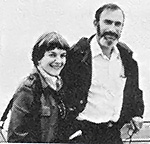
Paul Ehrlich (Bing Professor of Population Studies and Professor of Biological Sciences, Stanford University) and Anne Ehrlich (Senior Research Associate, Department of Biological Sciences, Stanford) are familiar names to ecologists and environmentalists everywhere. As well they should be. Because it was Paul and Anne who–through their writing and research–gave special meaning to the words “population,” “resources,” and “environment” in the late 1960’s. (They also coined the term coevolution, and did a lot to make ecology the household word it is today.) But while most folks are aware of the Ehrlichs’ popular writing in the areas of ecology and overpopulation (most of us–for instance–have read Paul’s book The Population Bomb), far too few people have any idea of how deeply the Ehrlichs are involved in ecological research (research of the type that tends to be published only in technical journals and college textbooks). That’s why it pleases us to be able to present these semi-technical columns by authors/ecologists/educators Anne and Paul Ehrlich.






