Originally published in the July 1983 issue of Mother Earth News.
When the winter snows finally melt up here in Alaska, we put away our dog sleds and skis. Why, we even let the huskies relax for a while–until summer comes and it’s time to bring out the backpacks for dogs!
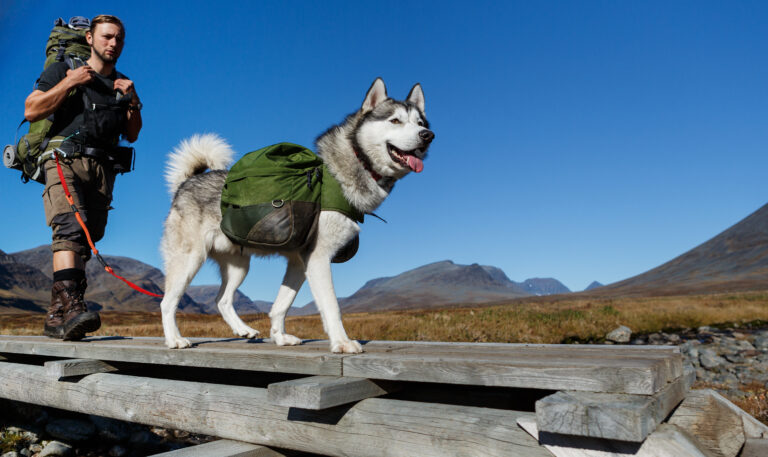
We use these pint-size “saddlebags” for activities that range from short berry-picking hikes to major cross-country expeditions, and we’ve found that our pack-toting canines can really ease our burdens. A trained dog–in good condition–can carry up to a third of its own weight (and more than that for a short distance). That means that a 90-pound husky can support 30 pounds of dog food, camping equipment, berries, fish, or whatever else can be stuffed into backpacks for dogs.
It’s pretty obvious that the bigger the dog, the more it can pack. Malamutes are a good breed for packing, being large and sturdily built. Other sled dogs–such as our local “village” breed and Alaskan huskies are likely to have longer legs and lighter frames than malamutes, which limit the amount they can transport. Still, these other types are very tough and won’t wear out if they’re not overloaded. Large breeds such as Saint Bernards and Great Pyrenees are fine for packing, too, though thickly furred animals have a tendency to become overheated. But whether a dog is traditionally suited for packing or not, any canine–be it a mastiff or a Chihuahua–can be taught to carry its share of the load.

Basics of Backpacks for Dogs
The basic dog pack consists of two simple pouches–one hanging on each side of the animal’s rib cage–connected by a cloth saddle that rests on the dog’s back. The underside of the saddle should be padded as a protection against friction sores or gouges from sharp cornered objects carried in the sacks, and the carrier should be securely fastened on by means of a harness. This rigging usually includes a chest strap, one or two belly straps, and sometimes a tail strap, all of which can be adjusted to prevent the dog from throwing off the pack.
When loading the pouches, always be careful to balance their weights evenly. If one is heavier than the other by even a small amount, the pack will become lopsided, with one sack hanging near the ground and the other riding the dog’s back uncomfortably. Unequal weighting will throw the animal off-balance, and the low satchel may even drag along the ground or snag on bushes.
Put any weighty objects in the bottom of the pouches to keep the dog from being top-heavy. And if you tie extra gear on the outside of the carrier, make sure that there are no loose ends or exposed flaps, since such protrusions may catch on a branch, jerk the dog, and perhaps tear the sack’s material.
Some dog packs have a handy wraparound strap, which simply loops around the dog–pack and all–to hold everything securely in place. This surcingle also keeps each pouch in its proper position, preventing it from slipping up over the dog’s back as it goes through thick brush. If you buy a model that does not have this useful feature, you can easily make such a strap with a length of 1″ nylon webbing–long enough to pass over the dog’s body and the pack once or twice–with a metal O-ring or similar buckle attached at one end.
Guidelines for Dog Packing
To harness your dog, place the empty carrier across its back, with the front evenly adjusted over the shoulders, and fasten the chest strap snugly. Then, after you’ve checked to make sure the pack is positioned correctly, cinch up the belly and tail straps (you may find that the harness arrangement varies from model to model). You can load a pack before placing it on your four-legged friend, but we don’t recommend it: Full pouches are hard to manipulate.
Transforming a pet into a pack animal takes some practice. It’s a good idea first to fit an empty pack onto Bowser and let the pooch run about for several minutes to an hour so that it can become accustomed to the feel of the knapsack. Then put in a light load–just a pound or two in each pouch–and take your trainee for a walk. Carrying a light but bulky load on each side, the animal will soon learn to dodge around trees (without the bruising caused by repeated banging into trunks with a heavy pack). Do this exercise several days in a row, adding more weight to the pouches each time.
If you burden the dog heavily, it will sometimes stagger about and may fall to the ground. If this happens, help the animal up and encourage it on. With a little practice, it should soon be trotting along in style.
Still, try not to ask too much of your furry friend. Putting a heavy weight on an animal that’s not used to packing–or overloading a well-conditioned one–is very hard on the dog and can leave it stiff and sore for days. Bear in mind, too, that a longhaired pack animal can quickly become overheated on warm days, and when you’re both away from home, this can be a real problem.
Consequently, if you don’t have adequate time to run your pet through a gradual training program, you should be wary of overloading its pack before you’re certain of how much the animal can support. A reliable rule of thumb is that–for short hikes–an untried dog should carry a load no heavier than a quarter of its own weight, and less than that for long treks. (Be prepared to shoulder the burden yourself if the pooch poops out!)
A side benefit of dog packing is that it can curb a roamer’s wanderlust. Once a dog realizes that it’s expected to work, it’s usually content to walk just ahead or beside you on the trail. In fact, a trick that works for us when we need to put an active canine on a leash and it persists in pulling our arms (our sled animals are trained to pull, remember?) is to add weight to its pack until the dog settles down. Then, as the animal tires, we transfer the surplus to our own backs. Let us share a few final words of advice.
Obviously, it would be foolhardy to put your great-grandmother’s fine crystal stemware or any breakable object into a dog pack. In addition, if something must be kept dry, put it in a plastic bag before loading it onto the dog. Things that might harm a satchel–such as a catch of fish–should also be wrapped carefully beforehand.
Last, but very important, never let a load carrying animal swim, unless you’re there to hold it up if necessary. Otherwise, as water seeps into the pouches, the dog might drown under the weight of its own pack!

Shopping for Dog Packs
Commercially made dog packs range from small day packs to big, all-terrain cross country affairs. Some manufacturers offer sew-it-yourself kits that cost less than ready-made bags. If you have the inclination, you can make your own dog pack by following the pattern and directions we’ve provided in Sew Your Own Dog Pack.

So the next time you head for a hike, be for a few hours of berry-picking two mile off the road or a major cross-country camping trip, take along your hound or husky and let it do a fair share of the work!
Originally published as “Dog Packing” in the July/August 1983 issue of MOTHER EARTH NEWS.