
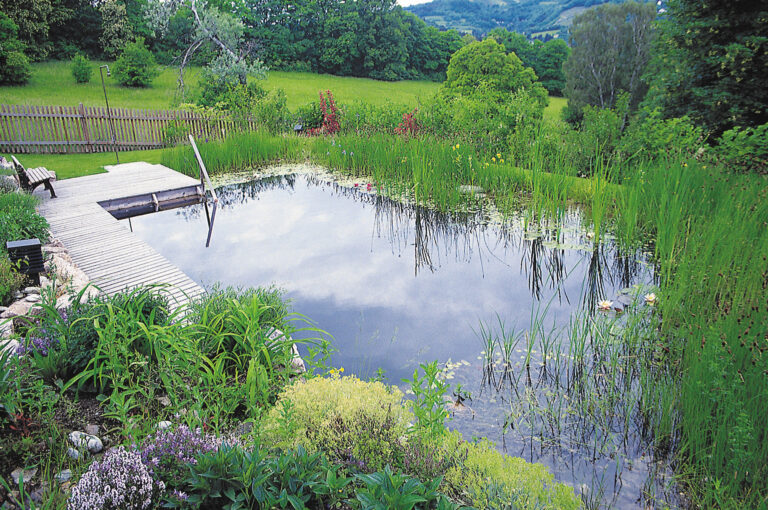
In Europe, where nude beaches are common and pragmatism is par for the course, it was only a matter of time before pools went au naturel. Natural pools, a clever, chemical-free mix of water garden and the swimming hole you remember as a child, have been mellowing out homeowners on the other side of the Atlantic for fifteen years.
Water plants foster the growth of beneficial microorganisms that kill bacteria and keep natural pools clean enough to comply with the European Union’s strict water quality standards. The plant portion, or regeneration zone, is separated from the swimming area by a wall concealed a few inches below the water’s surface. Sunlight heats the water in the regeneration zone naturally, and the warm water gradually filters into the two-meter-deep swimming area. A synthetic pool liner keeps the whole thing from leaking.
Biotop, an Austrian company, pioneered the concept in 1985 and has been perfecting it ever since. Along with thirty-six partners in Germany, Switzerland, the Netherlands, and England, the company has installed more than 1,500 natural pools. Tim and Tish Rickard and their two sons, Jack and Tom, became England’s first natural pool owners in October 2001. “I’m one of nature’s optimists,” Tim says. “If we were rich and famous, the pool would be as big as possible.” The family stumbled across chemical-free swimming while searching for ways to rehabilitate a pond on their Gloucester County farm.
As of late January, fifteen-year-old Jack was the only person to brave the Rickard’s new natural pool–the rest of the family was still waiting for warmer weather. “We’re happy in principle, but the plants haven’t begun to grow yet,” Tim says. “They should come up in spring, but Biotop still doesn’t know if it will work at this altitude.” (In general, a natural pool should be ready for use about sixty days after planting.) Tim feels fairly confident, however, that the family’s venture will succeed given Biotop’s track record in Austria and the company’s slow but steady expansion in other European countries.
Natural pools: what you need to know
- The minimum size for a natural pool is forty square meters, with half of any pool dedicated to regeneration. That means you’ll need twice the space as a traditional pool for an equivalent swimming area. There are no limits for larger pools.
- Although the plant area is fairly shallow, at least part of the swimming area must be two meters deep. A separate children’s area can be developed within the regeneration zone.
- Natural pools use a synthetic liner to prevent leakage over time, but these liners are free of heavy metals.
- Water never has to be changed. You need only replace water that evaporates.
- Frogs will naturally take up home in the regeneration area, but fish don’t mix well with a natural pool–they soil the water and can disturb your pool’s natural balance.
- Natural predators such as water striders and dragonfly larvae will come to live in your pool and feast on the mosquitoes.

Not playing in Peoria
Unfortunately, the U.S. pool industry hasn’t been as open to experimentation. The National Spa and Pool Foundation doesn’t endorse chemical-free pools, and the American Society of Landscape Architects was hard-pressed to name a designer who’s done significant work with natural pools. “I’ve gotten a lot of inquiries from the United States,” says Michael Littlewood, a British landscape architect who helped with the Rickard family pool. “I send brochures and details, but then I never hear from them again.”
Fear is one of the biggest barriers to widespread acceptance in the United States. People worry about slimy water, bacteria, mosquitoes, and snakes. “Seeing is believing,” says landscape architect Michael Glassman, the principal of Sacramento, California-based Michael Glassman and Associates. “I think it would take a while to catch on in the United States. It would almost have to be a situation [where you have] a sample pool.” Glassman has worked on several projects that use ultraviolet light and ozonization (see “Three Ways to Green an Existing Pool,” below) to reduce, but not eliminate, chemical use. He has found that a lot of Americans aren’t comfortable with the idea of plants in the swimming pool yet and are therefore unlikely to request a natural pool.
Three ways to green an existing pool
If you already own a traditional swimming pool, the switch to a natural version is a costly venture. It requires significant renovation–if not an out-and-out demolition–of your current pool. Fortunately, there are several ways to reduce your chemical use without calling in the heavy machinery.
Ionization
Ion systems work by dispensing microscopic copper and silver particles (ions) into the water as it passes through the circulation system. These ions kill bacteria and algae but are safe to humans. They’re also less prone to evaporation and dissipation than standard pool chemicals, which means longer lasting and more constant purification. Ionization is compatible with ozone, chemical, and ultraviolet systems.
Ozonization
Ozone is active oxygen, or three oxygen atoms, that are commonly used to clean water. This natural purifier kills bacteria, viruses, mold, and mildew without leaving chemical byproducts in the water. “I have a lot of clients who prefer ozonization,” says Carol Anderson, senior architect with Fields and Associates. “It’s perfectly natural. You can generate it onsite, inject into water, and kill bacteria.” Ozone is considered very safe when dissolved in water and quickly converts back into oxygen. This cleaning process is also compatible with chlorine.
Ultraviolet light
Running pool water past ultraviolet light is another way to kill bacteria. The lights are typically hidden within a pool’s circulation system so that water continually passes by the light. “A lot of pool companies don’t know about it,” says landscape architect Michael Glassman. “Each ultraviolet light costs around $500, but they’re supposed to last two years.” Ultraviolet light is often used in conjunction with ozonization, but it’s also compatible with chlorine.
Low maintenance
Meredith Schneeweiss, who lives in the Austrian village of Maria Anzbach, has owned a natural pool for about six years. Schneeweiss’s husband vacuums the pool twice a year, and she tends to the plants on a semi-regular basis. “It’s like gardening,” she says. Although it costs about the same to install a natural pool as a traditional one, most owners find that they save on operating costs (no chemicals to purchase) and can do the majority of maintenance themselves.
“Every once in a while, we trim the plants and fish things out that have fallen in,” Schneeweiss says. The couple’s pool stays clean without any mechanical aide, but most people choose to reduce maintenance even further with the addition of a plant filter, surface skimmer, and Biotop-Carbonator (to kill algae and balance pH). Biotop guarantees that mosquitoes won’t be a problem because natural predators such as water gliders feast on them in the plant area.

It’s that harmony–a seamless blending of environments–that natural pool owners cite as a major benefit. “It has enriched our lives,” Schneeweiss says. “While you’re separated from the plants, you still feel surrounded by them when you swim, which creates a very special kind of mood.” Her fifty-square-meter pool is home to irises in June, water lilies throughout the summer, and a rather loud frog chorus from the end of May until July. Besides creating a habitat for plants and animals, Schneeweiss’s pool is functional year-round: In winter the frozen crust is perfect for ice-skating.
In the United States, the primary challenge to installing natural pools reflects the delicate and distinctive ecology of each pool. “The range of climates is so large that the plant mixes would need to change,” Littlewood says. However, “Biotop hasn’t done research for the plants in each state,” he adds. Nor does the company have contractors in the United States, which means designers would have to develop their own models or pay a fee to become a Biotop franchise.
Biology aside, the concept has been slow to catch on in England, and it’s likely to be the same in the United States. Carol Anderson, a senior architect with Sausalito, California-based Fields and Associates, says her clients don’t often ask about natural pools but that “this kind of experimentation will lead to a safer swimming environment in the long run.”
Originally published in the July/August issue of Natural Home Magazine.





